
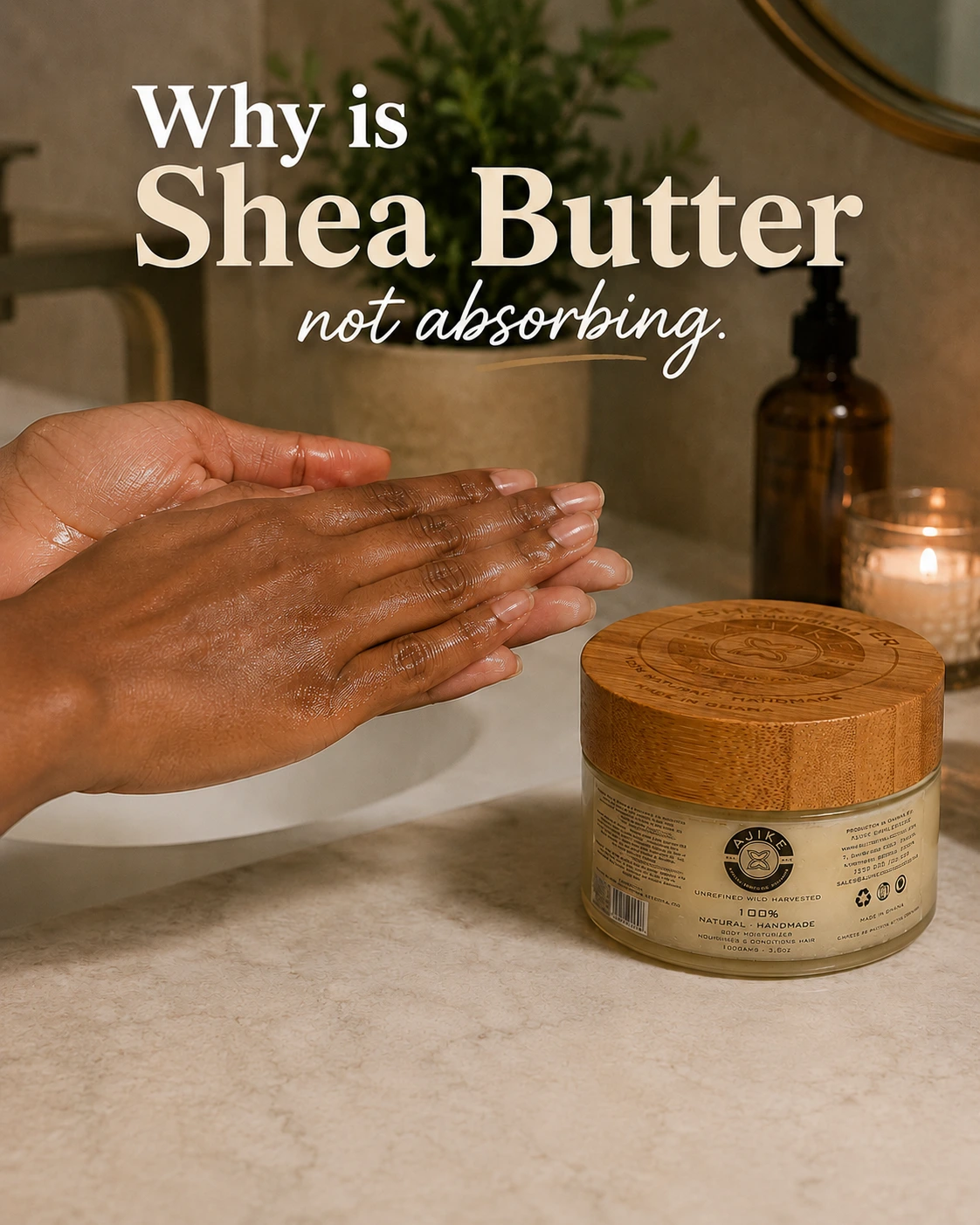
You bought raw shea butter expecting something amazing. And then you put it on your skin and it just sat there. Greasy, heavy, not sinking in. You waited. Still there. You went to get dressed and it was still on the surface.
This is one of the most common complaints about raw shea butter, and almost every time, it has nothing to do with the shea butter itself. The product is not the problem. The way it is being applied is.
This guide explains exactly why shea butter behaves the way it does, what the absorption problems actually come from, and how to use it so that every application works the way it should.
Read Also: New to shea butter? Start here: What Is Raw Unrefined Shea Butter?
First, Understand What Shea Butter Actually Is
Shea Butter Is an Occlusive, Not a Serum
This is the starting point and it changes everything. Shea butter is an occlusive moisturiser. That means its primary function is to form a barrier on the skin surface that slows water evaporation. It is not designed to absorb instantly like a water based serum or a light lotion. It works at the surface level first, and its active compounds penetrate more slowly over time.
Expecting raw shea butter to sink in immediately the way a glycerine based serum does is like expecting a wool blanket to behave like a silk scarf. Different materials, different jobs. Once you understand what shea butter is actually doing, the way it feels on the skin starts to make complete sense.
What Occlusive, Emollient and Humectant Mean in Plain Language
These three terms describe how different moisturising ingredients work, and understanding them helps you use shea butter correctly.
A humectant draws water into the skin. Glycerine, hyaluronic acid, and aloe vera are humectants. They feel lightweight and absorb quickly because water absorbs quickly.
An emollient softens and smooths the skin surface by filling the microscopic gaps between skin cells. Many plant oils and butters work as emollients. They feel smoother and lighter than occlusives.
An occlusive forms a physical layer on top of the skin that slows water loss through the skin surface. Raw shea butter is primarily an occlusive, though it also has significant emollient properties from its fatty acid content. Occlusives feel heavier because they are heavier. They sit on the skin by design.
The sequence that works best: apply a humectant to damp skin first, then apply an emollient, then seal with an occlusive if needed. Shea butter belongs at the end of a routine, not the beginning.
Why Shea Butter Is Not Supposed to Disappear Like Water
A product that vanishes instantly when you apply it is either extremely lightweight or it is not providing much barrier protection. Shea butter is providing barrier protection. The slight residue you feel in the first few minutes after application is the occlusive layer forming. Within 5 to 10 minutes of correct application to the right amount of skin, the shea butter should feel largely absorbed without being greasy. If it still feels heavy after that, the issue is almost certainly the amount you used or the state of the skin it was applied to.
The Real Reasons Shea Butter Sits on Top of Your Skin:f
You Are Applying It to Completely Dry Skin
This is the number one mistake. When skin is completely dry, its surface is tightly compacted and significantly less permeable than when it is slightly damp. Shea butter applied to completely dry skin has no water molecules to bond with and no open pathways into the upper layers of the stratum corneum. It sits on the surface because there is nowhere else for it to go.
Apply shea butter within 60 seconds of patting skin dry after bathing. The skin should be slightly damp, not wet. That residual moisture creates the conditions for the shea butter to distribute evenly and begin working with the skin rather than just sitting on top of it.
You Are Using Too Much
Most people use three to five times more shea butter than they need. Raw shea butter is concentrated and effective in small amounts. For the full body after a shower, a piece roughly the size of a large grape is generally sufficient for most adults. For the face, a grain-of-rice sized amount is more than enough.
When you use too much, the skin simply cannot absorb or distribute it all, and the excess sits on the surface. The greasy, heavy feeling that people associate with shea butter is almost always a problem of quantity, not quality.
Your Skin Is Not Warm Enough
Raw shea butter melts at around body temperature, which is why it goes from solid to oil when you hold it in your hands. If you are applying shea butter to cold skin, straight out of a cold bedroom or after a cold shower, the butter may not fully melt on contact and will remain in a semi solid state that does not distribute or absorb well.
Always warm the shea butter in your hands first, until it becomes an oil, before applying it to the skin. And if possible, apply it in a warm bathroom after a shower rather than in a cold room after you have dried off and cooled down.
You Are Not Giving It Time to Absorb
Shea butter is not a fast product. After applying a correct amount to damp skin, give it three to five minutes before dressing. Moving the skin against fabric before the shea butter has had time to begin working means you transfer the product onto your clothes rather than letting it work on your skin.
Most people apply it, feel the residue immediately, panic about greasiness, and try to rub it in harder, which just makes things worse. Apply, press gently, and leave it alone for a few minutes.
You Are Using the Wrong Grade of Shea Butter
Refined shea butter has had its texture modified through industrial processing. It is smoother, lighter feeling, and appears to absorb more quickly than raw shea butter. But this quick absorption comes at the cost of the active compounds that make shea butter genuinely useful. You are essentially using a less effective product because it feels better on application.
Raw unrefined shea butter has a denser, slightly grainier texture because it contains the full complement of fatty acids, triterpenes, and phytosterols. This richer composition is why it feels heavier and why it takes slightly longer to absorb. The feel and the effectiveness are directly related. Accepting slightly different absorption behaviour is the trade-off for using something that actually works.
Your Skin Has a Heavy Product Buildup Layer Underneath
If you have been using products containing mineral oil, silicones, synthetic waxes, or petroleum derivatives, there may be an invisible residue layer on your skin that is blocking absorption of everything you apply, including shea butter. These synthetic film forming ingredients do not rinse off with water alone.
Switching to a natural cleansing routine, using Ajike African black soap or our Shea Moisturizing Body Cleanser for body washing for a few weeks, will help clear this buildup layer. After the buildup is cleared, you may find that shea butter and other natural products absorb noticeably better than they did before.
Read Also: What Is African Black Soap?
Raw Shea Butter vs Refined Shea Butter: Absorption Is Different
Why Raw Shea Butter Feels Heavier Than Refined
The unsaponifiable fraction that makes raw shea butter therapeutically effective, particularly the triterpenes and phytosterols, contributes to its heavier texture. These compounds are large molecules that do not move through the skin as easily as the simple fatty acids. They work at the skin surface and in the upper layers of the stratum corneum rather than penetrating deeply.
Refined shea butter has had this fraction significantly reduced through bleaching and deodorisation. What remains is primarily oleic and stearic acid, which are lighter feeling on the skin. The refined version absorbs faster and feels lighter. It is also considerably less effective for anything beyond basic emollient moisturisation.
What Is Lost When Shea Butter Is Refined
Industrial refining removes the natural carotenoids (colour), the volatile compounds (scent), and crucially, a significant proportion of the unsaponifiable fraction including the triterpenes, phytosterols, and tocopherols. Studies have documented reductions of up to 80 percent in specific triterpene alcohols after standard industrial refining. These are the anti-inflammatory, barrier-repair, and skin-healing compounds that make raw shea butter worth using.
Why Heavier Does Not Mean Less Effective
The skin care industry has trained consumers to associate fast absorption with effectiveness. This works for water based serums, where active ingredients do need to penetrate to work. It does not apply to occlusives and barrier repair ingredients, where working at the skin surface is the entire point.
Raw shea butter's heavier feel on application is a sign of its richer, more complete composition. Learning to apply it correctly, in small amounts, to damp skin, is the way to get the benefit without the greasiness.
Whipped Shea Butter vs Raw Shea Butter: Which Absorbs Better?
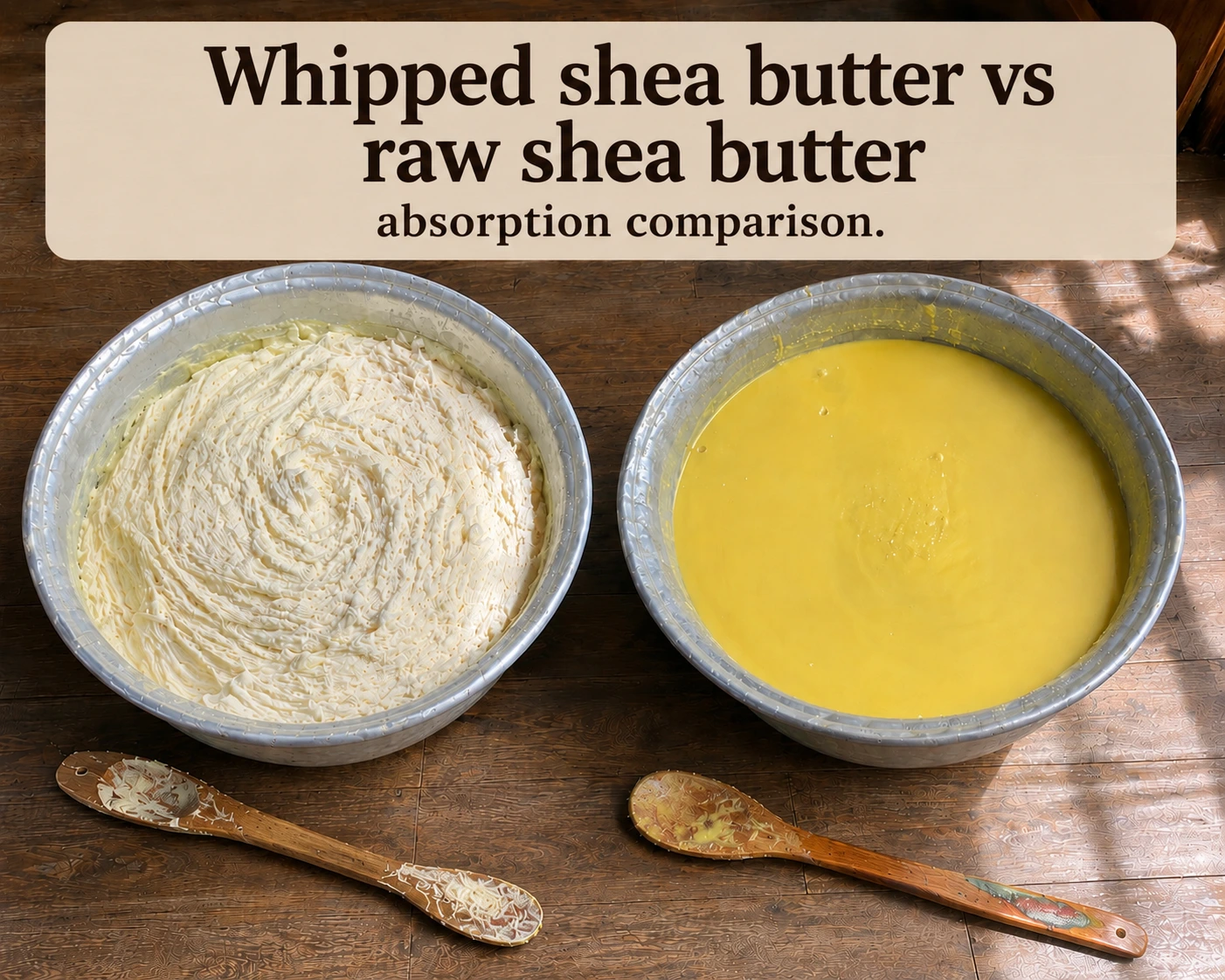
What Whipping Actually Does to Shea Butter
Whipping shea butter incorporates air into the fat, changing its texture from dense and solid to light and fluffy. The composition does not change. The fatty acid profile, the vitamins, and the unsaponifiable fraction remain the same. What changes is the physical structure: the air pockets in whipped shea butter mean that a given volume of whipped product contains less actual shea butter than the same volume of raw shea butter.
This is why whipped shea butter feels lighter and appears to absorb faster. You are applying less actual product per application because much of the volume is air.
When Whipped Shea Butter Makes More Sense
For people who find raw shea butter consistently too heavy or too difficult to spread, whipping it is a sensible practical solution. It makes the product easier to apply, easier to distribute evenly, and more comfortable on oily or combination skin types. The trade-off is that you may need to apply a slightly larger volume to achieve the same effect as a smaller amount of raw shea butter.
For daily body moisturisation where texture and ease of application matter as much as intensive therapeutic effect, whipped shea butter is an excellent option.
When Raw Shea Butter Is the Better Choice
For intensive barrier repair on eczema patches, very dry skin, or specific problem areas that need concentrated treatment, raw shea butter delivers more active compounds per application. For a scalp treatment or a pre-shampoo hair treatment where you want a concentrated product to work for 30 to 60 minutes before washing, raw shea butter is more appropriate.
For babies, raw shea butter without any additives is the purest option. Whipped versions often have oils or other ingredients added during the whipping process.
How to Whip Your Own Raw Shea Butter at Home
Place raw shea butter in a clean mixing bowl. If the shea butter is very hard and cold, leave it at room temperature for 30 minutes first. Beat with a hand mixer or stand mixer on medium speed for 5 to 10 minutes. The butter will become progressively lighter and fluffier as air is incorporated.
You can add a few drops of a lighter plant oil, such as baobab oil, coconut oil, jojoba oil, or sweet almond oil, during the whipping process to create a lighter texture and improve absorption further. Add essential oils last if you want a scented version. Store in a clean jar and use within 3 to 4 months.
Read Also: Learn more: Baobab Oil Benefits for Skin and Hair
How to Apply Raw Shea Butter So It Actually Absorbs
Read This First: Every step in this section matters. The difference between shea butter that feels greasy and shea butter that feels comfortable and absorbs well is almost always in these six steps, not in the product itself.
Step 1: Apply to Damp Skin, Not Dry Skin
This is the single most important change you can make. After your bath or shower, pat your skin dry with a towel but leave it slightly damp rather than completely dry. Apply the shea butter within 60 seconds of stepping out. The moisture on the skin surface creates conditions where the shea butter can distribute evenly and the skin is more receptive to what you are applying.
Step 2: Warm It Between Your Palms First
Take a small amount of shea butter and place it in the palm of one hand. Press both palms together and rub gently for 10 to 15 seconds. The heat from your hands will melt the shea butter from a semi solid into a smooth oil. It is this melted, oil form of shea butter that applies evenly and absorbs well. The solid, un-melted form will drag across the skin and feel uncomfortable.
Step 3: Use Far Less Than You Think You Need
Before you melt it in your hands, look at how much you have taken. Cut it in half. For the full body of an average adult, a piece of raw shea butter about the size of a large grape, melted in the palms, is sufficient for good coverage. For just the legs, a piece about the size of an almond is enough. For the face, a single rice-grain sized piece.
Start with less than you think you need. You can always add a little more if you feel an area needs it. It is much harder to fix over-application.
Step 4: Press and Pat, Not Rub and Spread
Once the shea butter is melted in your palms, press your palms onto the skin and distribute it with gentle pressing movements rather than vigorous rubbing. Rubbing shea butter into the skin generates friction that can irritate the skin and also pushes the product across the surface rather than allowing it to settle into the skin. Pressing and patting distributes it evenly while allowing initial absorption to begin.
Step 5: Give It Three to Five Minutes Before Dressing
After application, do something else for a few minutes. Brush your teeth. Do your hair. Make coffee. Give the shea butter time to begin working before you put clothes on over it. After three to five minutes of correct application, you should feel smooth, comfortable skin rather than greasy or heavy skin. If it still feels significantly greasy after five minutes, you used too much.
Step 6: Layer It Over a Humectant for Best Results
For maximum effectiveness, apply a humectant product to damp skin first: our Glycerine Hibiscus and Hyaluronic Acid Face Mist, or simply a few drops of glycerine mixed with water for the body. Wait 30 seconds. Then apply the shea butter over the top. The humectant draws water into the skin cells, and the shea butter seals it there. This layering sequence dramatically improves moisture retention compared to shea butter alone.
How to Use Raw Shea Butter Without the Greasy Feeling
The Damp Skin Technique Eliminates Greasiness
This deserves repeating because it is that important. Every complaint about shea butter feeling greasy that we have ever heard has one thing in common: the person was applying it to dry skin. Shea butter applied to dry skin has nowhere to go and nothing to bond with. It sits. It feels heavy. It transfers to clothes.
Shea butter applied to slightly damp skin in a small amount immediately distributes across the skin surface with the moisture, absorbs more effectively, and within a few minutes feels completely comfortable. The greasiness is not the shea butter. It is the application technique.
How Much Is Actually Enough for Your Whole Body
A practical guide to quantities that work without leaving residue:
- Full body after shower (average adult): grape-sized piece, melted in palms
- Legs only: almond-sized piece
- Arms and hands: pea-sized piece
- Face: rice-grain sized piece, warmed between fingertips
- Scalp treatment: hazelnut-sized piece worked directly into scalp
These amounts sound small. They work. The temptation to use more is understandable because raw shea butter is dense and feels like you are not using much. Trust the small amounts.
Mixing Shea Butter with a Lighter Oil
If you consistently find raw shea butter too heavy even with correct technique, mixing it with a lighter oil before application changes the texture significantly. Baobab oil, jojoba oil, or sweet almond oil all work well. A ratio of roughly two parts shea butter to one part oil, warmed together in the palms before application, produces a lighter, more fluid product that spreads and absorbs more easily.
The addition of a lighter oil does not reduce the effectiveness of the shea butter. It just makes the texture more manageable. For very oily or acne-prone skin, baobab oil is the best choice because of its low comedogenicity rating.
The Best Time of Day to Apply It
Evening, after your evening shower or bath, is generally the best time for raw shea butter application on the body. Overnight, the skin is in repair mode and moisture retention is at its most active. The slightly heavier feel of shea butter is not an issue while you are sleeping, and by morning the skin will feel deeply moisturised and comfortable.
For morning use, apply immediately after your morning shower on damp skin, give it five minutes to absorb, and then dress. If you have a light touch with the amount, morning application works well for most skin types. For very oily skin, consider reserving shea butter for evening only and using a lighter product in the morning.
Shea Butter Absorption for Different Skin Types
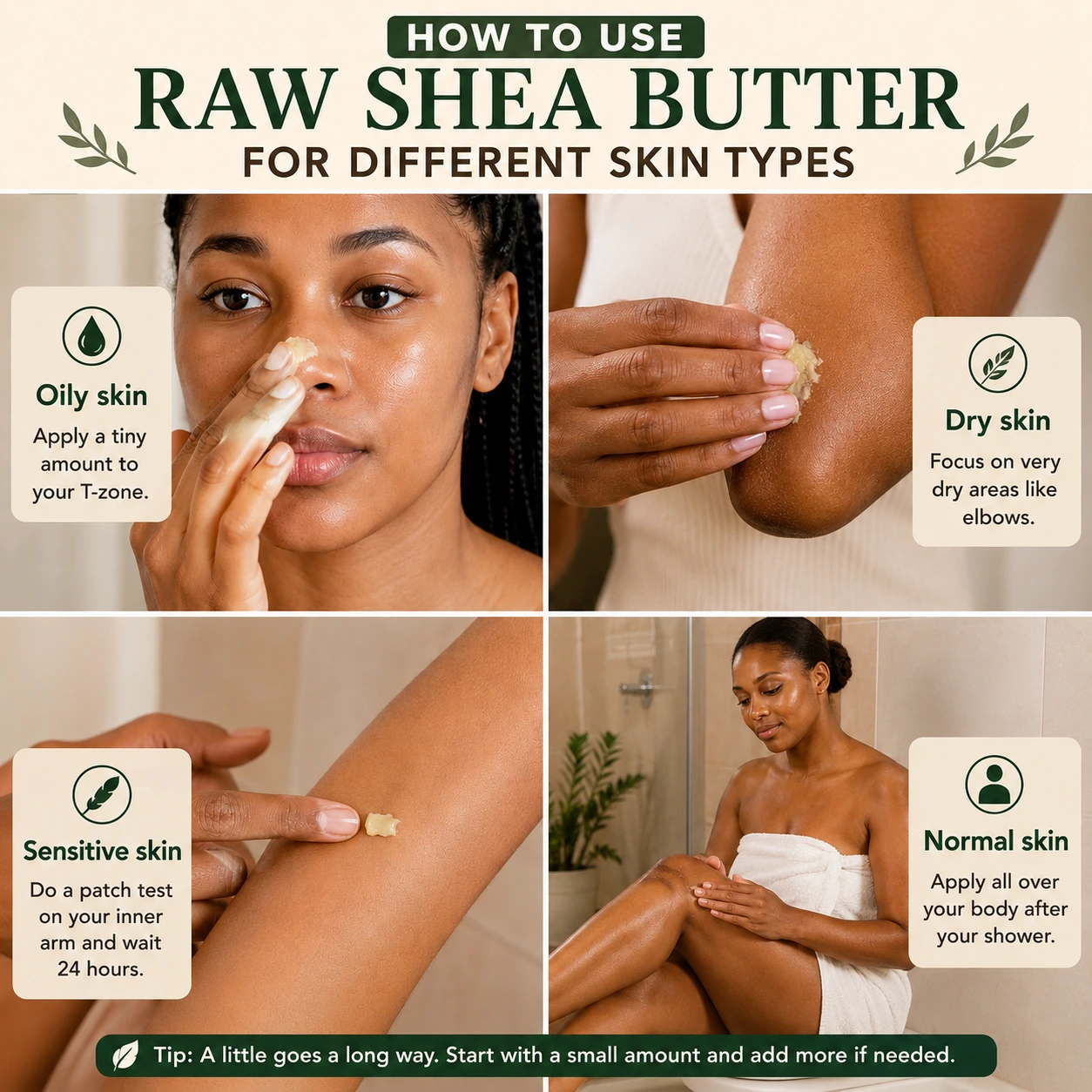
Oily Skin: How to Use Shea Butter Without Breakouts
Oily skin does need moisturisation, and shea butter can be part of that routine, but with specific adjustments. Use a genuinely tiny amount, rice-grain sized for the face and proportionally small for the body. Apply only to damp skin. Focus on dry areas rather than all-over application. For the face, consider mixing the shea butter with a few drops of baobab oil to lighten the texture.
Start with every other day evening application and monitor how your skin responds over 2 weeks before increasing frequency. If any congestion develops, reduce the amount rather than stopping entirely. Results may vary depending on skin type.
Dry Skin: Getting Maximum Moisture Benefit
Dry skin is where raw shea butter performs at its absolute best. Apply generously to damp skin after every bath or shower, morning and evening. For areas of very dry or rough skin, apply a slightly larger amount and allow it to absorb fully before covering with clothing. The overnight application is particularly effective for very dry patches: apply shea butter to the affected area before bed and cover with a cotton garment.
Dry skin types can use a larger amount than oily skin types, but the damp skin rule still applies. Dry skin applied with dry shea butter will still feel heavy and less effective than damp skin applied with melted shea butter.
Sensitive and Eczema-Prone Skin: The Safest Application Method
For sensitive and eczema-prone skin, the key is consistency rather than intensity. Apply a moderate amount to damp skin after every cleanse, twice daily if possible, and allow the cumulative effect of consistent application to build over weeks. The anti-inflammatory compounds in raw shea butter work best with regular, sustained application rather than heavy single-use applications.
Always patch test before using shea butter on new areas of eczema-affected skin. During an active flare, apply generously to the affected patches specifically. Discontinue use if irritation occurs.
Read Also: Full guide: Shea Butter for Eczema
Normal Skin: Making It Part of a Simple Daily Routine
Normal skin types have the most flexibility. Once daily application after the morning or evening shower, using a grape-sized amount for the body, gives you the moisturisation and skin health benefits without any of the issues that other skin types need to navigate. The damp skin rule still applies. The small amount rule still applies. Beyond that, normal skin is genuinely easy to care for with raw shea butter as the primary moisturiser.
How to Use Raw Shea Butter on Your Face Without It Sitting on Top
Why the Face Needs a Different Approach Than the Body
Facial skin is thinner than body skin, more reactive, and more prone to congestion. The sebaceous gland density is higher on the face than on the body. This means that the amount and application method that works for body use needs to be scaled back significantly for facial use.
The face also has more visible pores, and any product that contributes to congestion is immediately more noticeable on the face than on, say, the upper arm. This makes the quantity and timing of application more important for facial use than anywhere else.
How Much to Use on the Face
A single grain of rice. That is not a metaphor. Warm that single grain of rice sized amount between your fingertips until it is completely liquid. Then press it gently into slightly damp facial skin. That amount, correctly applied to damp skin, provides real moisturisation without any greasy or heavy feeling.
If you take more than that and find it feels heavy on your face, reduce the amount before changing anything else. Over-application is responsible for virtually every complaint about shea butter on the face.
The Right Time in Your Routine to Apply It
On the face, raw shea butter belongs at the very end of your skincare routine, after cleansing, after any toner or mist, after any serum, and after any lighter moisturiser. It is the final seal, not the base layer. Applying it first and then trying to layer lighter products over it will not work well because the occlusive layer of shea butter will block the absorption of everything that comes after it.
For most people, evening use is more practical for facial shea butter because the slight residue that remains for the first few minutes while it absorbs is not an issue while sleeping. Morning use is fine for dry skin types but requires careful timing and very small amounts for those who wear makeup.
Mixing With Baobab Oil for Lighter Facial Coverage
For a lighter facial application, place one rice-grain of shea butter and one or two drops of Ajike Pure Baobab Oil in your fingertips and warm together until melted. The baobab oil thins the shea butter, improves distribution, and adds its own skin benefits including non-comedogenic moisturisation and vitamin-rich nourishment. The resulting mixture absorbs noticeably faster than shea butter alone and is more comfortable for oily and combination skin types on the face.
Read Also: Full guide: How to Use Raw Shea Butter on Your Face Without Breaking Out.
Ajike Raw Shea Butter: Why Ours Absorbs the Way It Should
Wild Harvested and Unrefined: The Nutrient Profile Intact
Our raw shea butter is wild harvested in northern Ghana and processed using traditional water-based methods without chemical solvents, bleaching, or deodorisation. This means the unsaponifiable fraction, including the triterpenes and phytosterols that make raw shea butter genuinely effective, is intact.
The texture and weight you feel when applying Ajike shea butter is the texture and weight of a complete, uncompromised product. It is heavier than refined shea butter by design and by benefit. The correct application technique turns that richness into an asset rather than a problem.
Ivory and Yellow: Two Varieties for Different Preferences
Choose The Right Shea Butter For Your Skin & Hair
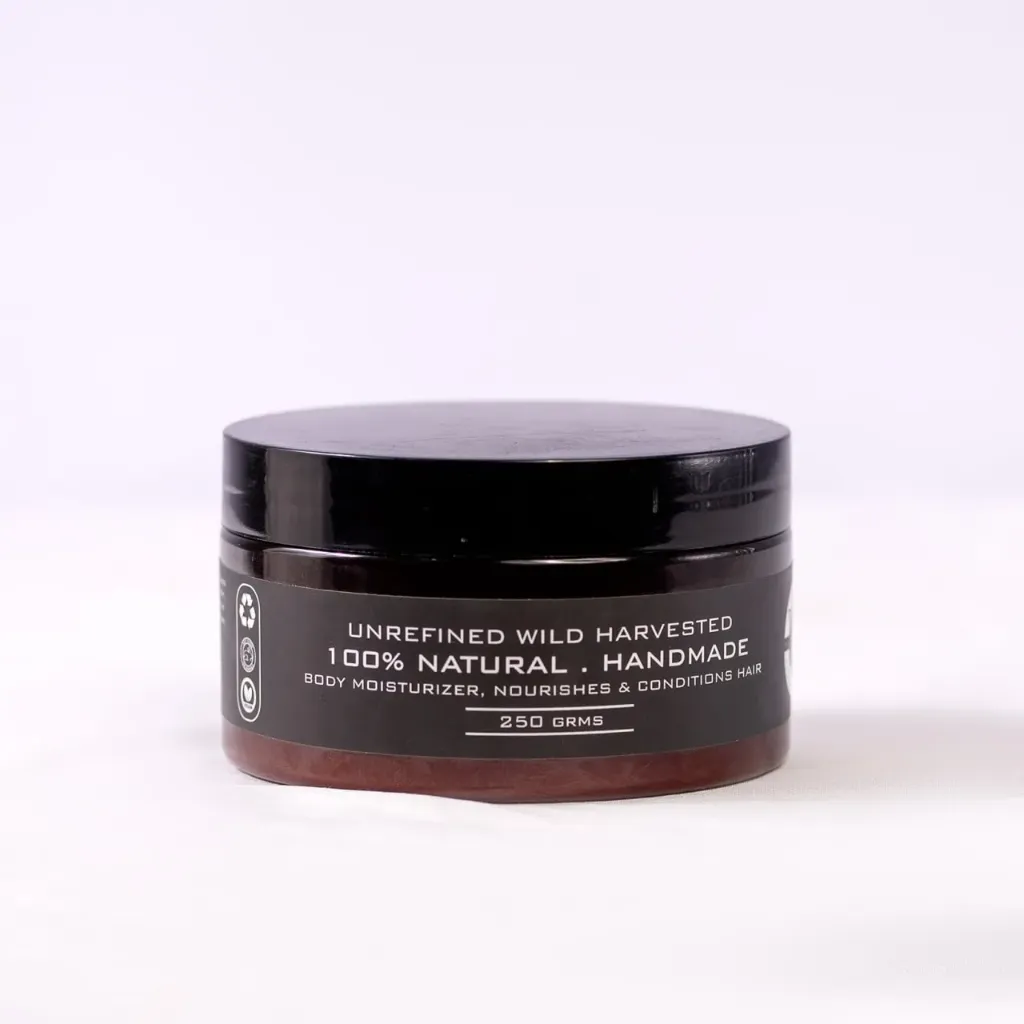
Raw Unrefined Shea Butter Ivory
Wild harvested, pure and unrefined shea butter with its complete natural nutrient profile intact. Perfect for daily skin and hair care.
View Product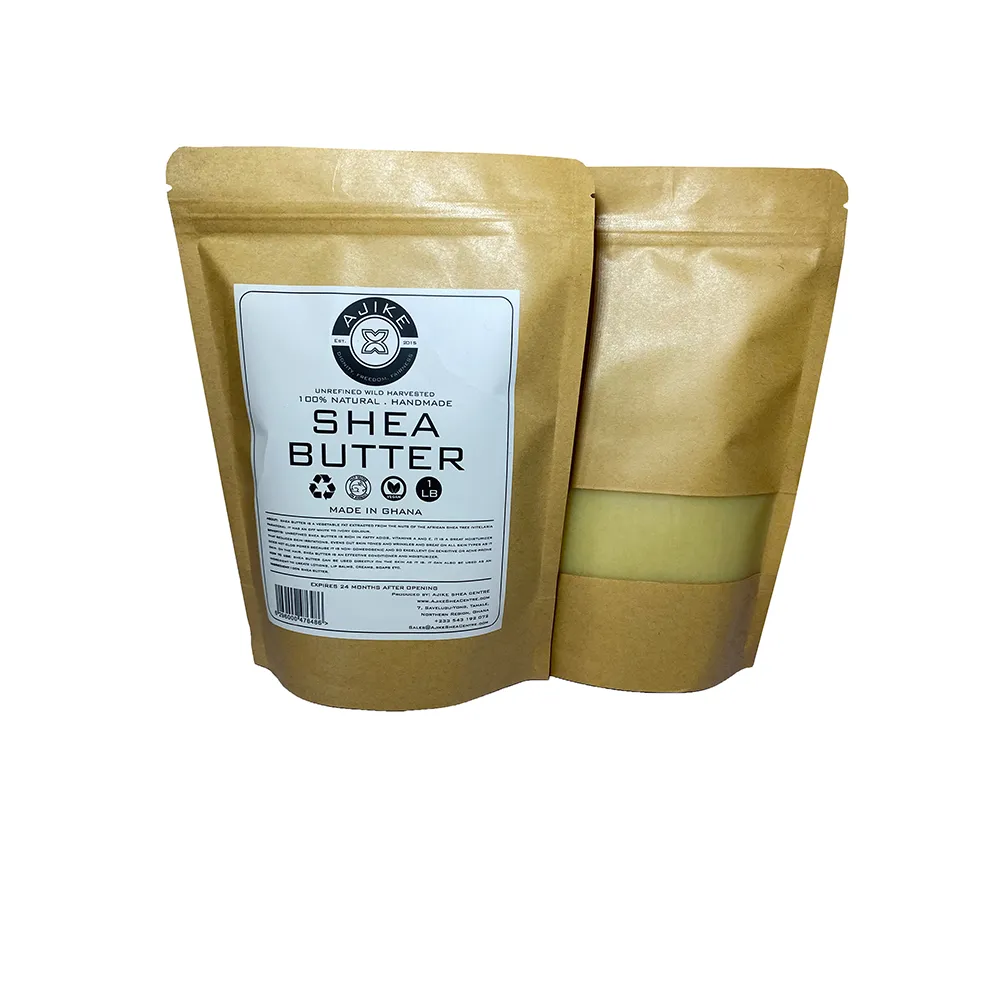
Raw Unrefined Shea Butter Yellow
Naturally coloured with wild-harvested burututu root, offering additional scalp and skin benefits with a rich golden appearance.
View ProductChoose The Right Shea Butter For Your Skin & Hair
Raw Unrefined Shea Butter Ivory
Wild harvested, pure and unrefined shea butter with its complete natural nutrient profile intact. Perfect for daily skin and hair care.
View Product
Raw Unrefined Shea Butter Yellow
Naturally coloured with wild-harvested burututu root, offering additional scalp and skin benefits with a rich golden appearance.
View ProductHow Fresh Small Batch Production Affects Texture and Absorption
Shea butter that has been sitting in a warehouse for a year or more before reaching you will have undergone some degree of oxidation, which changes its texture, scent, and absorptive properties. Older shea butter tends to be stiffer, less pliable, and slightly less pleasant to apply.
Ajike produces shea butter in small batches in Ghana and moves it relatively quickly through our supply chain. Fresher shea butter has a better texture, a more pleasant scent, and better absorption characteristics than aged product. This is another reason to source from producers who are making shea butter specifically for skincare use rather than buying from large commodity stockpiles.
Frequently Asked Questions
Almost always, this is either too much product or application to completely dry skin. Reduce the amount you are using to roughly half of what you currently use, and apply it immediately after patting skin dry while it is still slightly damp. Both changes together usually resolve the greasy feeling completely.
Applied correctly, in a small amount, to slightly damp skin, and warmed between the palms first, raw shea butter should feel comfortable and largely absorbed within three to five minutes. If it is taking significantly longer or still feels heavy after five minutes, use less product next time.
Whipping incorporates air into the shea butter, which changes the texture but not the composition. The lighter feel comes from the air pockets in the whipped product, which mean you are applying less actual shea butter per application. Both forms contain the same active compounds when made from raw unrefined shea butter. The whipped version is simply more comfortable for those who find the raw density difficult to work with.
Yes, with care. Use a very small amount, apply only to slightly damp skin, and focus on genuinely dry areas rather than all over the face or body. Consider mixing with a lighter oil like baobab oil to reduce the density. Start with every other day evening use and monitor how your skin responds. Results may vary depending on skin type.
Temperature affects both the texture of the shea butter and the temperature of your skin. In colder weather, shea butter is stiffer and your skin is cooler, which makes melting and distribution harder. In winter, be especially careful to warm the shea butter fully between your palms before applying, and apply immediately after a warm bath when the skin surface is at its most receptive.
Refined shea butter absorbs faster and feels lighter. Raw unrefined shea butter absorbs slightly more slowly and feels richer. However, the raw version contains the full complement of active compounds, including the anti-inflammatory triterpenes and phytosterols, that make shea butter therapeutically effective. Faster absorption does not mean better results. Raw shea butter applied correctly with the techniques in this guide provides better results than refined shea butter regardless of how quickly it absorbs.
Our latest content
Check out what's new in our company !