
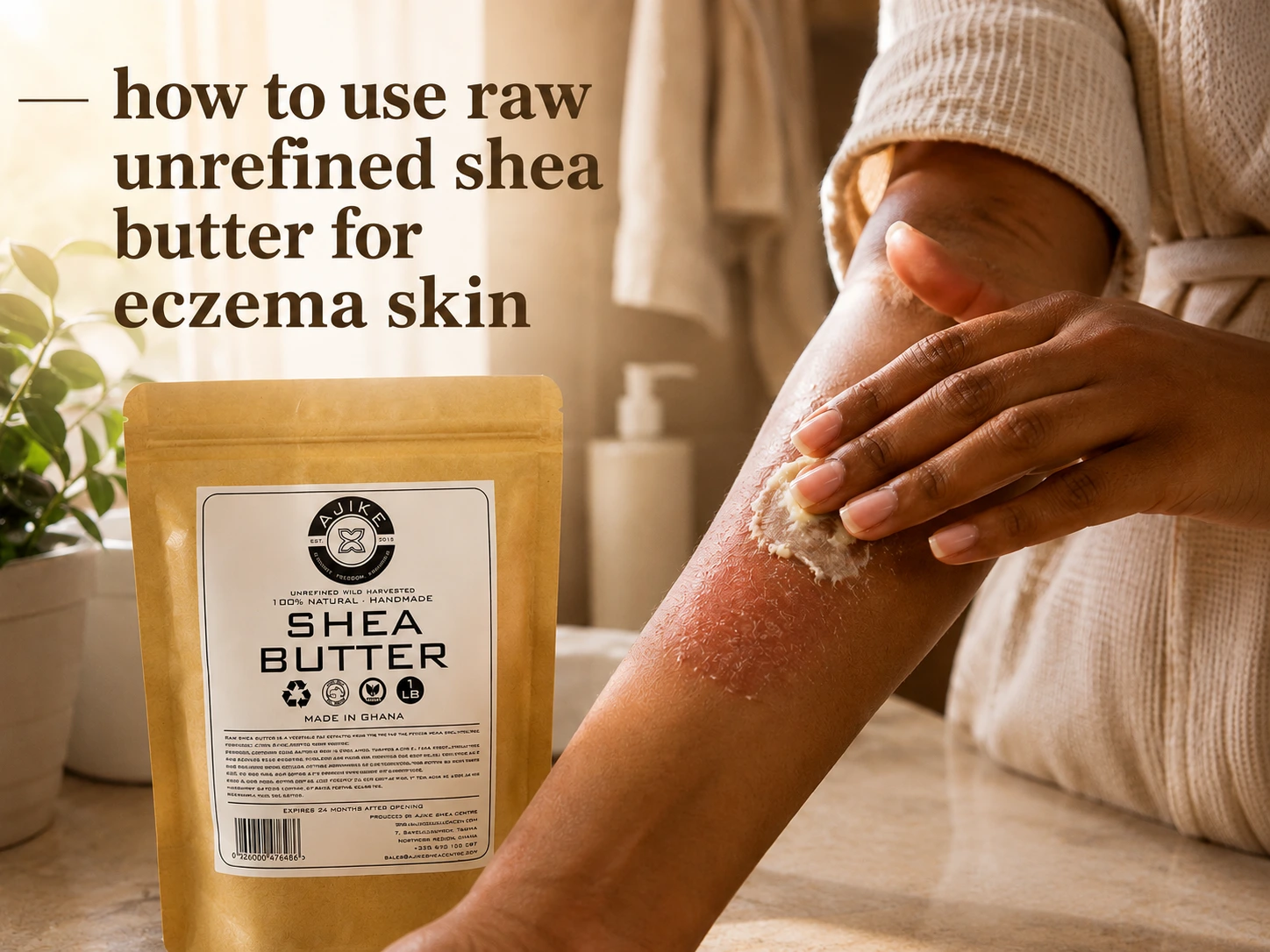
Managing eczema is one of the most exhausting skincare challenges there is. The itch that keeps you up at night. The flares that appear without obvious warning. The long search for products that help rather than make things worse.
Raw unrefined shea butter has been used for eczema-prone skin across West Africa for generations, and there are good reasons why it continues to be one of the most recommended natural options. But like everything with eczema, how you use it matters as much as what you use.
This guide covers what shea butter actually does for eczema skin, which types of eczema it helps with, how to use it correctly on different areas of the body, and what to realistically expect over the first weeks and months of use.
Read Also: For the cleanser to pair with: African Black Soap for Eczema and Itchy Skin
Why Eczema Skin Needs a Different Kind of Moisturiser
The Ceramide Deficiency at the Heart of Eczema
Eczema is not simply dry skin. At its biological core, atopic dermatitis involves a structural deficiency in the skin barrier, most commonly linked to reduced ceramide production. Ceramides are the lipid molecules that hold the outermost layer of skin together, filling the spaces between skin cells in the stratum corneum the way mortar fills the spaces between bricks.
In eczema-prone skin, ceramide levels are significantly lower than in healthy skin. This lipid deficiency means the barrier is leaky: water escapes the skin rapidly (high transepidermal water loss), and irritants, allergens, and bacteria penetrate inward more easily. The itching, inflammation, and chronic dryness of eczema flow directly from this structural problem. Any moisturiser that genuinely helps eczema needs to address this lipid barrier deficiency, not just add surface moisture.
Why Most Commercial Moisturisers Fall Short for Eczema
The majority of commercial moisturisers are built on a base of water, glycerine, and some combination of emollients and occlusives, held together with emulsifiers and preserved with synthetic preservatives. For normal skin, this formula works reasonably well. For eczema-prone skin, the problems begin immediately.
Many common moisturiser preservatives, particularly methylisothiazolinone and various parabens, are significant contact sensitisers for eczema skin. Synthetic fragrances, even at low concentrations, are among the most common eczema triggers. And critically, most commercial moisturisers provide no ceramide-building support. They add surface moisture and create the feeling of hydration, but they do not address the lipid barrier deficiency that is the actual problem.
What Eczema Skin Actually Needs from a Moisturiser
A moisturiser that genuinely helps eczema needs to do several things simultaneously: provide emollient support that fills the gaps between skin cells, support ceramide synthesis or provide ceramide-adjacent lipids that help restore barrier structure, have anti-inflammatory properties that help calm the chronic immune activation in eczema-affected skin, and be completely free from the synthetic additives that commonly trigger eczema reactions.
Raw unrefined shea butter meets all of these requirements better than almost any other single natural ingredient.
Where Shea Butter Fits in an Eczema Skincare Routine
Shea butter works as the moisturiser and barrier-repair step in an eczema routine, applied after cleansing while skin is still slightly damp. It is not a treatment for eczema as a medical condition and does not replace prescribed treatments when these are medically necessary. What it provides is consistent, gentle barrier support that reduces the daily deterioration of the skin barrier and supports recovery between flares.
In practical terms: cleanse with a gentle, fragrance-free cleanser, pat skin to slightly damp, apply shea butter immediately. This simple sequence, done consistently twice daily, is the foundation of shea butter use for eczema management.
Is Shea Butter Good for Eczema?
The Emollient Properties That Make It Suitable
Shea butter is one of the richest natural emollients available. Its fatty acid composition, particularly the high oleic and stearic acid content, fills the gaps between corneocytes in the stratum corneum in a way that physically supports barrier integrity. This emollient action reduces transepidermal water loss and improves the skin's ability to retain moisture throughout the day.
For eczema skin, which is chronically losing water through a leaky barrier, this emollient support is not cosmetic. It is functional barrier repair.
Oleic Acid and Stearic Acid: Supporting the Lipid Barrier
Oleic acid, which makes up 40 to 60 percent of raw shea butter, penetrates the upper layers of the stratum corneum and integrates with the skin's lipid bilayer, providing both immediate moisturisation and longer-term barrier support. Stearic acid, present at 35 to 45 percent, is actually a component of healthy skin's natural lipid matrix. Applying stearic acid-rich shea butter to skin with a depleted lipid barrier provides some of the raw materials the skin needs for barrier reconstruction.
The Unsaponifiable Fraction: Natural Anti-Inflammatory Action
This is what makes raw shea butter genuinely different from most other moisturisers for eczema. The unsaponifiable fraction of raw shea butter, which makes up 5 to 17 percent of the total content, contains the biologically active compounds that have anti-inflammatory and barrier-active effects. This fraction is almost entirely absent from refined shea butter.
The unsaponifiable fraction works in multiple ways relevant to eczema: supporting ceramide synthesis, inhibiting pro-inflammatory cytokine production, and providing antioxidant protection to the chronically inflamed skin.
Triterpenes and Phytosterols: Reducing Skin Inflammation
The triterpene alcohols in raw shea butter, particularly lupeol, alpha-amyrin, and beta-amyrin, have documented anti-inflammatory properties at the skin level. They inhibit the production of pro-inflammatory signalling molecules including specific prostaglandins and cytokines that drive the inflammatory cycle in eczema.
The phytosterols, including beta-sitosterol, support ceramide synthesis in the skin barrier and reduce transepidermal water loss through their structural integration with the skin's lipid bilayer. Together, the triterpenes and phytosterols provide a meaningful anti-inflammatory and barrier-supportive combination that is unique to the raw, unrefined product.
Natural Vitamin E: Antioxidant Protection for Inflamed Skin
Eczema-affected skin is under chronic oxidative stress from the ongoing inflammatory response and from scratching-induced skin damage. The tocopherols in raw shea butter provide antioxidant protection within the lipid environment of the skin barrier, neutralising some of the free radical load that contributes to ongoing inflammation.
What Shea Butter Cannot Do for Eczema: Honest Expectations
Shea butter cannot cure eczema. It cannot eliminate the underlying genetic and immune factors that cause atopic dermatitis. It cannot replace prescribed treatments when these are medically necessary, and it will not deliver dramatic, rapid results. What it provides is consistent, daily barrier support that over weeks and months of regular use produces a meaningful reduction in the frequency and severity of flares, improved skin comfort, and better moisture retention. Results may vary depending on skin type.
Important: Always patch test shea butter before applying to new areas of eczema-affected skin. Apply a small amount to the inner arm, leave for 24 to 48 hours, and monitor for any reaction. Discontinue use if irritation occurs.
Raw Unrefined Shea Butter vs Refined Shea Butter for Eczema
Why Refining Destroys the Anti-Inflammatory Compounds
The compounds most relevant to eczema management in shea butter, the triterpenes and phytosterols in the unsaponifiable fraction, are heat-sensitive and chemically reactive. Industrial refining subjects shea butter to high-temperature deodorisation, chemical bleaching, and solvent extraction, each of which degrades or removes these compounds. Studies have documented reductions of up to 80 percent in specific triterpene alcohols after standard refining.
What remains after refining is primarily the fatty acid component: oleic and stearic acid. These still provide some emollient benefit, but without the unsaponifiable fraction, refined shea butter loses the anti-inflammatory, ceramide-supporting, and barrier-active properties that make raw shea butter clinically relevant for eczema.
Why Raw Shea Butter Is the Only Version Worth Using for Eczema
For basic moisturisation on normal skin, the difference between raw and refined shea butter may be manageable. For eczema-prone skin, where the therapeutic properties of the unsaponifiable fraction are the primary reason to use shea butter rather than any other emollient, refined shea butter is a significantly inferior product. If you are using shea butter specifically because of eczema, it must be raw and unrefined.
How to Identify Genuine Raw Unrefined Shea Butter
Genuine raw unrefined shea butter has an ivory to pale golden colour, never bright white. It has a characteristic mild, nutty scent that comes from volatile compounds in the unsaponifiable fraction. It has a slightly grainy texture at room temperature that smooths completely when warmed between the palms. It melts at body temperature. If a product is bright white, odourless, and perfectly smooth, it is refined.
Read Also: Full guide: What Is Raw Unrefined Shea Butter?
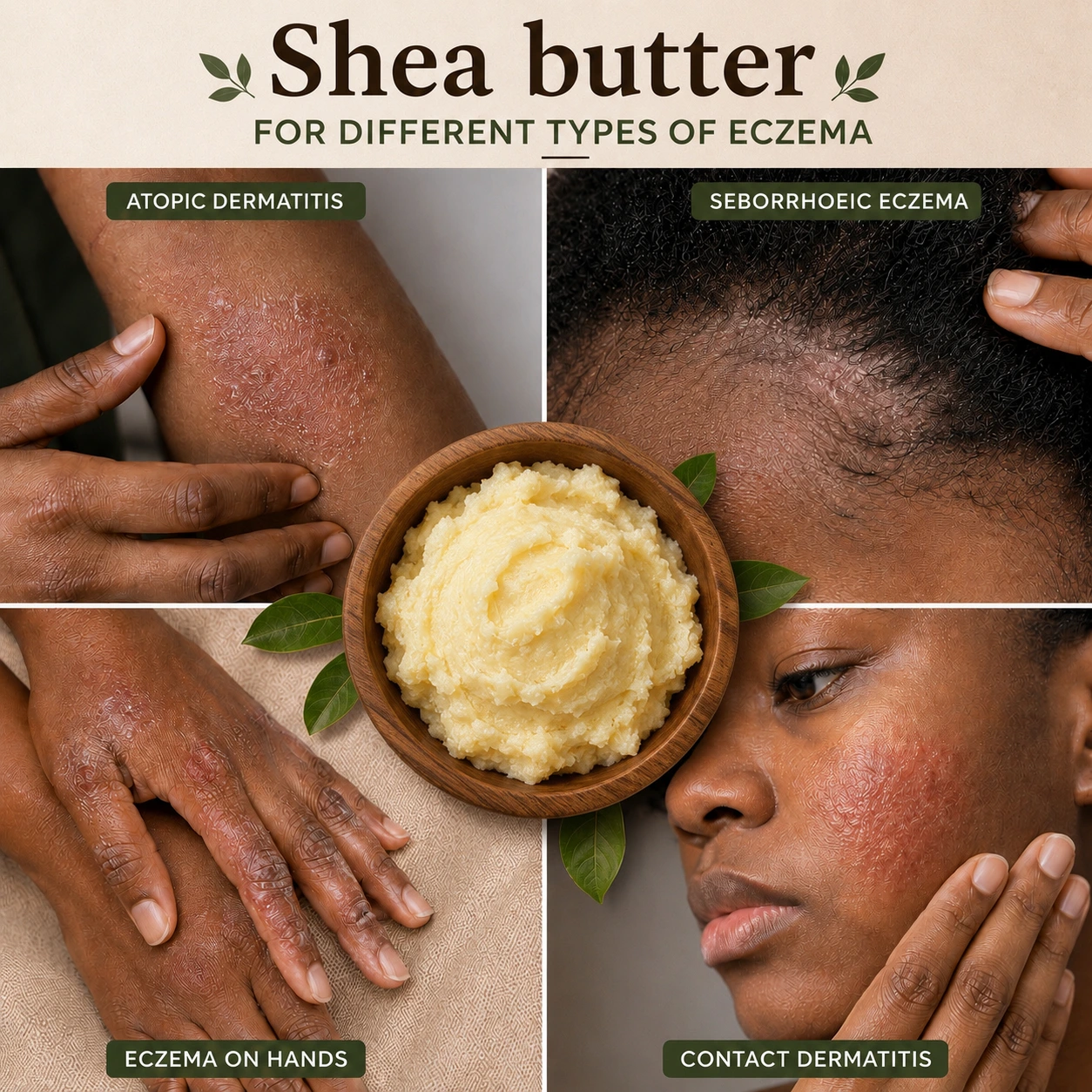
Shea Butter for Different Types of Eczema
Atopic Dermatitis: Chronic Dry Itchy Skin
Atopic dermatitis is the type of eczema that responds best to raw shea butter as a daily moisturiser. The combination of emollient support, ceramide-adjacent lipid replenishment, and anti-inflammatory action from the unsaponifiable fraction addresses the three core features of atopic dermatitis directly: leaky barrier, inflammation, and chronic dryness.
Use raw shea butter twice daily, applied immediately to slightly damp skin after every cleanse. The consistency of application is the most important factor. Twice daily for several weeks is required to see meaningful barrier improvement.
Contact Dermatitis: Reactive and Sensitised Skin
Contact dermatitis, whether irritant or allergic, is characterised by skin that has become reactive to specific triggers. Raw shea butter can be an appropriate daily moisturiser for contact dermatitis-prone skin because it contains none of the common contact allergens found in commercial moisturisers: no synthetic fragrances, no methylisothiazolinone, no parabens, no formaldehyde-releasing preservatives.
If your contact dermatitis is triggered by specific natural ingredients, check that you are not sensitive to any component of shea butter before using it regularly. Nut allergies are rare but worth considering; patch test before first full use.
Seborrhoeic Dermatitis: Scalp and Facial Eczema
For seborrhoeic dermatitis on the scalp, raw shea butter applied as a pre-wash scalp treatment can help reduce the scaling and inflammation associated with the condition. Work a small amount into the scalp, leave for 30 to 60 minutes, then wash out with a gentle shampoo. The anti-inflammatory compounds provide some relief from scalp irritation, and the emollient action helps loosen dry, flaking scalp skin.
For facial seborrhoeic dermatitis around the nose, eyebrows, and hairline, a very small amount of shea butter applied to affected areas after washing helps maintain moisture and reduce the dryness associated with the condition. Use cautiously on facial areas prone to oiliness.
Eczema Flare Ups: What to Do and What to Avoid
During an active flare, shea butter application should be increased in frequency and generosity on affected patches specifically. Apply after every cleanse, and if possible, reapply mid-day to actively inflamed areas. For very severe flares with open, weeping, or crusting skin, cleanse gently with water only on those areas and apply shea butter to the surrounding skin rather than directly to broken skin.
During a flare, avoid adding any new products to the routine. Keep everything as simple as possible: gentle cleanser, shea butter, nothing else. Introduce anything new only when the flare has resolved.
Eczema Between Flares: Maintenance and Prevention
The period between flares is the most important time for shea butter use. Consistent daily application during this period builds and maintains barrier integrity, which reduces the likelihood of the next flare occurring and reduces its severity when it does. Many eczema sufferers focus on treatment during flares and abandon their routine when the skin is clear. This is precisely when the routine matters most.
Twice daily application between flares is the goal. Once daily is the minimum. The barrier improvements that prevent future flares are built through consistent daily routine, not through intensive treatment during acute episodes.
Shea Butter for Eczema on Different Areas of the Body
Shea Butter for Eczema on the Face
Facial eczema requires the most careful application approach. Use a very small amount, warmed between fingertips until completely liquid, and pressed gently into slightly damp skin. Avoid the eye area and any areas of broken or actively weeping skin. For very sensitive facial eczema, consider applying a thin layer of shea butter and covering loosely with a soft cotton cloth overnight to allow the anti-inflammatory compounds to work with reduced evaporation.
On the face, shea butter works best in the evening when the absence of makeup and sun exposure allows the skin to focus on repair. Morning facial use is appropriate for dry skin types; for oily or combination eczema-prone skin, the evening application may be sufficient.
Shea Butter for Eczema on the Body: Arms, Legs and Torso
Body eczema patches on the arms, legs, and torso respond well to generous shea butter application immediately after bathing. Apply while the skin is still slightly damp, using enough product to cover the affected areas with a visible but thin layer. Allow to absorb for a few minutes before dressing.
For larger areas of body eczema, the Ajike Raw Shea Lotion, which contains raw shea butter in a lighter formulation, may be more practical for covering large areas than pure raw shea butter, which can be difficult to spread thinly across very large body surfaces.
Shea Butter for Eczema on the Scalp
Scalp eczema, whether atopic or seborrhoeic, responds well to shea butter as a pre-wash treatment rather than a leave-in product. Work a small amount directly into the scalp with fingertips, section by section, focusing on areas of scaling or inflammation. Leave for at least 30 minutes, or overnight for more intensive treatment, then wash out thoroughly with a gentle, fragrance-free shampoo.
Leaving raw shea butter in the hair as a leave-in product is not recommended for most hair types as it can cause buildup and heaviness. The pre-wash treatment approach provides the therapeutic benefit while avoiding these issues.
Shea Butter for Eczema on the Hands
Hands are among the most challenging areas for eczema management because they are constantly exposed to water, soap, and environmental irritants through daily activity. Hand eczema often improves significantly with consistent shea butter application throughout the day.
Apply raw shea butter to hands after every hand wash while hands are still slightly damp. This is impractical to do with pure raw shea butter at work or out of the house; keeping a small tube of the Ajike Shea Lotion or a small tin of shea butter in your bag for reapplication throughout the day is the practical solution. Before bed, apply shea butter generously and cover hands with thin cotton gloves overnight for intensive hand eczema treatment.
Shea Butter for Eczema in Skin Folds and Sensitive Areas
Skin folds such as the inside of the elbows, behind the knees, and around the neck are common sites for atopic dermatitis and can be particularly challenging to manage. The constant movement and friction in these areas, combined with the tendency for sweat to accumulate, creates an environment where eczema can become chronic and difficult to clear.
Apply shea butter to these areas twice daily without exception, immediately after bathing. The anti-inflammatory compounds are particularly valuable in skin folds where chronic low-grade inflammation tends to persist. Use a moderate amount rather than a large amount, as skin folds are already prone to occlusion and excess product can cause discomfort.
Shea Butter for Baby Eczema: Is It Safe and How to Use It
Why Baby Skin with Eczema Needs Extra Caution
Baby skin with eczema is among the most sensitive and reactive skin you will encounter. The infant skin barrier is not fully mature until around 12 months of age, and in babies with atopic dermatitis, this immaturity is compounded by the ceramide deficiency and immune dysfunction that underlie the condition. Any product applied to a baby with eczema needs to be both genuinely gentle and completely free from known irritants and sensitisers.
Is Raw Shea Butter Safe for Newborns and Infants with Eczema
Raw unrefined shea butter from Ajike, which contains no additives of any kind, is appropriate for use on baby skin including newborns with eczema. Its simple, plant-derived composition and absence of synthetic fragrances, preservatives, and additives make it one of the gentlest moisturising options available for infant eczema skin.
The one consideration to be aware of is tree nut allergy. Shea butter is derived from the shea tree, which is classified as a tree nut. If there is a family history of tree nut allergy, discuss with a paediatric healthcare provider before using shea butter on a baby's skin. Always patch test before full use.
How to Apply Shea Butter to a Baby with Eczema
For baby eczema, apply raw shea butter immediately after bathing while the skin is still slightly damp. Take a very small amount, warm it between clean adult fingertips until completely melted, and apply with gentle pressing movements to the baby's eczema-affected areas. Cover the body broadly rather than focusing only on visible patches, as the full-body application helps build overall barrier integrity.
For the face, use an even smaller amount and avoid the area around the eyes and nose. Press gently rather than rubbing, particularly on inflamed patches where the skin may be more fragile.
How Often to Apply on Baby Eczema Skin
Twice daily application is the goal for baby eczema: once after the morning bath or wash and once before bed. If the baby's skin is very dry or the eczema is active, a midday application to particularly affected areas is beneficial. After every nappy change, a small amount on any eczema patches on the bottom or thigh area is also helpful.
Consistency matters more than quantity. A small amount applied consistently twice daily will produce better results than generous application done inconsistently.
Signs the Baby Is Reacting: What to Watch For
Watch for increased redness, rash, swelling, or worsening of existing eczema patches within 24 to 48 hours of first use. Increased crying or distress during or after application that is not typical for the baby. New rash appearing in areas that were previously clear. Any of these signs warrant stopping use and consulting with a paediatric healthcare provider. Discontinue use if irritation occurs.
Read Also: Full guide: Shea Butter for Baby Skin
How to Use Shea Butter for Eczema: Step by Step
Step 1: Cleanse First with a Gentle Fragrance-Free Soap
Cleansing is the essential first step. Eczema skin benefits from gentle, regular cleansing to remove surface irritants, allergens, and the Staphylococcus aureus bacteria that colonise eczema skin and worsen inflammation. The cleanser must be fragrance-free, sulfate-free, and free from the preservatives that trigger eczema reactions.
Our Black Soap Eczema Soap is formulated specifically for this purpose: unscented, free from synthetic additives, and enriched with shea butter and neem for additional barrier support and antibacterial action.
Step 2: Pat Dry and Leave Skin Slightly Damp
After cleansing, pat the skin dry with a soft, clean towel. The emphasis is on pat, not rub. Rubbing eczema-affected skin creates friction that irritates the barrier further. Leave the skin slightly damp rather than completely dry. The window between slightly damp and completely dry is where shea butter application is most effective.
Step 3: Warm the Shea Butter Between Your Palms
Take a small amount of raw shea butter and place it in one palm. Press both palms together and warm the shea butter with gentle friction for 10 to 15 seconds until it melts completely to a smooth oil. Melted shea butter distributes more evenly, absorbs more effectively, and is less likely to drag across sensitive eczema-affected skin than partially-solid shea butter.
Step 4: Apply Immediately to Damp Skin
Apply the melted shea butter within 60 seconds of patting skin dry. Press and pat it onto the skin rather than rubbing. For eczema-affected areas, the pressing application is gentler on already-irritated skin and still distributes the product effectively. Work from the general body areas inward to the most affected patches.
Step 5: Pay Extra Attention to Affected Patches
Once the shea butter has been distributed across the skin broadly, go back to the specific eczema-affected patches and apply a slightly more generous amount to these areas. These are the areas where the barrier is most compromised and where the anti-inflammatory compounds in the shea butter are most needed. Allow these areas a moment of gentle pressing before you move on.
Step 6: Seal Over the Top with a Breathable Layer if Needed
For very severe eczema or very dry patches that are not responding to shea butter alone, applying a thin layer of our Shea Butter and Neem Eczema Cream over the top of the shea butter creates a layered barrier repair approach: the shea butter provides lipid replenishment and anti-inflammatory action, and the eczema cream adds additional targeted compounds and seals the layers in place.
For babies and for overnight treatment on severe patches, covering the shea butter application with a soft cotton garment or cotton bandage creates a modified wet wrap effect that significantly improves the penetration and effectiveness of the applied products.
How Often to Apply Shea Butter for Eczema
During a Flare: How Frequently to Reapply
During an active eczema flare, apply shea butter after every cleanse and as often as needed throughout the day to maintain skin comfort. On actively inflamed patches, reapplication every 3 to 4 hours is not excessive and provides the sustained anti-inflammatory and barrier support that inflamed skin needs. The more active the flare, the more frequent the application should be.
Between Flares: Daily Maintenance Routine
Between flares, twice daily application is the standard. Morning, immediately after washing, and evening, immediately after bathing, are the two non-negotiable application moments. This consistency is what builds barrier integrity over time and reduces the frequency of future flares. Do not drop to once daily during clear periods. The maintenance routine between flares is what makes the difference to long-term eczema management.
After Bathing: Why This Moment Matters Most
Of all the application moments in the day, the post-bath application is the most important. Bathing opens the pores, temporarily improves skin permeability, and leaves the skin with surface moisture that, if sealed in with shea butter within 60 seconds, provides hours of improved hydration. Bathing without immediately applying an emollient results in rapid water evaporation from the already-compromised eczema barrier.
The three-minute window after bathing is the single most valuable skincare opportunity for eczema-prone skin. Never waste it.
Before Bed: Overnight Barrier Repair
The overnight application is the second most important of the day. During sleep, the skin is in active repair mode and moisture loss, while reduced compared to daytime, continues throughout the night. Applying shea butter before bed and potentially covering affected areas with cotton provides an overnight barrier repair environment that accumulates benefit with every night of consistent practice.
Shea Butter for Eczema Scars and Post-Eczema Marks
What Causes Dark Marks After an Eczema Flare
After an eczema flare resolves, it often leaves behind flat dark marks on the skin, particularly on melanin-rich skin where post-inflammatory hyperpigmentation (PIH) is more pronounced. These marks form because the inflammation of the flare triggers melanocyte overactivity in the affected area, producing excess melanin that remains visible in the skin long after the active inflammation has resolved.
The more severe the flare and the more the skin was scratched or damaged, the more significant the post-eczema PIH is likely to be.
How Shea Butter Supports the Fading of Post-Eczema Marks
Raw shea butter supports the fading of post-eczema marks through two mechanisms. The vitamin A content in the unsaponifiable fraction supports skin cell renewal, gradually bringing fresher, less pigmented skin cells to the surface. The anti-inflammatory triterpenes and phytosterols reduce the ongoing inflammatory environment that continues to stimulate melanocyte activity even after the acute flare has resolved.
This is a gradual process. Shea butter does not bleach or chemically lighten post-eczema marks. It supports the natural renewal of the skin surface at a healthy, sustainable rate.
Realistic Timeline for Eczema Scar Improvement
Post-eczema marks from recent flares typically begin to fade noticeably within 6 to 12 weeks of consistent daily shea butter application. Older, more established marks from repeated flares in the same area take longer, often 3 to 6 months of consistent treatment. The baseline skin tone, the depth of the pigmentation, and how recently the flare occurred all affect the timeline.
Results may vary depending on skin type. Consistent application is the most important factor.
Combining Shea Butter with Other Ingredients for Faster Results
For faster fading of post-eczema PIH, pairing shea butter with our Nightly Face Serum with Lactic Acid and Papaya Oil in the evening provides additional chemical exfoliation that accelerates the removal of hyperpigmented surface cells. Apply the serum first on slightly damp skin, allow to absorb for 60 seconds, then apply shea butter over the top.
For body post-eczema marks, applying Ajike Shea Glow Lotion with Kojic Acid over the shea butter can help. The kojic acid gently inhibits melanin production while the shea butter provides barrier support and anti-inflammatory action.
What to Expect When You Start Using Shea Butter for Eczema
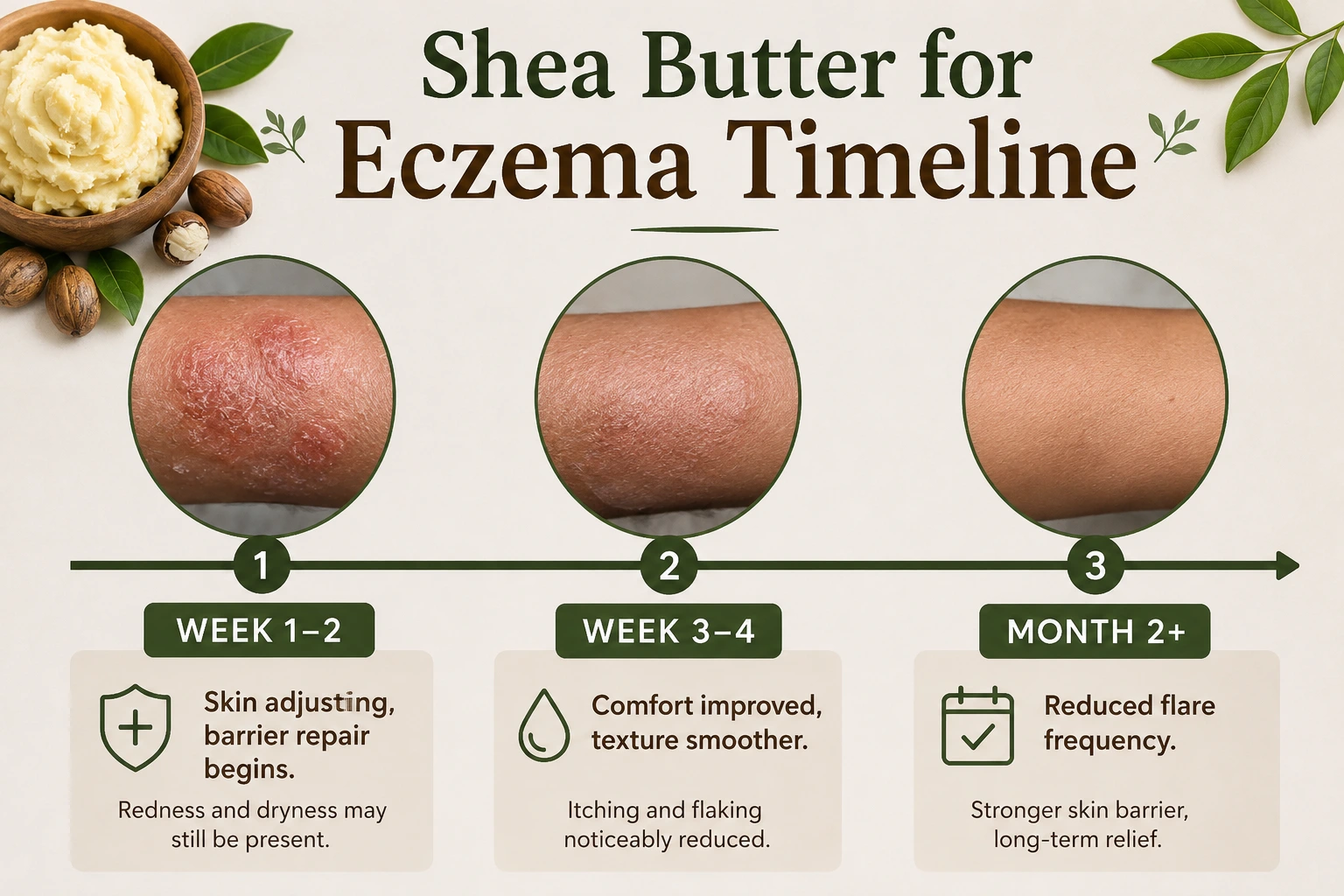
Week 1 and 2: Building the Moisture Habit
In the first two weeks, the most important thing happening is the establishment of the twice-daily routine. The skin is beginning to receive consistent lipid support that it has likely been lacking. You may notice that skin feels slightly more comfortable after cleansing, that the post-cleansing dryness is less intense, and that the skin is slightly less reactive to minor environmental triggers.
Visible improvement in eczema patches during weeks 1 and 2 is possible but not guaranteed. The barrier repair that produces visible improvement is a cumulative process that builds over time.
Week 3 and 4: Visible Improvement in Skin Texture and Comfort
By weeks 3 and 4, most consistent users notice meaningful improvements in skin comfort. Eczema patches that were very dry and rough begin to feel smoother. The itchiness, particularly the post-bath itching that many eczema sufferers experience, is reduced. The skin holds moisture better between applications.
The frequency of scratching often reduces during this period, which is itself beneficial: reduced scratching means less skin damage, less barrier disruption, and fewer triggers for new inflammation.
Month 2 and Beyond: Reduced Flare Frequency
Month 2 is typically where the most significant overall improvement becomes apparent. Many users report that their eczema flares are less frequent and, when they do occur, less severe and shorter in duration. The consistent daily barrier support has built up the skin's resilience to triggers that would previously have provoked a full flare.
This does not mean eczema is cured. It means the skin barrier is better maintained, and the threshold for a flare is higher. Continue the twice daily routine even when the skin appears completely clear.
Signs It Is Working
- Post-cleansing skin feels comfortable rather than tight or itchy
- Eczema patches are visibly smoother and less raised than before
- The frequency of nighttime itching is reduced
- Flares are less frequent or less severe than before starting
- Skin holds moisture better throughout the day between applications
- Post-eczema marks are beginning to fade
Signs You Should Stop and Reassess
- Skin is more inflamed or itchy after application than before
- Existing eczema patches are worsening rather than improving after 2 to 3 weeks
- New patches appearing in areas that were previously clear
- Any burning, stinging, or significant discomfort during or after application
Discontinue use if irritation occurs. If eczema worsens significantly, consult a dermatologist or healthcare provider.
Best Ajike Products for Eczema Using Shea Butter
Ajike Raw Unrefined Shea Butter: The Core Treatment
Our ivory raw unrefined shea butter is the foundation of our eczema recommendation. Wild harvested in northern Ghana, processed traditionally without chemical solvents or industrial refining, it retains the full unsaponifiable fraction including the triterpenes and phytosterols most relevant to eczema management. No additives, no fragrances, nothing beyond pure shea butter.
Ajike Shea Butter and Neem Eczema Cream: Targeted Eczema Relief
For eczema patches that need more targeted support than shea butter alone provides, our Eczema Cream combines raw shea butter with cocoa butter and neem extract. The neem contributes additional antibacterial action against Staphylococcus aureus, which colonises eczema skin and worsens inflammation, and the cream formulation makes application to larger areas easier than pure shea butter.
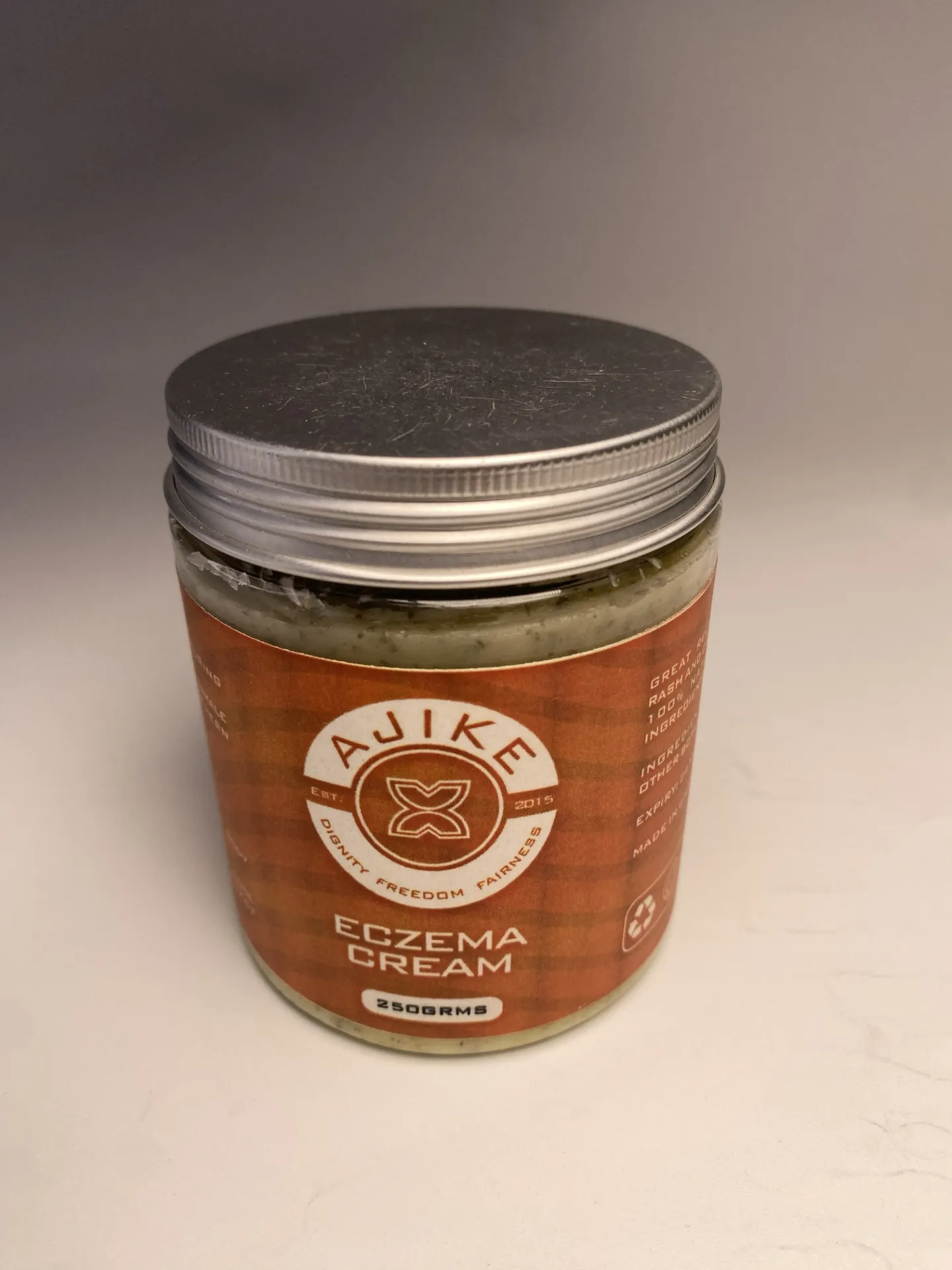
Comfort Dry & Eczema-Prone Skin
Shea Butter & Neem Eczema Cream
A soothing cream with shea butter, cocoa butter and neem extract for active eczema patches and general eczema-prone skin.
View Product
Comfort Dry & Eczema-Prone Skin
Shea Butter & Neem Eczema Cream
A soothing cream with shea butter, cocoa butter and neem extract for active eczema patches and general eczema-prone skin.
View ProductAjike Black Soap Eczema Soap: The Right Cleanser to Pair With
The cleanser you use before applying shea butter matters enormously. Our Black Soap Eczema Soap is the appropriate cleansing partner for eczema skin: unscented, free from synthetic additives, sulfate-free, and enriched with shea butter and neem. Using a harsh or fragranced cleanser before applying shea butter undermines the barrier support that the shea butter provides.
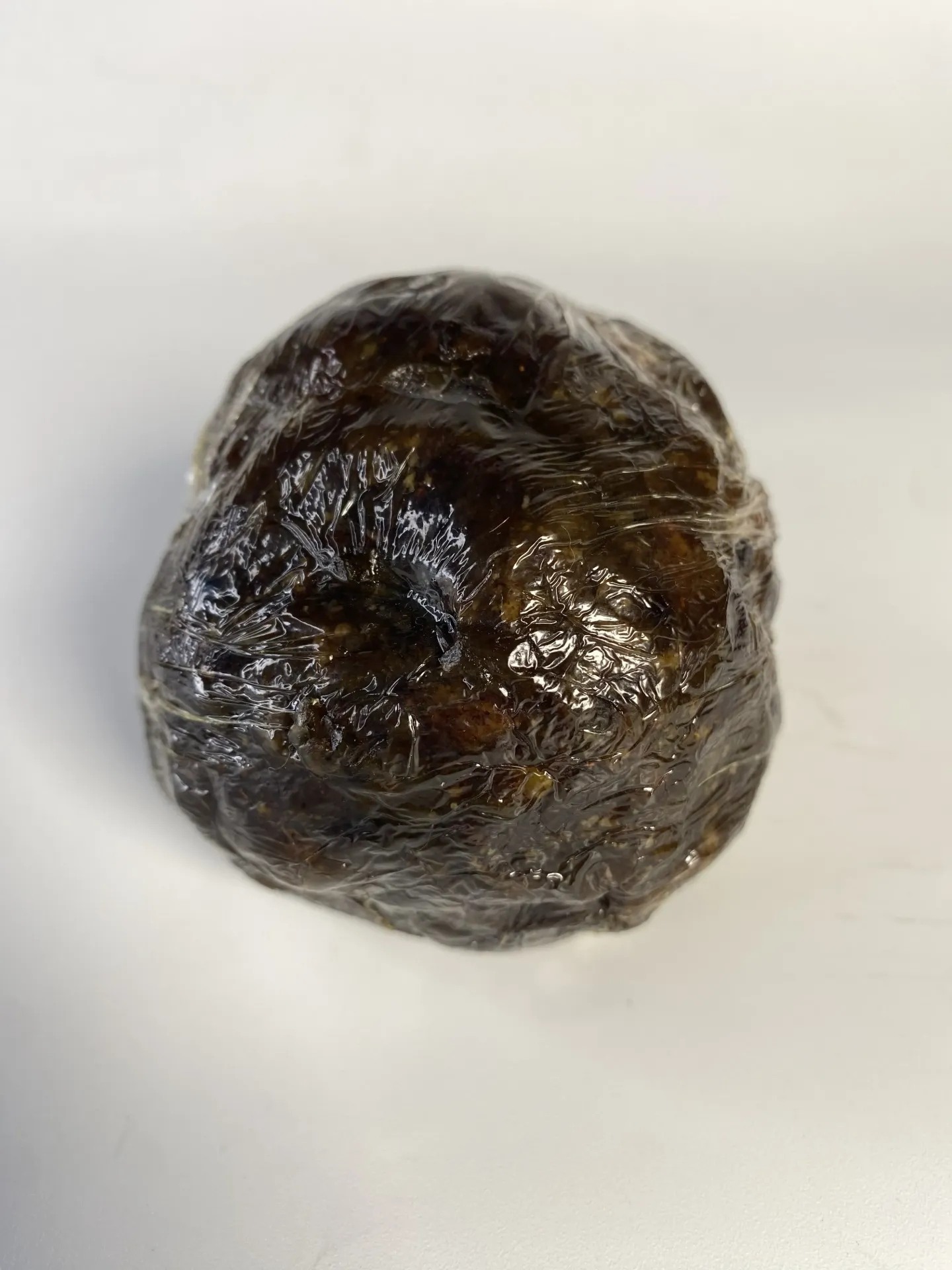
Cleanse Sensitive Skin Before Moisturising
Black Soap Eczema Soap
Unscented, fragrance-free and sulfate-free soap with shea butter, cocoa butter and neem. Formulated for eczema-prone skin and suitable for children and adults.
View Product
Cleanse Sensitive Skin Before Moisturising
Black Soap Eczema Soap
Unscented, fragrance-free and sulfate-free soap with shea butter, cocoa butter and neem. Formulated for eczema-prone skin and suitable for children and adults.
View ProductAjike Baby Moisturiser: For Infant and Baby Eczema
For babies and very young children with eczema, our Baby Moisturiser provides ultra-gentle moisturisation using edible-grade plant ingredients including shea butter, sunflower oil, argan oil, jojoba oil, coconut oil, and baobab oil. Completely fragrance-free and preservative-free, it is formulated specifically for the most sensitive possible skin.
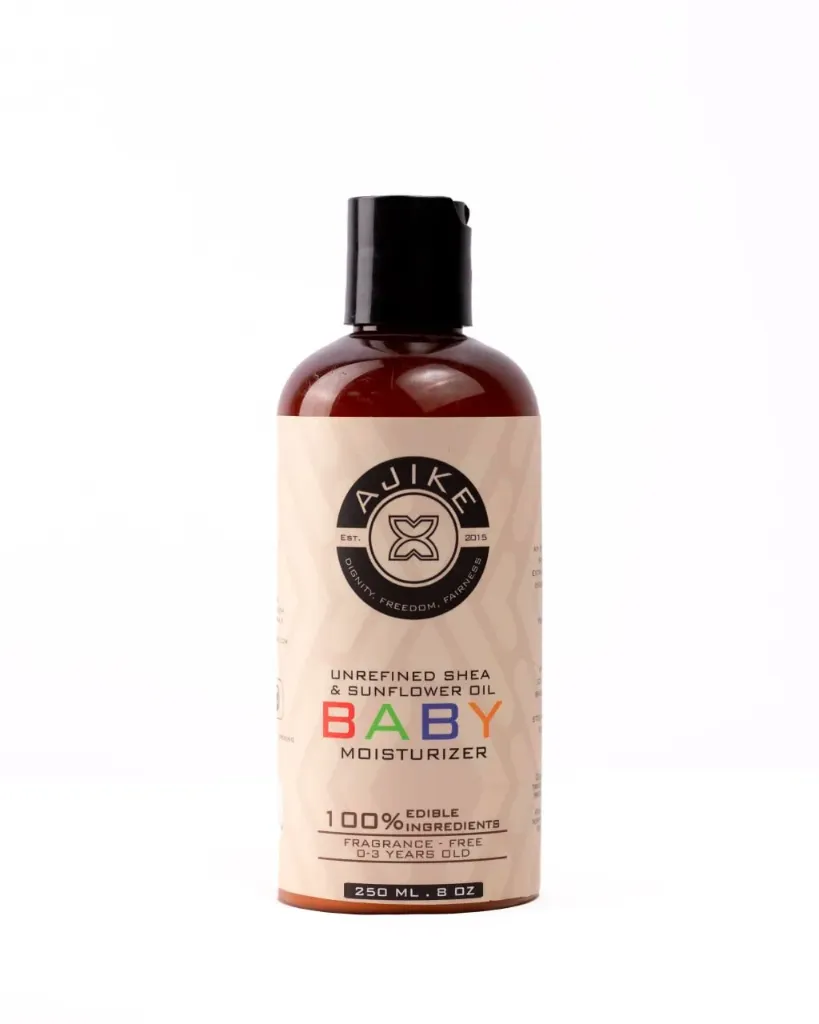
Gentle Moisture For Baby Eczema-Prone Skin
Unrefined Shea & Sunflower Oil Baby Moisturizer
Fragrance-free and preservative-free moisturiser made with edible-grade shea butter, sunflower, argan, jojoba, coconut and baobab oils.
View Product
Gentle Moisture For Baby Eczema-Prone Skin
Unrefined Shea & Sunflower Oil Baby Moisturizer
Fragrance-free and preservative-free moisturiser made with edible-grade shea butter, sunflower, argan, jojoba, coconut and baobab oils.
View ProductAjike Raw Shea Lotion: For Daily Maintenance Between Flares
For daily maintenance use between flares, particularly on large body areas, the Raw Shea Lotion provides the moisturising benefits of raw shea butter in a lighter, easier-to-apply formulation. It is more practical for covering large areas of the body quickly and is appropriate for everyday maintenance when intensive barrier repair from pure shea butter is not required.
Lightweight Moisture For Dry, Sensitive Skin
Raw Shea Lotion
A deeply moisturising lotion made with raw shea butter and plant-derived ingredients for daily care between flare-ups.
View Product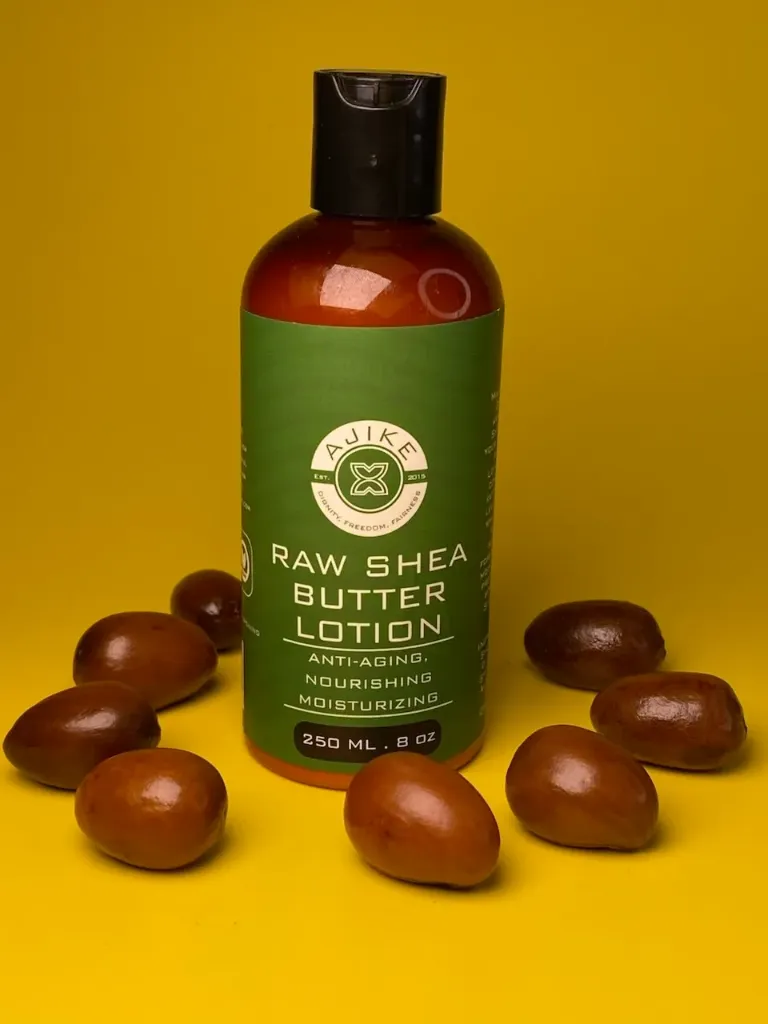
Lightweight Moisture For Dry, Sensitive Skin
Raw Shea Lotion
A deeply moisturising lotion made with raw shea butter and plant-derived ingredients for daily care between flare-ups.
View Product
Ajike Shea Butter: Wild Harvested in Ghana, Made for Real Skin
Why Wild Harvested Matters for Eczema Skin Specifically
Wild harvested shea trees in the savannah belt of northern Ghana draw nutrients from decades of growth in their natural environment. This nutrient-rich growing environment produces shea butter with a higher concentration of the unsaponifiable compounds, including the triterpenes and phytosterols, compared to shea from younger, cultivated trees in degraded soils.
For eczema skin, where these specific compounds are the most therapeutically relevant components of the shea butter, the quality of the source directly affects the quality of the outcome.
Completely Unrefined: Every Anti-Inflammatory Compound Intact
Our shea butter is processed using traditional water-based methods by producers in northern Ghana. No hexane extraction, no bleaching, no high-temperature deodorisation. The result is a shea butter where the triterpenes, phytosterols, and tocopherols in the unsaponifiable fraction are present at their natural concentrations. For eczema management, this is the version that works.
Trusted Across Generations of West African Families
Shea butter has been applied to eczema-affected and sensitive skin across West Africa for generations. Long before modern dermatology named and characterised atopic dermatitis, communities in Ghana, Burkina Faso, Mali, and Nigeria were using raw shea butter to manage exactly the symptoms we now associate with eczema: chronic dryness, itching, inflamed patches, and barrier fragility. This is not anecdotal. It is centuries of observed, practical knowledge.
No Additives, No Fillers, Nothing That Does Not Belong
Our ivory shea butter contains one ingredient: raw unrefined shea butter. Nothing else. No vitamin E added to compensate for what refining removed. No fragrance. No preservatives. No mineral oil to bulk out the formulation. For eczema-prone skin that reacts to unknown additives in products, knowing exactly what is in what you are applying matters.
Frequently Asked Questions
Yes. Raw unrefined shea butter provides emollient support for the eczema skin barrier, anti-inflammatory action from the triterpenes and phytosterols in the unsaponifiable fraction, and ceramide-supporting compounds that contribute to barrier repair. Used consistently twice daily on slightly damp skin, it produces meaningful improvement in skin comfort and barrier integrity over weeks to months of regular use. Results may vary depending on skin type.
No. Eczema is a chronic condition with genetic and immune components that no topical product can cure. Raw shea butter can significantly improve eczema management by supporting the skin barrier, reducing inflammation, and decreasing flare frequency with consistent use. It is a management tool, not a cure.
It depends on the severity and location. For intensive treatment of active eczema patches, raw shea butter is the more potent option because it provides the highest concentration of the anti-inflammatory unsaponifiable compounds. For daily maintenance across large body areas, a shea butter cream such as our Eczema Cream or Raw Shea Lotion is more practical. Many people use both: raw shea butter on specific active patches and the lotion or cream on the broader skin surface.
Most people notice improved skin comfort within the first 2 weeks of twice-daily application. Visible improvement in eczema patches typically becomes apparent by weeks 3 to 4. Meaningful reduction in flare frequency usually develops over month 2 and beyond. The timeline varies depending on eczema severity, skin type, and consistency of application. Results may vary depending on skin type.
Yes. During a flare, increase the frequency of shea butter application on affected areas and use it after every cleanse. For very severe flares with open, weeping, or crusting skin, apply to the surrounding skin rather than directly to broken skin until the open areas have closed. Discontinue use and consult a healthcare provider if the flare worsens significantly after applying shea butter.
Yes, Ajike raw unrefined shea butter with no additives is appropriate for baby eczema skin. Always patch test before first full use. Be aware of any family history of tree nut allergy, as shea is a tree nut derivative. Consult a paediatric healthcare provider before using on a baby with severe eczema or if you have any concerns. Discontinue use if irritation occurs.
Start writing here...
Our latest content
Check out what's new in our company !