
Start writing here...
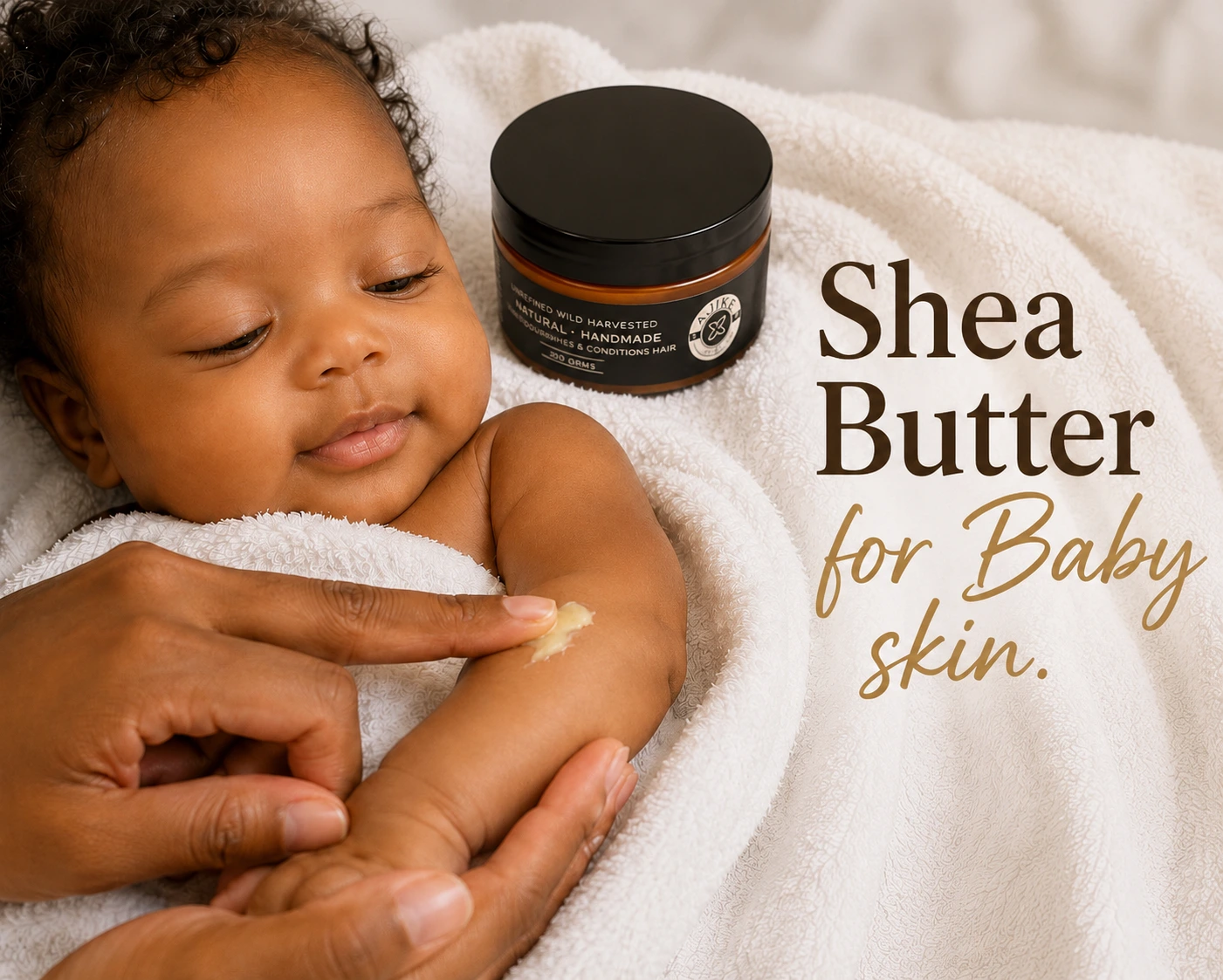
When you have a newborn or young baby, every product decision feels significant. The skin in front of you is the most delicate you will ever care for, and the question of what is safe, what actually helps, and what to avoid is one that every new parent navigates with a mixture of research and instinct.
Shea butter has been used on baby skin across West Africa for generations. Not as a trend or a modern natural beauty movement, but as a daily, practical staple that has been trusted by communities in Ghana, Nigeria, and across the Sahel region for as long as shea trees have been producing nuts. This is not marketing language. It is the honest background of an ingredient with centuries of use on some of the youngest, most sensitive skin in the world.
This guide explains why baby skin is different, whether raw shea butter is genuinely safe for newborns and infants, how to use it correctly for different conditions, and what to avoid mixing with it on baby skin.
Read Also: Full shea butter science: What Is Raw Unrefined Shea Butter?
Why Baby Skin Is Not Just Smaller Adult Skin
The Structural Differences in Newborn and Infant Skin
A newborn's skin is structurally distinct from adult skin in several important ways. The stratum corneum, the outermost protective layer of the epidermis, is thinner in newborns than in adults. The skin cells are smaller. The cell turnover rate is faster. The ratio of skin surface area to body weight is significantly higher than in adults, which affects how much of any topically applied ingredient can be absorbed systemically.
At birth, the skin is covered in vernix caseosa, a white waxy protective coating produced by the sebaceous glands in utero. Vernix has natural antimicrobial properties and serves as the baby's first skin barrier protection. Most maternity guidance now recommends leaving vernix on the skin for as long as possible after birth rather than immediately washing it off, precisely because it provides natural protection during the period when the skin's own barrier is at its most immature.
Why Baby Skin Loses Moisture Faster Than Adult Skin
Transepidermal water loss (TEWL) is higher in newborns and young infants than in older children or adults. The thinner stratum corneum and the still-developing lipid barrier means that water evaporates through the skin surface more rapidly. This is why baby skin can become dry quickly even in relatively humid environments, and why moisturising after every bath is not optional but essential for maintaining baby skin health.
The situation improves progressively over the first year as the skin barrier matures. By around 12 months, infant skin barrier function is significantly closer to adult function, though it remains more sensitive than adult skin through early childhood.
The Developing Skin Barrier in the First Year of Life
The skin barrier develops rapidly but progressively over the first year. At birth, the skin's acid mantle, the thin acidic film on the skin surface that protects against microbial colonisation and supports barrier enzyme activity, has a relatively high (less acidic) pH in full-term newborns that gradually decreases toward the healthy adult range of 4.5 to 5.5 over the first weeks and months of life.
Premature babies have an even less mature skin barrier and acid mantle than full-term newborns, making appropriate skincare choices even more important for premature infants. Any product that disrupts the acid mantle or compromises the barrier in a full-term newborn will have a more significant effect on a premature baby.
Why Ingredients That Are Fine for Adults Can Be Too Much for Babies
Because of the higher surface-area-to-weight ratio, the thinner skin, and the higher TEWL, the effective dose of any topically applied ingredient is proportionally higher for a baby than for an adult applying the same amount. An essential oil at a concentration that is safe for adult skin can be inappropriately high for infant skin. A preservative that is well tolerated by adult skin may be a sensitiser for immature infant skin.
This is the core reason why baby-specific products use different ingredient standards from adult products, and why the simplest, purest ingredients are always the safest starting point for baby skincare.
Is Raw Shea Butter Safe for Babies and Newborns?
What Makes Raw Shea Butter Suitable for Infant Skin
Raw unrefined shea butter with no additives is one of the most appropriate natural moisturisers for baby skin. Its composition is entirely plant-derived, containing only the fatty acids, vitamins, and unsaponifiable compounds naturally present in the shea kernel. It contains no synthetic fragrances, no preservatives, no emulsifiers, no stabilisers, and no mineral oil.
The fatty acid profile of shea butter, rich in oleic and stearic acid with ceramide-supporting linoleic acid, mirrors the types of lipids the skin itself uses to build and maintain the barrier. For developing infant skin that is still establishing its own barrier integrity, supporting this process with structurally compatible lipids is a sensible approach.
Is Raw Shea Butter Safe for Newborns Specifically
Yes. Raw unrefined shea butter with no additives has been used on newborn skin in West Africa for generations without documented adverse effects in the general population. In communities where shea butter is a traditional part of newborn care, it is applied from the first days of life.
The main precaution to be aware of is the potential for nut allergy sensitisation. Shea butter is derived from the shea tree, which is classified as a tree nut. While shea butter allergy is rare and shea is considered a low-allergen tree nut, any baby with a family history of tree nut allergy should be assessed by a paediatric healthcare provider before shea butter is applied to the skin.
The Edible Grade Standard: Why It Matters for Baby Products
Ajike uses edible-grade plant ingredients in our baby range. This is not a casual claim. Edible-grade means the ingredients meet the safety standards required for human consumption, not just for topical cosmetic use. The standards for what can be eaten are considerably stricter than the standards for what can be applied to skin in a cosmetic product.
For baby skin, where anything applied topically can be absorbed systemically at a higher rate than adult skin, and where babies also have direct mouth contact with their skin through sucking and chewing on hands and feet, the edible-grade standard provides a meaningful additional safety margin.
Are There Any Babies Who Should Not Use Shea Butter
Most babies can use raw unrefined shea butter safely. The exceptions to consider are: babies with confirmed or suspected tree nut allergy or a strong family history of tree nut allergy, babies with very reactive skin that has shown adverse reactions to multiple natural ingredients, and premature babies whose skin barrier is particularly immature. For any of these situations, consult a paediatric dermatologist or healthcare provider before introducing shea butter.
What to Do If Your Baby Has a Nut Allergy
Shea butter is derived from the shea tree (Vitellaria paradoxa), which is classified as a tree nut. However, shea nut allergy specifically is quite rare because the proteins responsible for tree nut allergies are generally not present or are present in very low concentrations in shea butter compared to other tree nuts like peanuts, almonds, or cashews.
That said, if your baby has a confirmed or suspected nut allergy, the conservative approach is to avoid shea butter until you have been able to discuss it with your baby's healthcare team. A skin prick test or guided introduction under medical supervision is the appropriate route rather than applying it at home without medical guidance.
Always Patch Test: Even on healthy babies with no nut allergy history, patch test raw shea butter on the inner forearm before first full body application. Apply a small amount, leave for 24 to 48 hours, and check for any redness, rash, or increased irritation before using it more broadly.
Shea Butter for Baby Dry Skin
What Causes Dry Skin in Babies and Newborns
Newborn skin that looks dry and peeling in the first weeks of life is almost universally normal and temporary. After birth, the outer layer of the skin that was protected by amniotic fluid adjusts to the dry air environment, and surface peeling is a natural part of this transition. In full-term newborns, this resolves on its own within the first two weeks without any treatment needed.
Ongoing dry skin in babies beyond the newborn period can be caused by bathing too frequently or for too long, using bath products that are too stripping for delicate infant skin, low indoor humidity in winter months, and in some cases, the early presentation of atopic dermatitis.
How Shea Butter Addresses Baby Dry Skin
Raw shea butter addresses baby dry skin through its emollient and occlusive properties. The oleic acid content penetrates the upper layers of the stratum corneum and provides direct moisturisation to the skin cells. The stearic acid provides surface emolliency. The occlusive layer that forms at the skin surface reduces TEWL, which is the primary cause of dryness in infant skin. Applied consistently after every bath while the skin is still slightly damp, raw shea butter provides effective daily moisturisation for dry baby skin.
Where Baby Dry Skin Appears Most Often
The areas most commonly affected by dryness in babies are the shins and lower legs (these areas have the lowest density of sebaceous glands), the ankles and feet, the backs of the hands and the knuckles, the cheeks (particularly in winter with cold air exposure), and around the mouth from drool and sucking. These areas benefit most from consistent shea butter application after bathing and as needed throughout the day.
How Long Before You See Improvement
For simple dry skin without an underlying condition, consistent twice-daily raw shea butter application typically produces visible improvement within 3 to 5 days. The skin softens and the visible dry, flaking surface smooths as the moisture balance is restored. If dryness persists or worsens after a week of consistent application, consider whether the bathing routine needs adjustment, whether the environment is particularly dry, or whether the dryness may be the beginning of eczema rather than simple dry skin.
Shea Butter for Baby Eczema
Why Babies Get Eczema and How It Presents
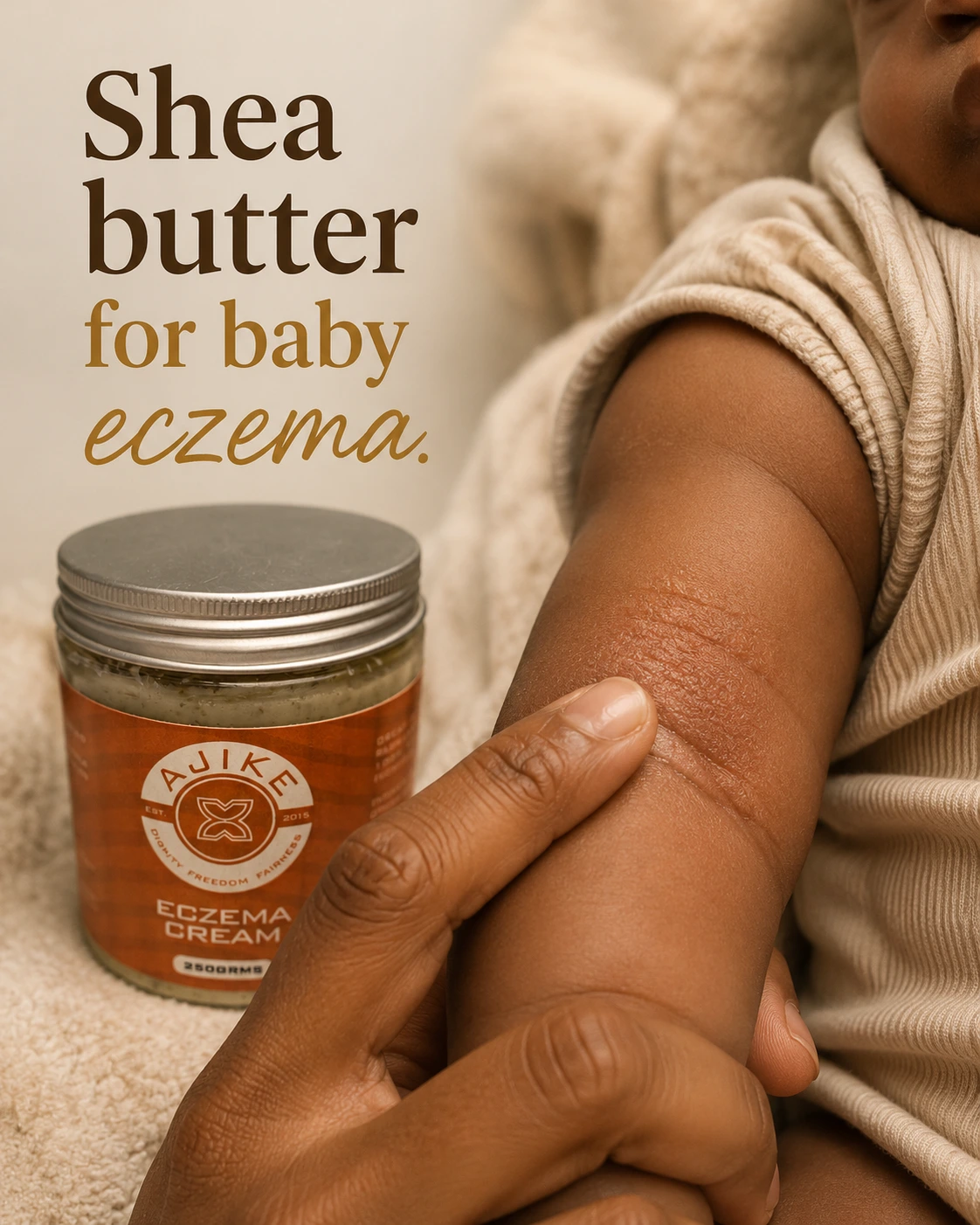
Eczema, or atopic dermatitis, affects approximately 10 to 20 percent of infants in developed countries. It most commonly first appears between 2 and 6 months of age. In babies, eczema typically presents on the cheeks, forehead, and scalp first, often spreading to the neck, wrists, and the fronts of the elbows and knees as the baby becomes mobile.
Baby eczema looks different from adult eczema. In infants, the affected skin is often weeping and crusting rather than simply dry and thickened. The itching is intense and babies will scratch or rub affected areas against bedding or the caregiver. On dark-skinned babies, eczema may present as grey, violet, or hyperpigmented patches rather than the red patches typical of lighter-skinned presentations, which can delay diagnosis.
How Shea Butter Helps Eczema-Prone Baby Skin
Raw shea butter provides three of the most important things that eczema-prone baby skin needs simultaneously: emollient barrier support from the fatty acid profile, ceramide-adjacent lipid replenishment from the linoleic acid and phytosterols, and anti-inflammatory support from the triterpenes in the unsaponifiable fraction.
For a baby whose skin barrier is both developmentally immature and further compromised by atopic dermatitis, consistent application of raw shea butter provides the lipid building blocks for barrier reconstruction and the anti-inflammatory compounds that help modulate the chronic immune activation of eczema.
Using Shea Butter During an Eczema Flare vs Between Flares
During a flare: apply shea butter more frequently to affected areas. After every nappy change on body eczema. After every feed clean-up for facial eczema. Generously to active patches but avoiding open, weeping, or actively infected skin where the barrier is completely broken.
Between flares: this is when the routine matters most. Twice daily application during clear periods builds the barrier resilience that reduces the frequency and severity of future flares. Many parents relax their moisturising routine when the baby's skin looks clear. This is the opposite of what the skin needs. The clear period is when barrier building happens.
Combining Shea Butter with Prescribed Eczema Treatment
Many babies with moderate to severe eczema are prescribed topical corticosteroids or other medical treatments for flare management. Raw shea butter is compatible with these prescribed treatments as a moisturising layer applied before or between applications of the prescribed treatment.
A common protocol used in paediatric dermatology is: cleanse with a gentle fragrance-free wash, apply any prescribed medical treatment to active patches, then apply an emollient moisturiser over the broader skin area. Ajike raw shea butter and our Eczema Cream are suitable as the emollient layer in this protocol.
When to See a Doctor Rather Than Treat at Home
Always see a healthcare provider if: the eczema is severe and covering large areas of the body, the skin is weeping, crusting, or showing signs of infection (increased redness, warmth, yellow crusting, or the baby is unusually distressed), the eczema is not improving after two to three weeks of consistent moisturising, the baby is not sleeping because of itching, or you are concerned about the diagnosis.
Raw shea butter and natural moisturisers are appropriate for mild eczema management and as part of the routine alongside prescribed treatment. They are not a substitute for medical evaluation and treatment when eczema is severe.
Read Also: Full eczema guide: Shea Butter for Eczema - How to Use It and What to Expect
Shea Butter for Baby Rash
Different Types of Baby Rash and What Causes Them
Baby rash is a broad term that covers a range of different conditions with different causes and requiring different management. The most common include diaper rash (irritant contact dermatitis from prolonged contact with urine and stool), heat rash (miliaria from blocked sweat glands), cradle cap (seborrhoeic dermatitis of the scalp), newborn milia (small white spots from blocked sebaceous glands), and erythema toxicum neonatorum (a common harmless newborn rash that resolves on its own).
Before applying any treatment, it is helpful to identify which type of rash you are dealing with, as the appropriate approach differs between them.
Diaper Rash: Can Shea Butter Help?
Diaper rash is caused by prolonged contact of the skin with the urine and stool in nappies. The combination of moisture, ammonia from urine, and digestive enzymes from stool irritates the skin barrier. Prevention is more effective than treatment: frequent nappy changes, allowing airy time without nappies where possible, and using a barrier cream at each nappy change.
Raw shea butter can be used as part of a diaper area barrier routine. Applied to clean, dry skin at each nappy change, its occlusive properties create a breathable barrier between the skin and the nappy contents. For mild diaper rash, shea butter combined with our Baby Diaper Ointment provides both the barrier protection and the soothing properties needed for recovery.
Heat Rash: Is Shea Butter Appropriate?
Heat rash (miliaria) occurs when sweat glands become blocked and sweat cannot reach the skin surface, creating small red or clear bumps, typically on the neck, chest, back, and skin folds. The treatment for heat rash is cooling and reducing sweating: move the baby to a cooler environment, avoid over-bundling, and use loose, breathable clothing.
Applying shea butter, or any occlusive moisturiser, to active heat rash is generally not recommended because the occlusive properties can further block the sweat glands and worsen the condition. For heat rash, allow the skin to cool and breathe. Resume shea butter use once the heat rash has resolved.
Cradle Cap: Shea Butter on the Scalp
Cradle cap, or infantile seborrhoeic dermatitis, appears as yellowish, greasy-looking scales on the baby's scalp. It is caused by overactive sebaceous glands and is very common in the first weeks and months of life. It is not caused by poor hygiene and is not contagious. It usually resolves on its own by 6 to 12 months.
Applying a small amount of raw shea butter or our yellow shea butter to the scalp, leaving it for 15 to 20 minutes, and then gently loosening the scales with a soft baby brush before washing with a gentle baby shampoo is a traditional approach to managing cradle cap that many parents find effective. The oils soften the scales, making removal gentler and less likely to cause skin trauma.
When Shea Butter Is Not the Right Answer for a Rash
Shea butter is not appropriate for any rash that involves open, broken, or actively infected skin. It is not appropriate for heat rash, as discussed above. It is not appropriate for viral rashes such as chickenpox or roseola, where the skin condition requires medical management rather than moisturisation. And it is not appropriate for any rash that you cannot identify, until you have had the rash assessed by a healthcare provider.
When in doubt about any rash on a baby, particularly in the first three months of life, consult a healthcare provider before applying any treatment.
Unrefined Shea Butter for Infant Skin: Why the Grade Matters
What Happens to Shea Butter When It Is Refined
Refined shea butter undergoes industrial processing that includes solvent extraction (often with hexane), bleaching with chemical agents or activated clay, and high-temperature steam deodorisation. Each step is designed to produce a whiter, more uniform, odourless product that is easier to use in commercial cosmetic formulations.
For baby skin, the concerning aspect of this process is not just what is removed, though the loss of the anti-inflammatory unsaponifiable fraction is significant, but also the potential for trace residues of the processing chemicals to remain in the finished product. Regulatory limits for these residues are set with adult skin in mind, not infant skin with its higher absorption rate.
Why Refined Shea Butter Is Not Suitable for Baby Skin
For adults, refined shea butter is simply a less effective product. For babies, the reduced therapeutic value combined with the potential for trace processing chemical residues makes raw unrefined shea butter the clearly preferable choice. The anti-inflammatory and barrier-supporting properties of the unsaponifiable fraction are particularly valuable for the developing infant skin barrier, and these are the compounds most affected by refining.
When choosing shea butter for a baby, raw and unrefined is the only appropriate grade. The bright white, odourless, perfectly smooth product in many commercial baby products is almost certainly refined.
How to Identify Genuine Unrefined Shea Butter
The identifying characteristics of genuine raw unrefined shea butter are consistent: an ivory to pale cream colour, never bright white; a mild, earthy, nutty scent; a slightly grainy texture at room temperature that softens and melts completely when warmed between adult palms; and natural variation between batches. Bright white, odourless, and perfectly smooth means refined.
Ivory vs Yellow Shea Butter for Babies: Which to Choose
For babies, ivory shea butter is the correct choice. It is the purest option with no additions beyond the shea itself. Our yellow shea butter, while natural and beneficial, contains wild-harvested burututu root, an additional plant compound that, while not harmful, has not been specifically studied for use on infant skin and introduces an unnecessary complexity for the simplest, most sensitive skin type you will encounter.
Keep it simple for babies. Ivory shea butter. Nothing added.
How to Use Shea Butter on Baby Skin: Step by Step
Step 1: Always Patch Test First, Even on Babies
Before applying raw shea butter to a baby's full body for the first time, patch test on the inner forearm. Apply a small amount of lather or the smallest amount of shea butter to the inner forearm, leave for 24 hours, and check for any redness, raised rash, or increased irritation in that area before proceeding. This is not excessive caution. Infant skin can surprise you, and identifying a reaction in a small area before it happens over the full body is practical parenting.
Step 2: Warm the Shea Butter Properly Before Applying
Take a very small amount of raw shea butter and warm it between clean adult palms until it melts completely to a smooth oil. The temperature of your palms is enough to do this in 10 to 15 seconds. Apply the melted oil to baby skin, never semi-solid shea butter directly from the jar. Cold, semi-solid shea butter applied directly to baby skin can be uncomfortable and does not distribute or absorb evenly.
Step 3: Apply After Bath While Skin Is Still Slightly Damp
The three-minute window after bathing is as important for babies as it is for adults. Pat the baby dry with a soft towel, leaving the skin slightly damp, and apply the warmed shea butter immediately. The slightly damp skin helps distribute the shea butter evenly and seals in the surface moisture, providing more effective and longer-lasting hydration than application to completely dry skin.
Baby baths should be short, under ten minutes, and use lukewarm water. Long baths or hot water increase TEWL after bathing and reduce the effectiveness of any post-bath moisturiser.
Step 4: Use Gentle Circular Motions, Especially on Dry Patches
Apply the melted shea butter using gentle, circular massaging motions. This application method has two benefits: it distributes the product evenly, and the gentle massage stimulates the baby's circulation and tactile nervous system in a way that is beneficial for development. For areas of dry skin or eczema patches, spend slightly more time in gentle circular motions to ensure good coverage.
Never press or rub hard on infant skin. The goal is light, even coverage with minimal pressure.
Step 5: Pay Attention to Problem Areas Without Over-Applying
Focus additional attention on the areas where the baby's skin is driest or most affected: typically the shins, ankles, cheeks, and skin folds. Apply a slightly more generous amount to these areas. But resist the temptation to pile on product. Even for dry baby skin, a thin, even layer of shea butter that is absorbed effectively is better than a thick layer that sits on the surface.
Step 6: Let It Absorb Before Dressing Your Baby
Give the shea butter two to three minutes to begin absorbing before putting clothing on over it. This reduces the amount transferred to the clothing, gives the initial absorption time to begin, and prevents the fabric from creating friction against a freshly oiled skin surface that could be uncomfortable.
How Much Shea Butter to Use on a Baby
Newborns: How Much Is Enough
For a newborn, the amount required is genuinely tiny. A piece of raw shea butter no larger than a single large dried pea, melted in adult palms, is sufficient for a full newborn body moisturisation after bathing. The newborn body surface area is small, and the thin newborn skin absorbs efficiently. Using more than this amount means excess product that cannot be absorbed and simply sits on the surface.
For the face specifically, warm a barely visible amount between adult fingertips and press very gently to the baby's cheeks, forehead, and chin if those areas are dry.
Infants 3 to 12 Months: Adjusting the Amount
As the baby grows, the surface area increases and the amount of shea butter needed increases proportionally. By three months, a hazelnut-sized amount for the full body is appropriate. By six months, an almond-sized amount. By twelve months, approximately the size of a small grape for the full body.
These are starting points, not fixed rules. If the skin looks well-moisturised and there is no dry residue on the skin after a few minutes, the amount is correct. If areas of skin look dry shortly after application, increase slightly.
Toddlers: When to Move to a Lighter Application
By 12 to 18 months, as the skin barrier matures, many toddlers do well with a lighter moisturiser for daily use, reserving the raw shea butter for dry patches, eczema-prone areas, and overnight intensive use when needed. Our Raw Shea Lotion can replace pure raw shea butter for daily full-body toddler moisturisation while keeping the shea butter itself for targeted or intensive use.
The Most Common Mistake: Using Too Much
The most consistent error parents make when using shea butter on babies is using too much. The baby's skin looks dry, so the instinct is to apply more. More shea butter does not mean more moisturisation if the skin cannot absorb what is already there. It means more product sitting on the surface, transferring to clothing and bedding, and potentially contributing to congestion in baby skin folds.
Start with the small amounts described above. If the baby's skin is still dry after consistent twice-daily use of the correct amount, the issue is more likely application technique (dry skin rather than damp, not warming the butter first) than insufficient product volume.
How Often to Apply Shea Butter on Baby Skin
After Every Bath: The Most Important Application
The post-bath application is non-negotiable for babies with any degree of dry skin or eczema. Bathing, even with the gentlest products, temporarily disrupts the baby's skin barrier and increases TEWL. Applying raw shea butter immediately while the skin is still slightly damp counteracts this disruption and restores the barrier effectively.
If you bathe your baby daily, apply shea butter daily after the bath. If you bathe every other day, apply shea butter on non-bath days as well, to the driest areas at minimum.
Mid-Day Reapplication: When and Why
For babies with eczema, very dry skin, or in winter when indoor air is particularly dry, a mid-day reapplication to the driest areas is beneficial. This does not need to be a full body application. Focus on the areas that dry out fastest: the shins, cheeks, and any active eczema patches. A very small amount of shea butter warmed between adult fingers and pressed to these areas takes less than two minutes and meaningfully extends the moisturising protection through the day.
During a Dry Skin or Eczema Flare: Increased Frequency
During a dry skin episode or an eczema flare, increase application frequency. After every bath, after every nappy change for body eczema patches, and a mid-day application to active patches. The more frequently the barrier is supported during a flare, the shorter and less severe the flare tends to be. Reapplication every two to four hours on actively affected patches during a severe flare is not excessive.
What Over-Application Looks Like and Why to Avoid It
Signs of over-application include a greasy appearance on the skin that does not clear within a few minutes, product residue visible on clothing and bedding, and in the case of skin folds, product accumulation that creates warmth and moisture in the fold that can actually contribute to irritation. Skin folds in babies, the neck creases, elbow and knee creases, and groin folds, need shea butter applied in the fold area but in very thin amounts, spread carefully to ensure coverage without accumulation.
What Not to Mix with Shea Butter on Baby Skin
Synthetic Fragrances: The Biggest Risk
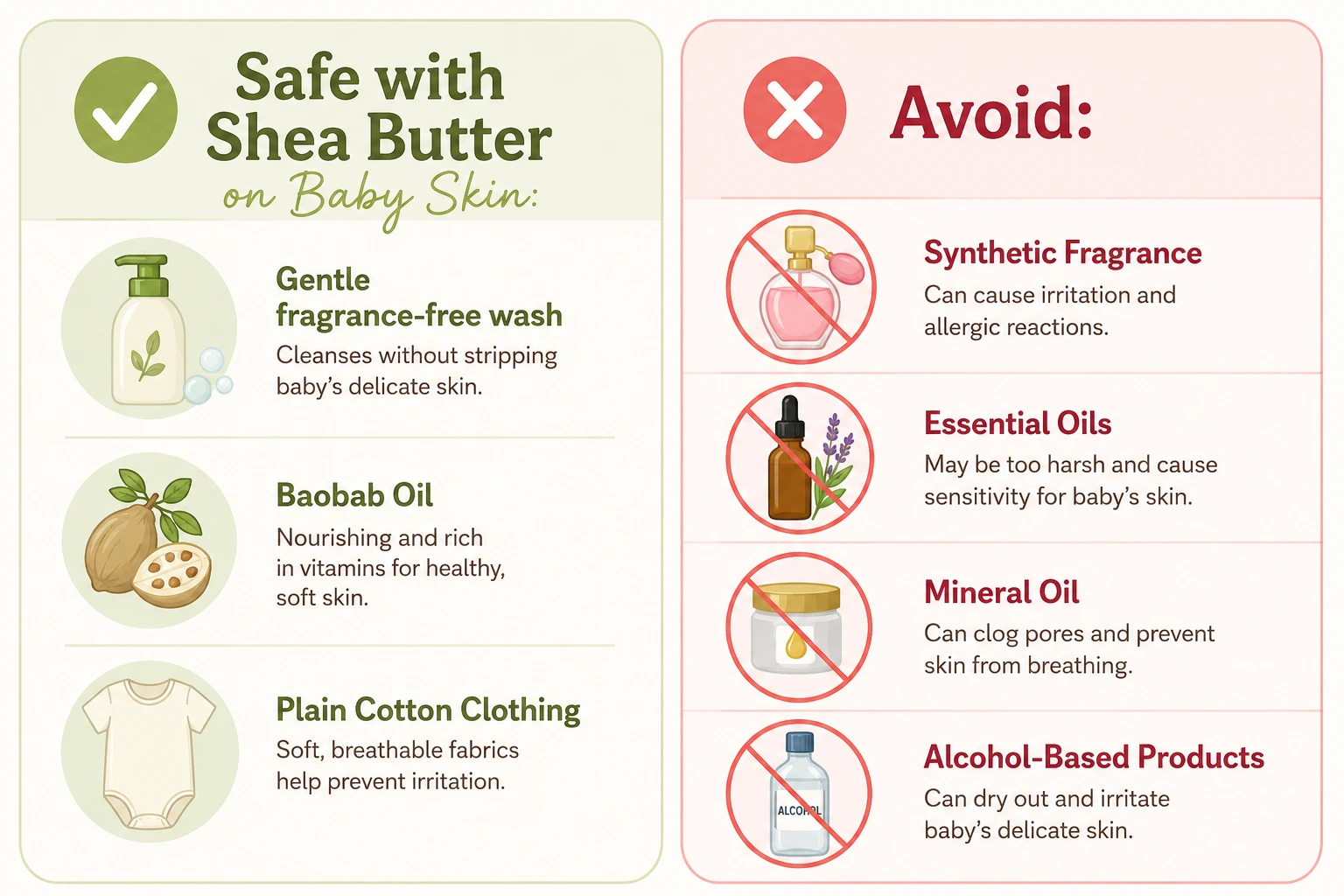
Synthetic fragrances are among the most common causes of contact sensitisation in infant skin. What begins as an exposure in early infancy can develop into a persistent fragrance allergy that affects the individual throughout their life. For baby skincare products used alongside or combined with shea butter, fragrance-free is not just a preference. For baby skin, it should be the baseline requirement.
Check every product in your baby's routine: bath wash, any body lotion used alongside the shea butter, any laundry detergent used for baby clothing and bedding. Fragrance in the laundry detergent can transfer to the skin from clothing and cause reactions that are then mistakenly attributed to the skincare products.
Essential Oils: Not Safe for Young Babies
Essential oils, even those commonly considered mild such as lavender, chamomile, or tea tree, are not appropriate for use on babies under three months of age and should be used with significant caution on babies under 12 months. Essential oils are highly concentrated plant compounds. The phytochemicals that give them their properties are present at concentrations far above what is found in any whole plant ingredient.
The higher skin permeability of infant skin, combined with the higher surface-area-to-weight ratio, means that topically applied essential oils can reach systemic concentrations in babies that would be negligible in adults. Certain essential oils have documented adverse effects on infants, including camphor (toxicity risk), menthol (respiratory effects in babies), and some citrus oils (photosensitisation). Keep essential oils away from baby skin entirely for the first year, and introduce with extreme caution and at very low dilutions after that.
Mineral Oil and Petroleum-Based Products
Mineral oil (also listed as paraffinum liquidum, petrolatum, or petroleum jelly) is commonly used in baby products as an occlusive moisturiser. It is inert and non-irritating. However, it is also completely non-functional beyond simple occlusion. It provides no vitamins, no anti-inflammatory compounds, no ceramide support. For normal dry skin management in a healthy baby, mineral oil is an option. For eczema-prone skin or a baby whose barrier needs active support rather than just surface occlusion, raw shea butter provides meaningful advantages that mineral oil cannot.
Avoid products that combine shea butter and mineral oil, as the mineral oil adds no benefit and its occlusive heaviness combined with shea butter creates a more congesting product than shea butter alone.
Products with Alcohol: Why They Undo Everything Shea Butter Does
Denatured alcohol (alcohol denat.), isopropyl alcohol, and ethanol are drying, barrier-disrupting ingredients that have no place in baby skincare. They are sometimes present in baby wipes, in certain baby skin treatments, and in hand sanitisers. Applied to baby skin before or alongside shea butter, they disrupt the skin barrier and increase TEWL, directly counteracting the barrier support that the shea butter provides.
For the diaper area and general baby skin cleaning between baths, use fragrance-free, alcohol-free baby wipes or simply warm water and a soft cloth.
What Is Safe to Use Alongside Shea Butter on Baby Skin
- Gentle, fragrance-free, sulfate-free baby wash and shampoo — Ajike Shea Baobab Baby Hair and Body Wash
- Plain baobab oil - lightweight, non-comedogenic, vitamin-rich. Safe for baby skin as an alternative or addition to shea butter
- Unfragranced baby lotion using natural plant ingredients — Ajike Baby Moisturiser
- Fragrance-free, alcohol-free baby wipes for between-bath cleaning
- Unbleached, undyed cotton clothing and bedding that minimises skin irritant exposure
Ajike Products for Baby Skin Using Shea Butter
Ajike Raw Unrefined Shea Butter: The Purest Option
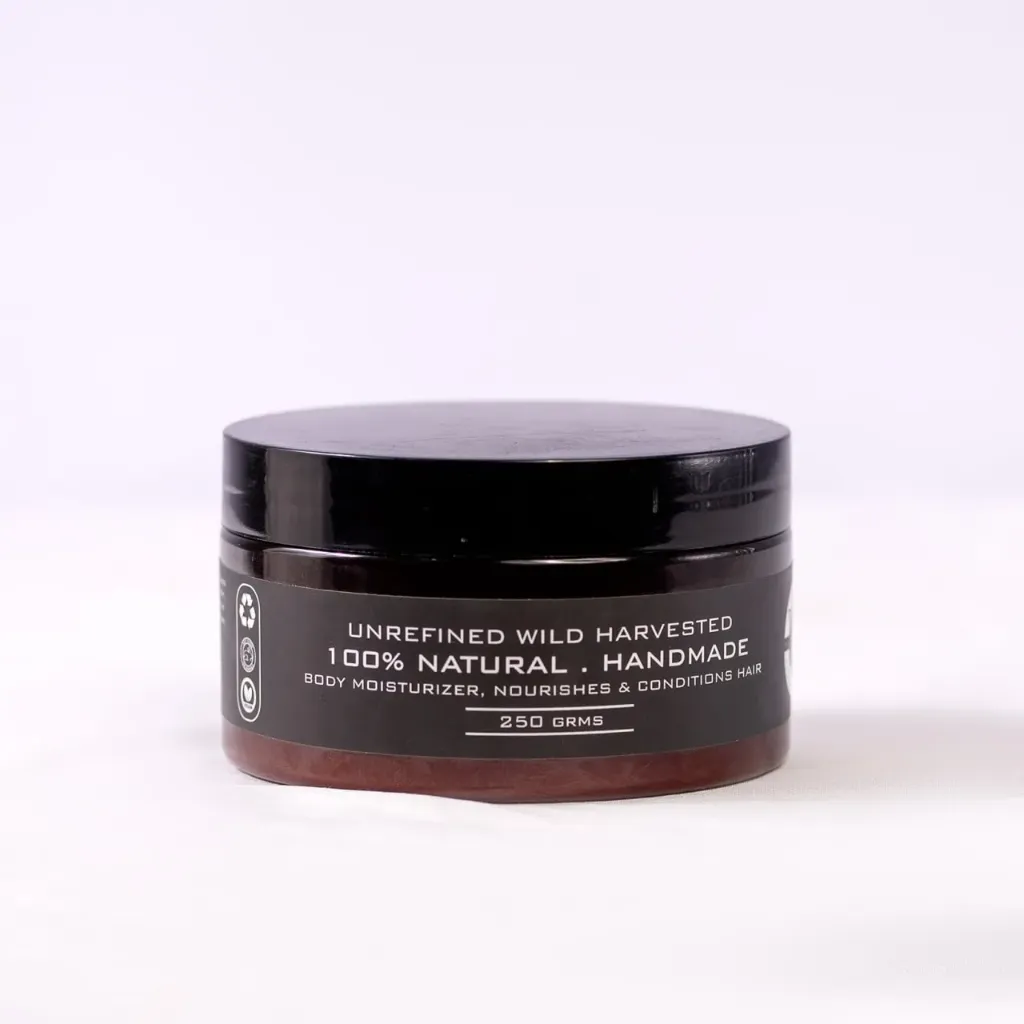
Our ivory raw unrefined shea butter with no additions is the simplest, purest shea butter option for baby skin. One ingredient, wild harvested in Ghana, traditionally processed, completely unrefined. For parents who want the most straightforward option for baby moisturisation after bathing, this is it.
Gentle Natural Moisture From Birth
Raw Unrefined Shea Butter Ivory
Wild harvested, pure and unrefined shea butter with no additives. A simple one-ingredient moisturiser suitable from birth after patch testing.
View Product
Gentle Natural Moisture From Birth
Raw Unrefined Shea Butter Ivory
Wild harvested, pure and unrefined shea butter with no additives. A simple one-ingredient moisturiser suitable from birth after patch testing.
View ProductAjike Baby Moisturiser: Formulated with Edible Grade Ingredients
Our Baby Moisturiser is specifically formulated for infant and baby skin using edible-grade plant ingredients: shea butter, sunflower oil, argan oil, jojoba oil, coconut oil, and baobab oil. Completely fragrance-free and preservative-free. The lotion format makes it easier to apply quickly during nappy changes and for daily full-body use than pure raw shea butter, which requires warming first.
Ultra-Gentle Daily Moisture For Baby Skin
Unrefined Shea & Sunflower Oil Baby Moisturizer
Fragrance-free and preservative-free lotion made with edible-grade shea butter, sunflower, argan, jojoba, coconut and baobab oils.
View Product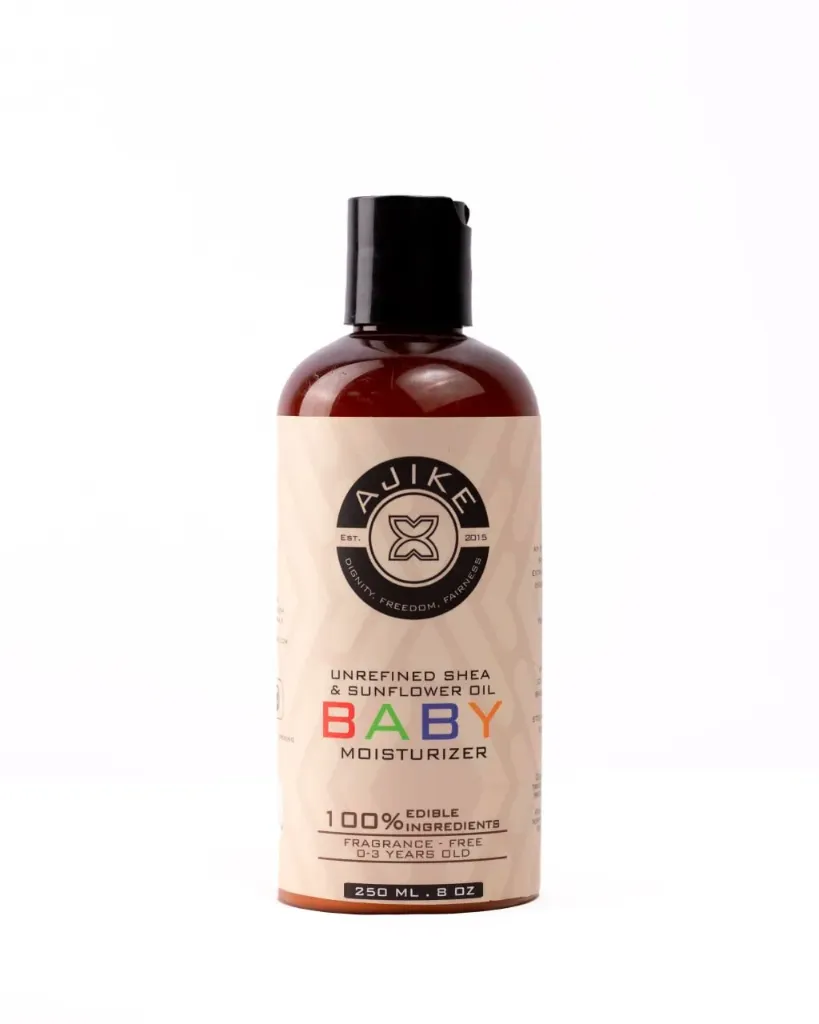
Ultra-Gentle Daily Moisture For Baby Skin
Unrefined Shea & Sunflower Oil Baby Moisturizer
Fragrance-free and preservative-free lotion made with edible-grade shea butter, sunflower, argan, jojoba, coconut and baobab oils.
View Product
Ajike Baby Body Butter: For Very Dry Baby Skin
For babies with particularly dry skin or mild eczema, our Baby Body Butter provides the intensive moisturisation of a butter format with the gentleness of our edible-grade formulation. Richer than the baby lotion, it is appropriate for overnight use on very dry patches or for intensive barrier support during a dry skin episode.
Ajike Baby Diaper Ointment: For Diaper Rash and Barrier Protection
Our Baby Diaper Ointment is formulated specifically for the diaper area, using shea butter and zinc-based barrier protection to both soothe existing diaper rash and create a protective layer that prevents new irritation. Applied at each nappy change to clean, dry skin, it provides the barrier protection needed to allow irritated diaper area skin to heal while protecting it from further contact with urine and stool.
Ajike Shea Baobab Baby Hair and Body Wash: The Right Cleanser to Pair With
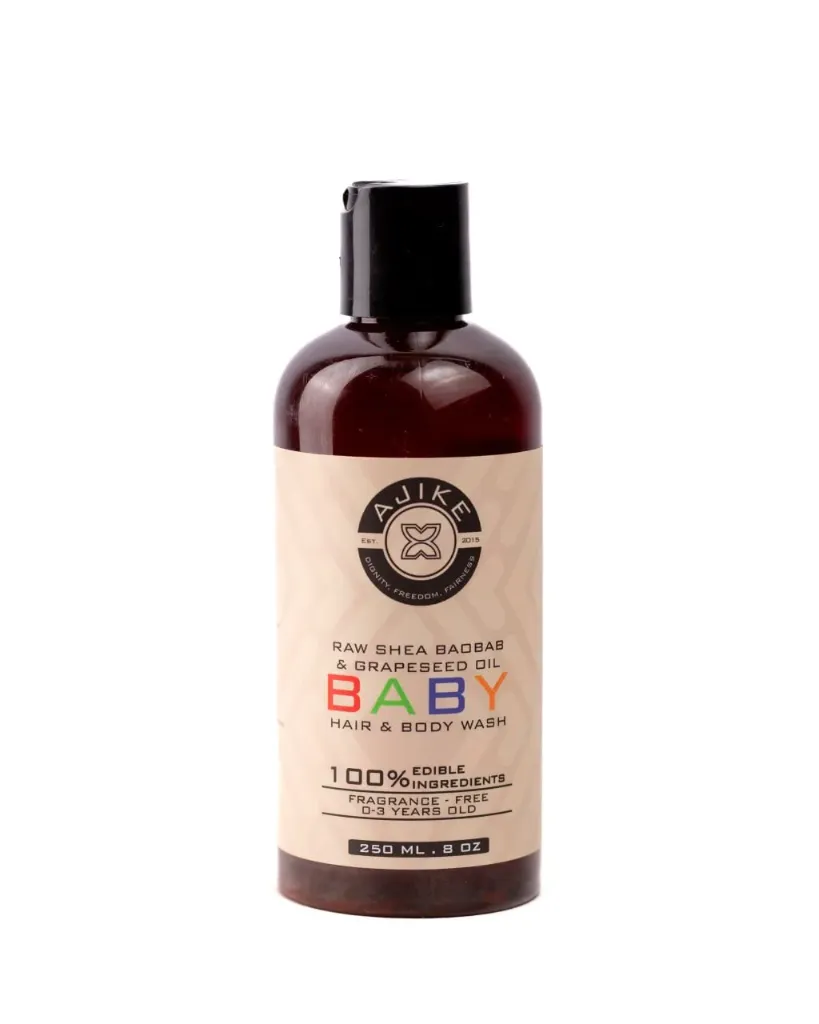
Using the right cleanser before applying shea butter is as important for babies as it is for adults. Our Shea Baobab Baby Hair and Body Wash is formulated with edible-grade ingredients, is fragrance-free, sulfate-free, and gentle enough for newborn skin. It cleanses without stripping the delicate baby skin barrier, creating the best possible conditions for the shea butter moisturiser that follows.
Gentle Hair & Body Cleansing For Baby Skin
Shea Baobab Baby Hair & Body Wash
Fragrance-free and sulfate-free baby wash made with shea butter and baobab oil for gentle hair and body cleansing from newborns to toddlers.
View Product
Gentle Hair & Body Cleansing For Baby Skin
Shea Baobab Baby Hair & Body Wash
Fragrance-free and sulfate-free baby wash made with shea butter and baobab oil for gentle hair and body cleansing from newborns to toddlers.
View ProductAjike and Baby Skin: Our Philosophy
Why We Use Edible Grade Ingredients in Our Baby Range
The edible-grade standard in our baby range is a deliberate, non-negotiable commitment. It is not a marketing position. Babies have a higher skin absorption rate than adults, they put their hands and feet in their mouths, and they cannot tell you if something feels wrong or is irritating their skin. In this context, formulating with ingredients that are safe enough to eat is the only responsible standard.
Every ingredient in our baby range could, in principle, be eaten safely. This standard eliminates entire categories of potential concerns before they can arise.
Fragrance-Free and Preservative-Free: What That Means in Practice
Fragrance-free means genuinely fragrance-free. Not simply low-fragrance. Not unscented (which can mean fragrance chemicals have been added to mask other scents). No fragrance of any kind. Our baby products contain no added scent, no essential oils, and no fragrance chemicals.
Preservative-free means the products rely on their formulation chemistry and packaging for shelf stability rather than on synthetic preservative systems. This requires more careful formulation and more careful packaging, but it eliminates the preservative sensitisation risk that is a real concern for infant skin.
Handcrafted in Ghana: Made with the Most Vulnerable Skin in Mind
Ajike was founded in Ghana in 2015. Our products are developed and made in Ghana, where baby skin care using shea butter is not a trend but an unbroken generational practice. The understanding of how shea butter interacts with infant skin comes from this lived, community-level knowledge, combined with modern understanding of infant dermatology.
We do not adapt our baby products from formulations designed for adult Western markets. We formulate from the experience of communities where shea butter has been applied to babies from birth for generations.
Why Shea Butter Is at the Centre of Our Baby Range
Shea butter is the foundational ingredient in our baby range because it is the natural ingredient with the most complete combination of emollient, barrier-supportive, and anti-inflammatory properties suited to developing infant skin. It is not a novel ingredient that requires justification. It is the most traditional and most proven natural moisturiser for baby skin in the regions where both Ajike and shea butter come from.
Frequently Asked Questions
Yes, raw unrefined shea butter with no additives is generally safe for newborn skin. It has been used on newborn skin in West Africa for generations. The main precaution is potential nut allergy: if there is a family history of tree nut allergy, consult a healthcare provider before using. Always patch test before first full body application, even on newborns.
Yes, in small amounts. Warm a tiny amount between adult fingertips until completely melted and press gently to dry areas of the baby's face. Avoid the area directly around the eyes. For cradle cap on the scalp, apply to the scalp before bathing, leave for 15 to 20 minutes, and wash out.
Very little. A piece no larger than a dried pea, melted in adult palms, is sufficient for a full newborn body moisturisation after bathing. The amount increases proportionally as the baby grows.
Yes. Raw unrefined shea butter provides emollient barrier support, ceramide-adjacent lipid replenishment, and anti-inflammatory properties from its unsaponifiable fraction, all of which are relevant to eczema management in baby skin. For babies with moderate to severe eczema, use alongside, not instead of, any prescribed medical treatment. Consult a healthcare provider if the eczema does not improve. Results may vary depending on skin type.
We recommend ivory shea butter for babies. Yellow shea butter with burututu root introduces additional plant compounds that have not been specifically studied for infant use. For babies, the simplest, purest option is always preferable. Our ivory shea butter with no additions is the appropriate choice.
If you see redness, rash, swelling, or increased irritation after applying shea butter to your baby, discontinue use immediately. Clean the affected area with warm water and a gentle cleanser. Monitor for 24 to 48 hours. If the reaction is severe, involves spreading redness, swelling of the face, or the baby seems distressed, seek medical attention. For mild reactions that resolve after stopping, note the reaction and discuss with your healthcare provider before introducing shea butter again.
Our latest content
Check out what's new in our company !