
Start writing here...
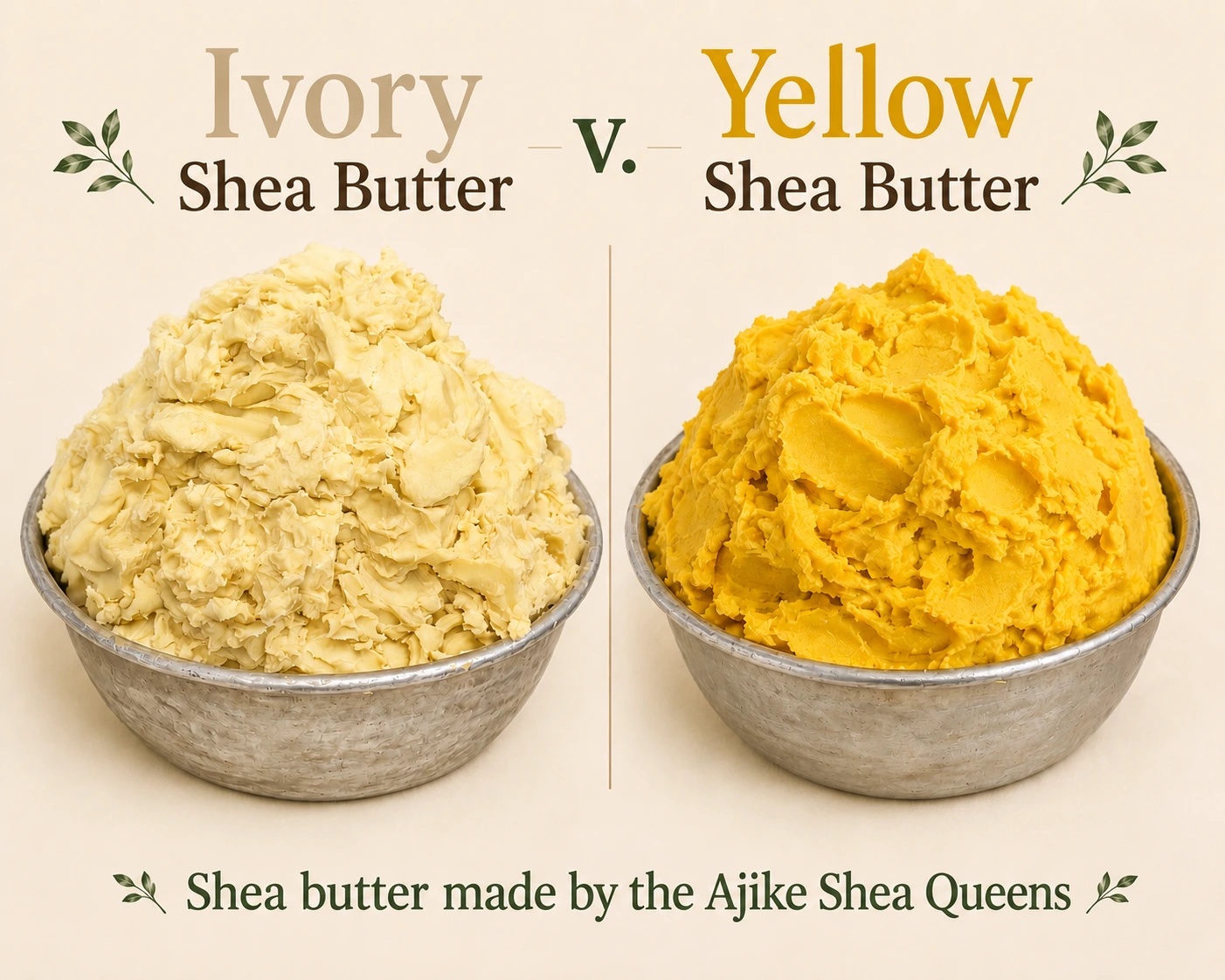
If you have shopped for raw shea butter, you have probably noticed that some is ivory or cream coloured and some is yellow. You may have wondered whether the yellow one is stronger, or more natural, or better for hair. You may also have seen prices varying considerably between the two and wondered what you are actually paying for.
The honest answer is more complicated than most sellers will tell you. The yellow colour in most shea butter you encounter is artificial. The genuine yellow shea butter, coloured naturally with burututu root, is a different product with additional properties, and it is relatively rare.
This guide covers exactly what makes each variety what it is, what the actual differences are, how to tell genuine from fake, and which one is right for your specific needs.
Read Also: New to shea butter? Start here: What Is Raw Unrefined Shea Butter?
Why This Question Matters More Than You Think
The Market Is Full of Fake Yellow Shea Butter
Walk into a natural beauty market in Ghana or Lagos, or browse shea butter listings online, and you will find yellow shea butter everywhere. The problem is that the vast majority of it is not genuinely yellow. It has been dyed yellow with annatto seed extract, turmeric, synthetic food dye, or other colourants to meet consumer demand for the golden-coloured product.
This is not necessarily dishonest in every case. Annatto is a natural colourant derived from the achiote plant and is not harmful. But it adds nothing to the therapeutic properties of the shea butter. You are paying for colour, not content. And the artificial colourant version carries none of the additional benefits that genuinely burututu-infused yellow shea butter provides.
Why Colour Alone Tells You Very Little
The colour of shea butter is not a reliable indicator of quality, potency, or authenticity on its own. Raw ivory shea butter from different batches and different regions varies naturally in shade from pale cream to a deeper ivory. Some unrefined shea butter has a slight greenish or greyish tinge depending on the nuts and processing. This natural colour variation is completely normal.
A very bright, uniform, intense yellow colour in a shea butter product is actually more likely to indicate artificial colouring than authentic yellow shea butter, which tends to be a warmer, more golden amber tone rather than the vivid yellow of annatto-dyed products.
What You Should Actually Be Looking At
The question to ask is not whether the shea butter is ivory or yellow. The question is whether it is genuinely raw and unrefined, and in the case of yellow shea butter, whether the yellow colour comes from burututu root or from a dye.
Both genuinely raw ivory shea butter and genuinely burututu-infused yellow shea butter are excellent products. Refined shea butter in either colour is a lesser product. And artificially dyed shea butter that claims to be something it is not is simply a lower-quality product presented with misleading information.
What Is Ivory Shea Butter?
Where the Ivory Colour Comes From
The ivory to cream colour of unrefined shea butter comes from the natural carotenoids present in the shea kernel. Carotenoids are plant pigments responsible for yellow, orange, and red colours in many fruits and vegetables. The specific carotenoids in shea butter are present at relatively low concentrations, which gives the butter a pale, warm ivory tone rather than a bright yellow.
These carotenoids are heat-sensitive and are among the first compounds destroyed when shea butter is subjected to industrial bleaching and deodorisation. The bright white colour of refined shea butter is the colour of shea butter after its natural carotenoids and other pigments have been removed. Ivory is the colour of shea butter with its carotenoids intact.
The Natural Colour Range of Genuine Ivory Shea Butter
Authentic raw ivory shea butter is not a single uniform colour. Depending on the region, the specific shea trees, the ripeness of the nuts at harvest, and the degree of roasting during processing, genuine ivory shea butter can range from a very pale, almost white cream to a deeper warm ivory with a slight yellowish tinge. Some batches have a very mild greenish or greyish undertone from trace minerals in the local soil.
This natural variation between batches is a sign of authenticity. Industrial refined shea butter achieves a perfectly uniform white precisely because the refining process removes all the natural variation. If your ivory shea butter looks exactly the same from batch to batch, one of two things is true: it is very carefully standardised through processing, or it is refined.
What Ivory Shea Butter Smells Like
Raw ivory shea butter has a characteristic mild, earthy, nutty scent with a slight smokiness from the roasting step in traditional processing. The scent varies in intensity from batch to batch but is always present in a genuine raw product. It is not an unpleasant smell and fades quickly once applied to the skin.
The scent comes from volatile compounds in the unsaponifiable fraction. When these compounds are removed through deodorisation during refining, the scent disappears. An odourless ivory shea butter is almost certainly refined, regardless of what the label says.
The Nutrient Profile of Ivory Shea Butter
Genuine raw ivory shea butter contains the full complement of shea butter's beneficial compounds: oleic acid (40 to 60 percent), stearic acid (35 to 45 percent), linoleic acid (5 to 10 percent), and the unsaponifiable fraction (5 to 17 percent) containing triterpenes, phytosterols, natural vitamin E (tocopherols), and vitamin A (beta-carotene and carotenoids).
This is the baseline nutrient profile of raw shea butter without any additions. It is already a remarkably complete skin and hair care ingredient on its own.
What Is Yellow Shea Butter?
Why Most Yellow Shea Butter on the Market Is Artificially Coloured
Yellow shea butter has a strong consumer association with quality in many African markets, and particularly in West African diaspora communities internationally. The reasoning behind this association has some basis in tradition: genuinely yellow shea butter, made with burututu root, was historically a more specialised and valued product.
But the market has responded to this consumer preference in the simplest possible commercial way: by adding yellow colourant to regular shea butter. Annatto seed extract, the same natural orange-yellow dye used in food products including some cheeses and butters, is the most common colourant used. It is not harmful, but it adds nothing beyond colour. The therapeutic properties of the shea butter are unchanged by its presence.
What Genuine Yellow Shea Butter Actually Is
Genuine yellow shea butter gets its colour from the infusion of burututu root during the traditional shea butter making process. This is a practice specific to certain communities and regions within the West African shea belt, and it produces a shea butter that is genuinely different from ivory shea butter in both colour and composition.
The colour from burututu root is a warm, amber to golden yellow rather than the bright, uniform canary yellow of annatto-dyed products. It is not as vivid as the dyed versions. To an untrained eye, genuinely burututu-infused yellow shea butter can look like less impressive yellow shea butter compared to the vibrantly coloured artificial versions. But the content is what matters.
The Traditional Role of Burututu Root in Shea Butter Production
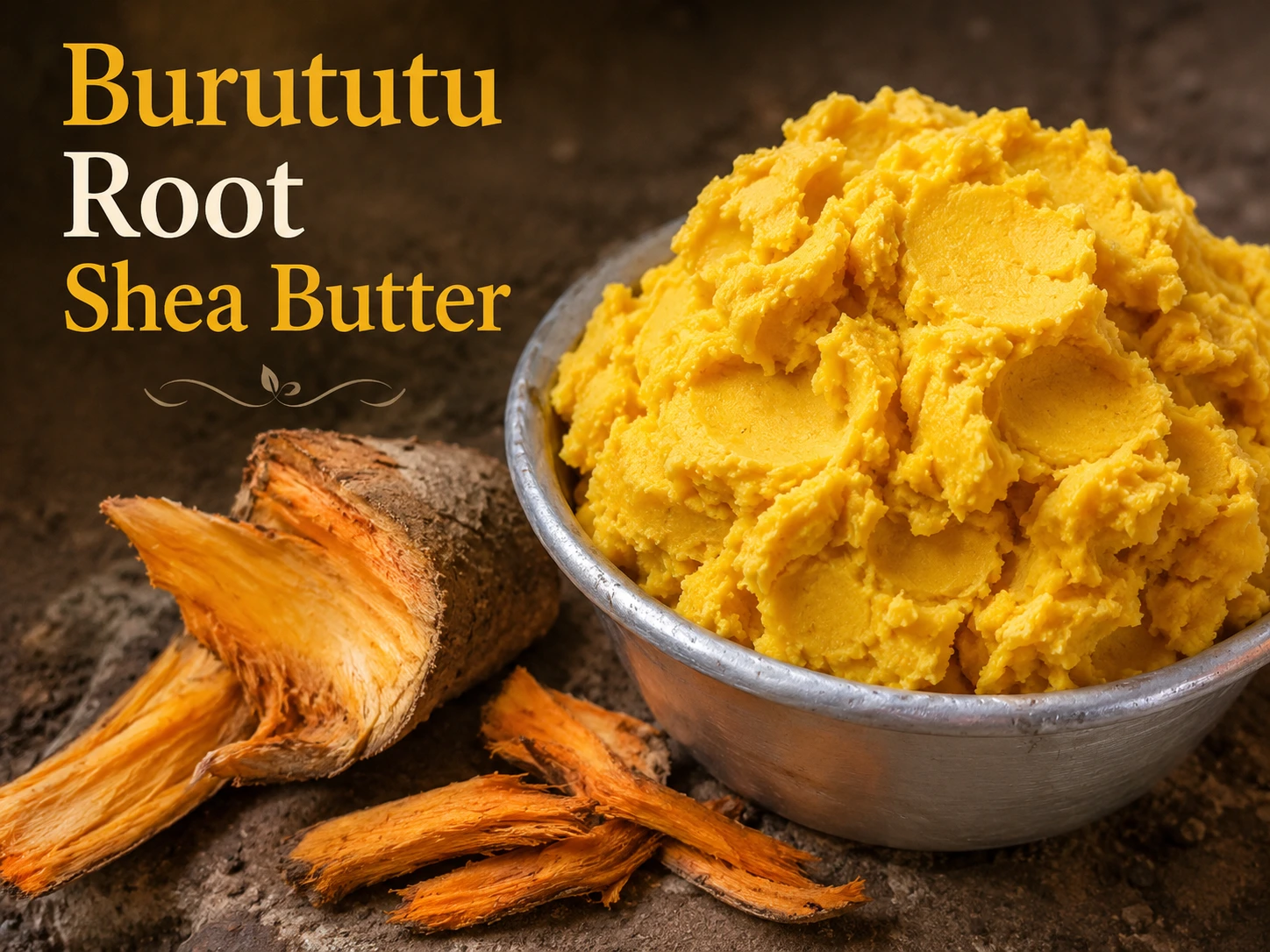
Burututu root, botanically known as Crossopteryx febrifuga, has been used in traditional medicine across West and Central Africa for generations. Its use in shea butter production developed as a way to combine the moisturising properties of shea butter with the medicinal properties of the burututu plant, creating a product that was valued both for daily skincare and for specific therapeutic applications.
The root bark is added during the boiling and skimming stage of traditional shea butter production. As the shea fat boils with water and the burututu root, the bioactive compounds from the root infuse into the fat. The root is removed, and the resulting shea butter carries both the golden colour of the burututu and its additional compounds.
What Burututu Root Is and What It Does for Skin
Beyond its role as a natural colourant, burututu root contains several bioactive compounds including glycosides, tannins, and alkaloids that have been documented in research for their anti-inflammatory, antimicrobial, and antioxidant properties. When these compounds are present in the shea butter, they add a dimension of activity that ivory shea butter alone does not provide.
For scalp conditions in particular, the antimicrobial properties of burututu are complementary to the emollient and anti-inflammatory properties of the shea butter itself. This is why yellow shea butter with genuine burututu root is especially valued in natural hair care communities.
Burututu Root: The Ingredient That Makes Authentic Yellow Shea Butter Different
What Burututu Root Is
Crossopteryx febrifuga, known commonly as burututu in West Africa, is a shrubby tree or large shrub found across the savannah regions of West, Central, and East Africa. It grows in similar territory to the shea tree. The root bark of the plant has a long history of use in traditional medicine across the region for fever, inflammation, pain, and various skin conditions.
In ethnobotanical literature, burututu has been documented as a treatment for malaria, jaundice, and inflammatory conditions, with significant overlap between traditional use and modern pharmacological research into its active compounds. This is not a minor or obscure plant. It is a well-established part of the West African traditional medicine system.
How It Is Traditionally Used in Shea Butter Making
The dried root bark of burututu is added to the water in which shea butter is boiled during the final purification stage of traditional processing. The length of boiling time and the quantity of root used determine the depth of colour and the intensity of compound infusion in the final product. The root pieces are then strained out, and the golden butter is skimmed and cooled.
This process is simple but requires knowledge of the appropriate quantities and timing. Too little root and the colour is pale and the compound infusion minimal. Too much and the taste and scent profile of the shea butter changes significantly. This is skilled traditional knowledge, not a process that can be replicated by simply adding an extract.
The Skin and Scalp Benefits of Burututu Root
Research into Crossopteryx febrifuga has documented antimicrobial activity against several bacterial and fungal species, anti-inflammatory activity through inhibition of prostaglandin synthesis, and antioxidant activity from the plant's polyphenol content. In the context of shea butter use, these properties add value in several specific ways.
For scalp use, the antimicrobial activity is relevant to conditions where Malassezia yeast or Staphylococcus aureus are involved, including dandruff and scalp eczema. For eczema-prone skin broadly, the additional anti-inflammatory activity complements the anti-inflammatory properties already present in the shea butter's unsaponifiable fraction. For all skin types, the antioxidant compounds add to the free radical protection provided by the shea butter's tocopherols.
Why Wild Harvested Burututu Root Matters
Burututu root used in genuine traditional yellow shea butter making is wild harvested, like the shea nuts themselves. Wild harvested plant material draws nutrients from its natural growing environment and tends to have higher concentrations of active compounds than cultivated equivalents. This is the same principle that makes wild harvested shea butter more nutritionally complete than shea from young cultivated trees.
At Ajike, our yellow shea butter uses wild harvested burututu root from the same regions where the shea itself is harvested. The two ingredients come from the same landscape, collected and processed by the same communities, using the same traditional knowledge.
How to Tell If Yellow Shea Butter Contains Real Burututu Root
Genuine burututu-infused yellow shea butter has a warm, golden amber colour rather than a vivid, bright yellow. It has a distinctive earthy scent that is slightly different from ivory shea butter, with an additional woody or herbal note from the burututu infusion. It may cost more than ivory shea butter, because the burututu sourcing and the more complex processing add to the production cost.
Artificially coloured yellow shea butter smells the same as regular ivory shea butter because the dye adds no scent. The colour is more vivid and uniform. The price is often the same as or lower than ivory shea butter. If the yellow shea butter you are considering costs less than comparable ivory shea butter, it is almost certainly dyed.
Ivory Shea Butter vs Yellow Shea Butter: The Actual Differences
Feature | Ivory Shea Butter | Authentic Yellow (Burututu) |
Colour | Pale cream to deep ivory, natural variation | Warm amber to golden, not vivid yellow |
Scent | Mild, nutty, slightly smoky | Same base scent plus earthy, woody herbal note |
Texture | Slightly grainy at room temp, melts at body temp | Same texture as ivory shea butter |
Base nutrients | Full shea butter nutrient profile | Full shea butter profile plus burututu compounds |
Anti-inflammatory | From shea unsaponifiable fraction | From shea fraction plus burututu glycosides |
Antimicrobial | Mild, from natural fatty acids | Enhanced by burututu root compounds |
Best for | Skin, hair, babies, sensitive users | Scalp conditions, natural hair, eczema, hair growth |
Colour and Appearance
Ivory shea butter ranges from very pale cream to a deeper warm ivory depending on batch and origin. Authentic yellow shea butter with burututu root is a warm amber to golden colour, noticeably different from ivory but not the vivid bright yellow of annatto-dyed products. If you put genuine ivory and genuine yellow Ajike shea butter side by side, the difference is clear and attractive. The yellow is warmer and richer, not garish.
Scent
Ivory shea butter has the classic mild, nutty, earthy scent of traditional shea. Authentic yellow shea butter has the same base note but with an additional woody, herbal dimension from the burututu root. People describe this extra note variously as earthy, slightly medicinal, or herbal. It is subtle but distinct if you are familiar with both varieties.
Texture and Consistency
Both genuine ivory and genuine yellow shea butter have essentially the same texture because the base product is the same. Slightly grainy at room temperature, smoothing completely when warmed between the palms, melting at body temperature. The burututu infusion does not significantly change the physical texture of the shea butter.
Nutrient Profile Comparison
The fatty acid profile of both varieties is identical because the fatty acids come from the shea kernel itself, not from anything added during processing. The difference lies in the additional burututu compounds in the yellow variety: the glycosides, tannins, and alkaloids from the root bark that infuse into the fat during the boiling process. These are present in addition to the shea butter's own unsaponifiable fraction, not instead of it.
Skin Benefits Comparison
For general skin moisturisation, barrier repair, anti-aging support, and sensitive skin use, both varieties provide equivalent benefit from the shea butter content itself. The yellow variety adds an extra dimension of anti-inflammatory and antioxidant activity from the burututu compounds, which is beneficial but not dramatically different for everyday skin moisturisation on non-problematic skin.
For skin conditions involving inflammation, including eczema, psoriasis, and post-acne marks, the additional anti-inflammatory properties of the burututu-infused variety provide a modest but real additional benefit.
Hair and Scalp Benefits Comparison
For hair use as a moisture sealant, both varieties perform similarly. The difference becomes more significant when applied to the scalp. The antimicrobial properties of burututu root are relevant to scalp conditions including dandruff (where Malassezia yeast is a driver) and scalp eczema (where Staphylococcus aureus is involved). For scalp treatments, authentic yellow shea butter is the more appropriate choice.
Which One Is Better for Different Skin Types
For normal, combination, and dry skin focused on daily moisturisation: either variety is excellent. For eczema-prone and inflammatory skin conditions: yellow shea butter provides slightly more anti-inflammatory support. For oily and acne-prone skin: ivory shea butter in small amounts on damp skin is marginally preferred because the burututu's antimicrobial profile, while generally beneficial, has not been specifically studied for acne. For babies and very sensitive skin: ivory shea butter with no additions is the purer, simpler option.
Ivory Shea Butter Benefits for Skin and Hair
Deep Moisturisation and Skin Softening
The oleic acid content of ivory shea butter, making up 40 to 60 percent of the total fat, penetrates the upper layers of the stratum corneum and delivers lasting moisturisation. The stearic acid component provides surface emolliency, smoothing skin texture and improving the skin's feel. Together, these give raw ivory shea butter one of the most complete moisturising profiles of any single natural ingredient.
Skin Barrier Repair
The phytosterols in the unsaponifiable fraction of ivory shea butter support ceramide synthesis in the skin barrier, and the linoleic acid content contributes the omega-6 fatty acid that is a component of ceramide production. Regular application of raw ivory shea butter provides the raw materials the skin needs for barrier reconstruction, particularly valuable for eczema-prone and chronically dry skin.
Eczema and Dry Skin Conditions
For eczema management and chronic dry skin, ivory shea butter provides the core therapeutic properties needed: emollient barrier support, ceramide-adjacent lipid replenishment, anti-inflammatory triterpenes, and antioxidant tocopherols. Applied consistently twice daily to slightly damp skin, it produces meaningful improvement in barrier integrity and skin comfort over weeks of regular use.
Read Also: Full guide: Shea Butter for Eczema: How to Use It and What to Expect
Anti-Aging and Skin Elasticity
The vitamin A content in the form of beta-carotene supports gentle skin cell renewal. The vitamin E tocopherols provide antioxidant protection against free radical damage that drives skin aging. The oleic acid supports collagen production in the skin. Used consistently, raw ivory shea butter contributes to the skin's long-term structural health and resilience.
For Hair: Sealing Moisture and Reducing Breakage
As a moisture sealant for natural and textured hair, ivory shea butter applied in small amounts to damp hair after washing locks in moisture and improves hair flexibility. Well-moisturised hair is significantly more resistant to breakage than dehydrated hair. For daily hair use, the absence of additional scent in ivory shea butter is an advantage for those who prefer unscented products.
Who Should Choose Ivory Shea Butter
Ivory shea butter is the right choice for: babies and young children where simplicity and purity are the priority, people with fragrance sensitivity or contact dermatitis where any additional compound, even from natural sources, might be a concern, those who prefer an unscented product for personal or olfactory reasons, and as a general daily moisturiser for all skin types.
Yellow Shea Butter Benefits for Skin and Hair
Everything Ivory Shea Butter Does, Plus More
Authentic yellow shea butter with burututu root provides all of the same skin and hair benefits as ivory shea butter, because the shea butter base is the same. The oleic acid, stearic acid, vitamins, triterpenes, phytosterols, and all the other compounds of raw shea butter are present at the same concentrations. The burututu infusion adds on top of this foundation rather than replacing any part of it.
Additional Anti-Inflammatory Action from Burututu Root
The glycosides and other bioactive compounds from burututu root add an extra layer of anti-inflammatory activity to the shea butter's existing unsaponifiable fraction. For chronically inflamed skin conditions, having two sources of anti-inflammatory action working together is more powerful than either source alone.
The practical benefit is particularly noticeable for scalp inflammation and for eczema-prone skin that does not fully respond to ivory shea butter alone. Adding the burututu dimension can provide additional relief where the shea butter's own anti-inflammatory properties are not sufficient on their own.
Scalp Health and Dandruff Support
This is where authentic yellow shea butter stands apart most clearly. The antimicrobial activity of burututu root compounds, particularly against Malassezia and bacterial species, makes it a more appropriate choice for scalp conditions than ivory shea butter. For dandruff, seborrhoeic dermatitis on the scalp, scalp eczema, and general scalp inflammation, yellow shea butter applied as a pre-wash scalp treatment provides a meaningful therapeutic advantage over ivory.
For Textured and Natural Hair
Natural hair communities across West Africa and in the diaspora have long favoured yellow shea butter for hair use, and specifically for scalp use. The burututu's antimicrobial and anti-inflammatory properties are relevant to the scalp conditions that can impede healthy hair growth. For hair that is not growing as well as it should because of scalp health issues, switching from ivory to authentic yellow shea butter for scalp treatments may produce noticeable improvement.
Who Should Choose Yellow Shea Butter
Authentic yellow shea butter is the better choice for: scalp conditions including dandruff, scalp eczema, and seborrhoeic dermatitis, natural hair care routines where scalp health support is a priority, eczema-prone skin seeking additional anti-inflammatory support beyond what ivory shea butter provides, and anyone interested in the traditional combination of shea and burututu as it has been used in West Africa for generations.
Which Shea Butter Is Better: Ivory or Yellow?
For Daily Body Moisturising
Either. Both genuine ivory and genuine yellow shea butter are excellent for daily body moisturisation. The choice comes down to personal preference for scent and whether the additional burututu properties are relevant to your specific skin concerns. If you have no particular skin conditions and are simply looking for a natural daily body moisturiser, ivory is simpler and slightly more economical.
For Facial Use
Ivory shea butter. For the face, simplicity and purity are more important than additional active compounds, because the face is more reactive and the consequences of a reaction are more visible. The cleaner, simpler ivory shea butter in a very small amount is the right choice for most facial applications.
For Eczema and Sensitive Skin
Authentic yellow shea butter if available and if the person has no concerns about the burututu compounds. The additional anti-inflammatory properties are a genuine advantage for eczema management. However, ivory shea butter alone provides excellent eczema support, and for very reactive sensitive skin where introducing any new compound carries risk, ivory is the safer starting point.
For Hair and Scalp Care
Authentic yellow shea butter, particularly for scalp use. The antimicrobial properties from burututu root add a meaningful dimension for scalp health that ivory shea butter does not provide. For hair shaft use as a moisture sealant, both work equally well.
For Babies and Young Children
Ivory shea butter. For babies, the purest, simplest option is always preferable. Ivory shea butter with no additions is appropriate for baby skin from birth. Yellow shea butter, even with natural burututu root, introduces additional compounds that have not been specifically tested for infant use.
For Those Who Prefer Unscented Products
Ivory shea butter. Both genuine varieties have a scent, but the yellow variety has a more complex and slightly more prominent scent from the burututu infusion. For fragrance-sensitive individuals, ivory shea butter has the milder, more predictable scent profile.
The Honest Answer: Both Are Excellent When Authentic
The ivory versus yellow question matters primarily in the context of authenticity. A genuine raw ivory shea butter is an excellent product. A genuine burututu-infused yellow shea butter is an excellent product with some additional properties. An artificially coloured yellow shea butter is simply ivory shea butter with a dye added, providing no advantage.
Focus on authenticity and raw quality first. The colour difference, when the product is genuine in both cases, is a secondary consideration determined by your specific needs.
How to Spot Fake Yellow Shea Butter
Signs the Yellow Colour Is Artificial Dye
- The colour is very bright, vivid, and uniform, more like a canary yellow than a warm amber
- The scent is identical to regular ivory shea butter with no additional herbal or woody note
- The price is the same as or lower than comparable ivory shea butter
- The ingredients list mentions annatto, achiote, turmeric extract, or food colouring
- The colour is perfectly consistent from batch to batch with no natural variation
What Real Burututu-Infused Shea Butter Looks and Smells Like
Genuine yellow shea butter with burututu root is a warm, amber to golden colour rather than a vivid yellow. There is natural variation between batches in both the depth of colour and the exact tone. The scent is the characteristic shea butter scent plus something extra: earthy, slightly woody, and herbal. If you close your eyes and smell it, you can tell there is something in addition to the shea itself.
What the Ingredients List Should and Should Not Say
A genuine burututu-infused yellow shea butter should list, in some form, shea butter (Vitellaria paradoxa) and burututu root or Crossopteryx febrifuga. Some producers may list it as a traditional infusion without using the botanical name. An ingredients list that says shea butter and annatto, or shea butter and beta-carotene, or shea butter and turmeric is telling you the colour is artificial.
Why Price Is a Useful Indicator
Sourcing and processing genuine burututu root, and the more complex traditional processing required to infuse it into the shea butter properly, adds cost. Authentic yellow shea butter should cost more than comparable ivory shea butter from the same producer. If yellow shea butter costs the same or less than ivory, the additional cost of the burututu process has not been reflected in the price, which strongly suggests the colour is artificial.
How to Use Ivory and Yellow Shea Butter
Application Method for Both Varieties
The application method is the same for both varieties because the physical properties of the shea butter are the same. Always warm the shea butter between palms until it is completely melted before applying. Always apply to slightly damp skin, not completely dry skin. Use less than you think you need. Press and pat rather than rub and spread. Give it a few minutes to absorb before dressing.
Read Also: Full application guide: Why Is Shea Butter Not Absorbing Into My Skin?
On the Face: How Much and When
For facial use of either variety, use a rice-grain sized amount warmed between fingertips until fully liquid. Apply as the last step of an evening skincare routine to slightly damp skin. Press gently into the skin. For oily or acne-prone skin, use ivory shea butter only on genuinely dry areas of the face rather than all over.
On the Body: Damp Skin Technique
For body use, apply within 60 seconds of patting skin dry after bathing, when the skin is still slightly damp. A grape-sized amount of either variety, melted in the palms, is sufficient for an average adult body. Work from the extremities inward. Give it three to five minutes before dressing.
On Hair and Scalp: Different Approach Needed
For scalp use, particularly with yellow shea butter, apply directly to the scalp sections before washing. Work a small amount into each section with fingertips. Leave for 30 to 60 minutes or overnight, then wash out thoroughly with shampoo. For hair shaft use as a sealant, apply a very small amount to damp hair after washing and conditioning, focusing on the mid-lengths and ends.
For Babies: What to Know Before You Start
For baby use, stick to ivory shea butter. Warm a very small amount between adult fingertips until completely melted and apply gently to damp baby skin after bathing. Patch test on the inner arm 24 to 48 hours before first full use. If there is any family history of tree nut allergy, consult a healthcare provider before using shea butter on a baby. Discontinue use if irritation occurs.
Ajike Ivory and Yellow Shea Butter: Both Wild Harvested in Ghana
Our Ivory Shea Butter: Pure, Unrefined, Wild Harvested
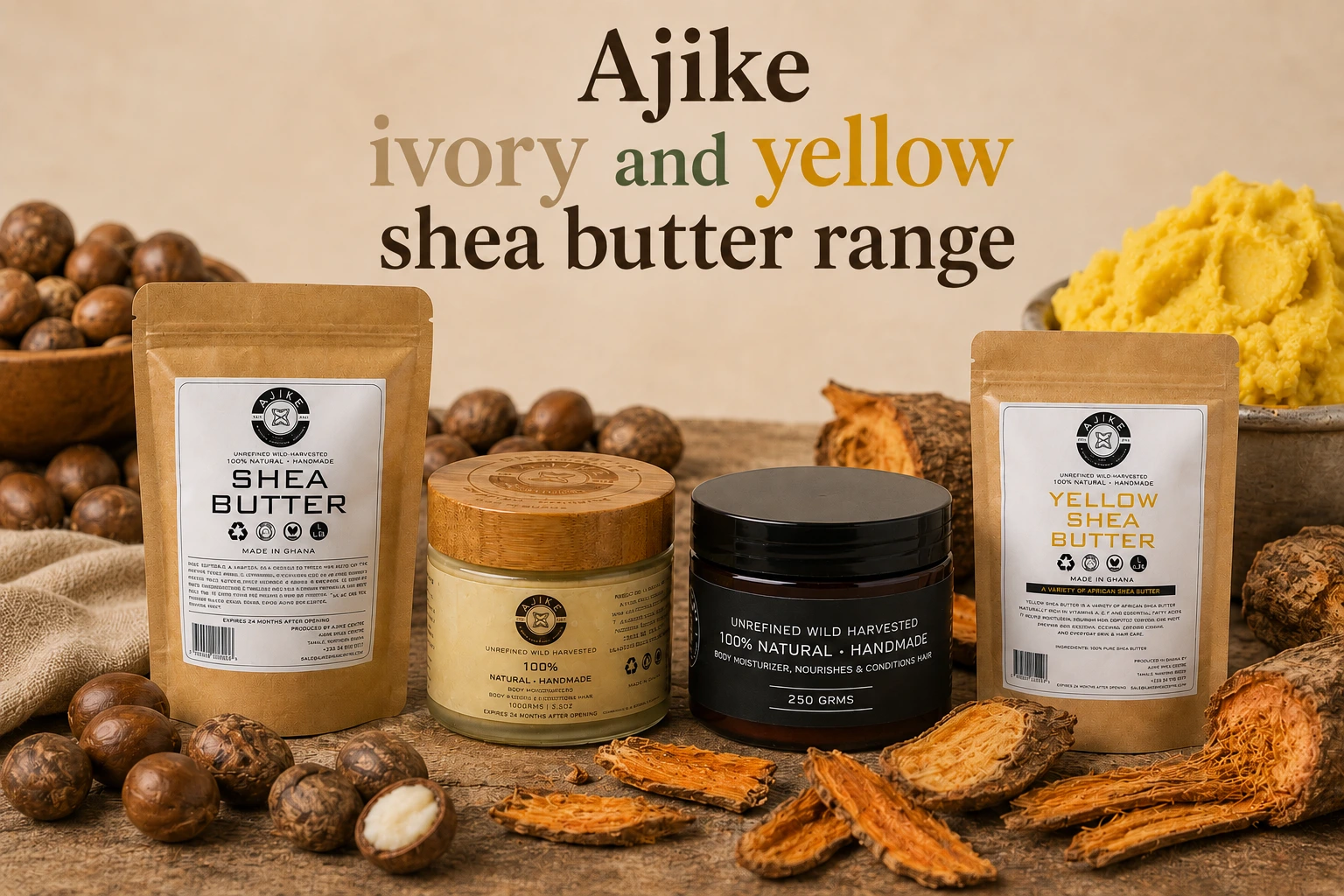
Ajike's ivory shea butter is wild harvested in northern Ghana from trees that have been producing nuts for decades in the natural savannah environment. It is processed using traditional water-based methods without chemical solvents, bleaching, or deodorisation. The result is a shea butter that retains its natural colour, scent, and complete nutrient profile including the full unsaponifiable fraction.
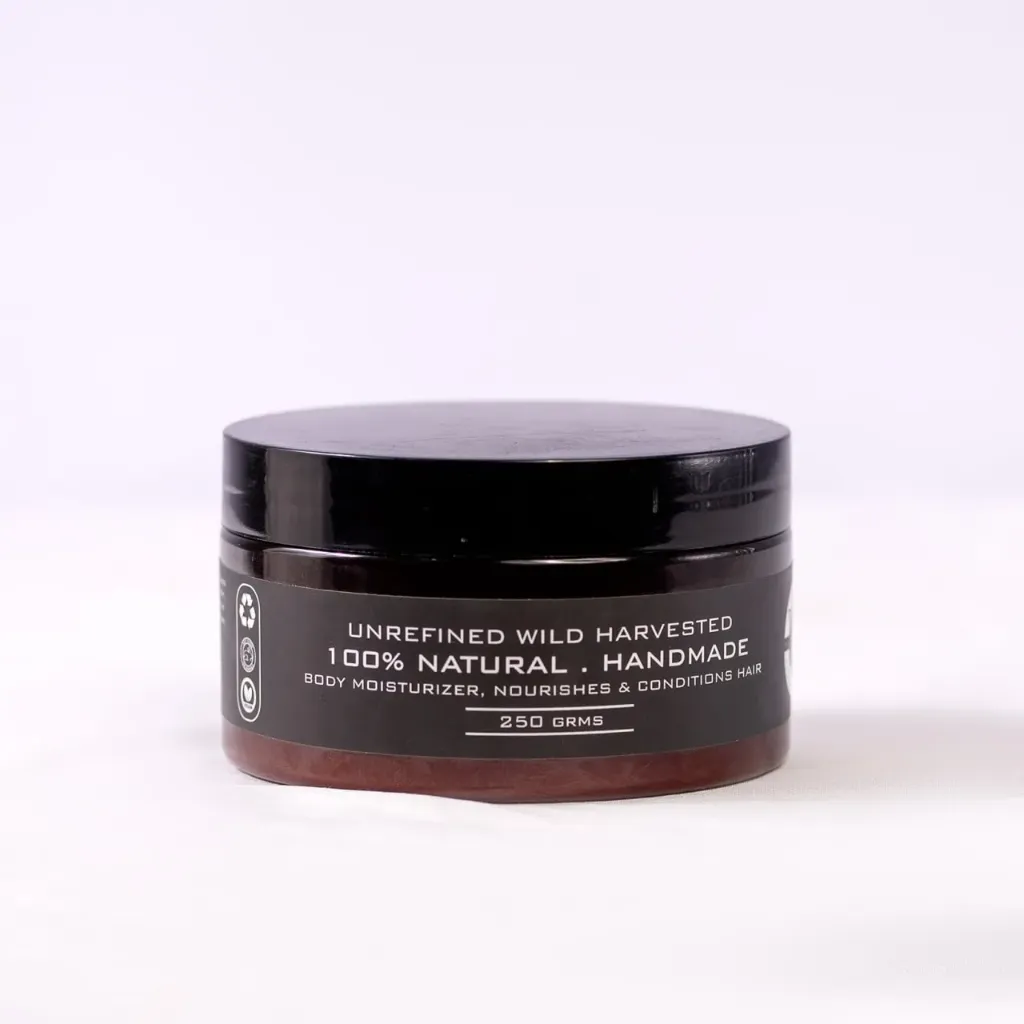
We offer our ivory shea butter in a glass jar with wooden lid (for those who want a premium presentation), in a plastic jar (for everyday practical use), and in a glass jar with lemongrass essential oil added for those who prefer a lightly scented version.
Rich Natural Moisture For Skin & Hair
Raw Unrefined Shea Butter Ivory
Wild harvested, pure and unrefined shea butter with no additives. Its natural ivory colour and full nutrient profile make it ideal for dry skin and hair care.
View Product
Rich Natural Moisture For Skin & Hair
Raw Unrefined Shea Butter Ivory
Wild harvested, pure and unrefined shea butter with no additives. Its natural ivory colour and full nutrient profile make it ideal for dry skin and hair care.
View ProductOur Yellow Shea Butter: Naturally Coloured with Wild Harvested Burututu Root
Ajike's yellow shea butter uses the same wild harvested Ghanaian shea as our ivory variety, with wild harvested burututu root added during traditional processing. The burututu root is sourced from the same northern Ghana regions as the shea nuts. The resulting butter has a warm amber to golden colour from the natural root pigment and the characteristic earthy-herbal scent note of genuine burututu infusion.
The yellow shea butter is available in a pouch format, which is practical for use in hair care routines where you may want to scoop out a portion for scalp treatment.
Nourish Scalp, Hair & Dry Skin Naturally
Raw Unrefined Shea Butter Yellow Pouch
Wild harvested shea naturally coloured with burututu root for a warm amber-golden tone. Ideal for scalp, natural hair and eczema-prone dry skin.
View Product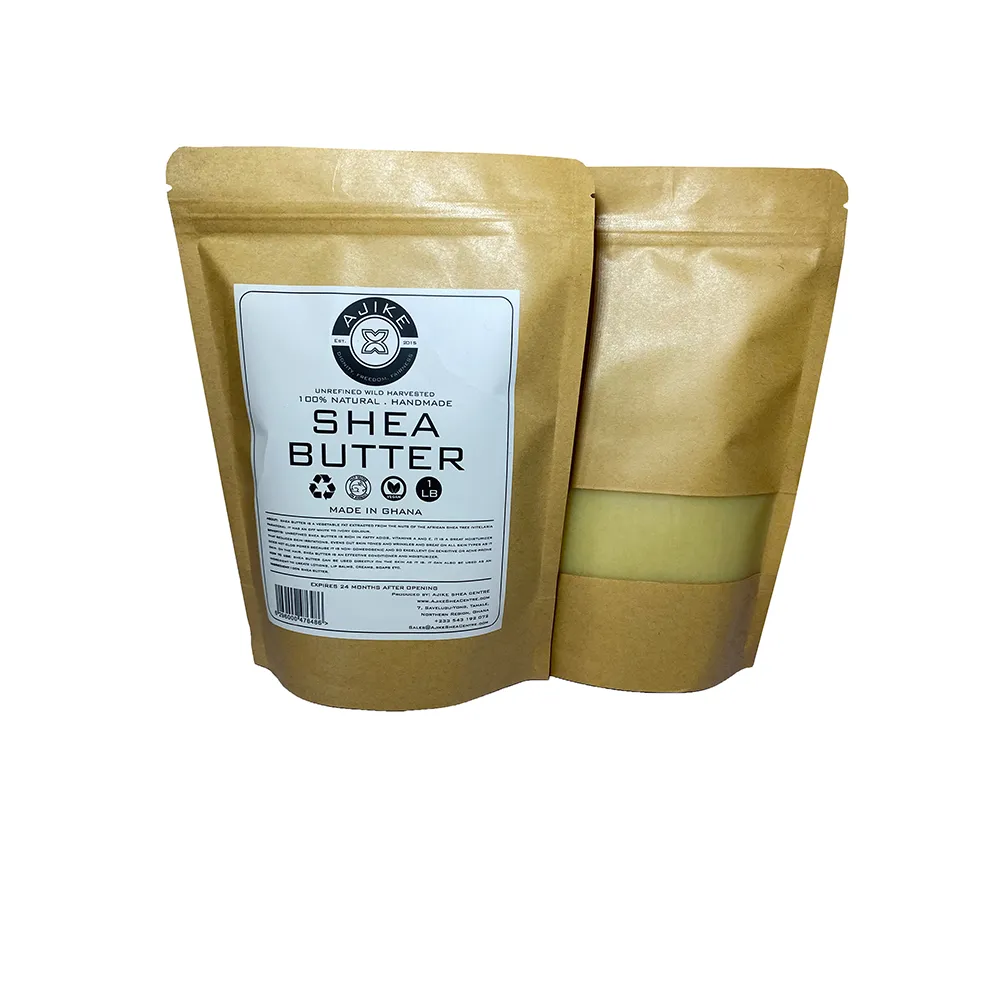
Nourish Scalp, Hair & Dry Skin Naturally
Raw Unrefined Shea Butter Yellow Pouch
Wild harvested shea naturally coloured with burututu root for a warm amber-golden tone. Ideal for scalp, natural hair and eczema-prone dry skin.
View Product
Why We Offer Both and How to Choose
We offer both varieties because they genuinely serve different needs and preferences. They are not competing products. They are complementary ones. Many Ajike customers use ivory shea butter for daily body and facial moisturisation and yellow shea butter specifically for scalp treatments. Others choose one variety for all uses based on their personal preference or specific skin and hair concerns.
If you are new to raw shea butter, starting with ivory is simpler. If you have scalp concerns, dandruff, or hair that is not thriving, try the yellow. If you are not sure, the product descriptions and this article should help you decide.
Small Batch Production: What It Means for Quality
Both of our shea butter varieties are produced in small batches by our producers in northern Ghana. Small batch production means tighter quality control, fresher product that moves quickly through the supply chain rather than sitting in storage, and natural batch-to-batch variation that is the hallmark of genuinely traditional processing.
We test each batch before it goes into our products or ships to customers as standalone raw shea butter. The colour, scent, texture, and consistency are verified against our benchmarks for each variety. What you receive is a product that has been evaluated and confirmed to meet the standards of genuine raw shea butter.
Frequently Asked Questions
Genuine yellow shea butter with burututu root provides additional anti-inflammatory and antimicrobial properties beyond what ivory shea butter offers on its own. For scalp conditions and eczema-prone skin, this is a meaningful advantage. For general moisturisation and baby use, ivory shea butter is equally good and simpler. Neither is universally better. Each is better for specific purposes.
Vivid, uniform bright yellow colour is usually a sign of artificial colouring, most commonly annatto seed extract. Genuine yellow shea butter with burututu root is a warm amber to golden colour, not a vivid bright yellow. The colour from burututu root is subtler and more variable between batches than the consistent bright yellow of artificial dyes.
We recommend ivory shea butter for babies. The purer, simpler composition of ivory shea butter with no additions is more appropriate for infant skin. Yellow shea butter, even with natural burututu root, introduces additional plant compounds that have not been specifically tested for infant use. If there is any family history of tree nut allergy, consult a paediatric healthcare provider before using any shea butter on a baby.
Yes, in genuinely traditionally produced yellow shea butter, the burututu root is infused during the traditional processing rather than added as an extract after the fact. This infusion process is what gives the butter its distinctive warm golden colour and its additional active compounds. It is not the same as simply mixing in a burututu extract, and the result is different from artificial colouring with annatto or turmeric.
Genuine burututu-infused yellow shea butter is more expensive because of the additional cost of sourcing and processing the burututu root and the more complex traditional production process required to properly infuse it into the shea butter. If yellow shea butter costs the same as or less than ivory shea butter, it is likely artificially coloured.
Absolutely. Using ivory shea butter for daily face and body moisturisation and yellow shea butter specifically for scalp treatments is a practical approach that takes advantage of the specific strengths of each variety. There is no reason to limit yourself to one if both serve your needs.
Our latest content
Check out what's new in our company !