
Start writing here...
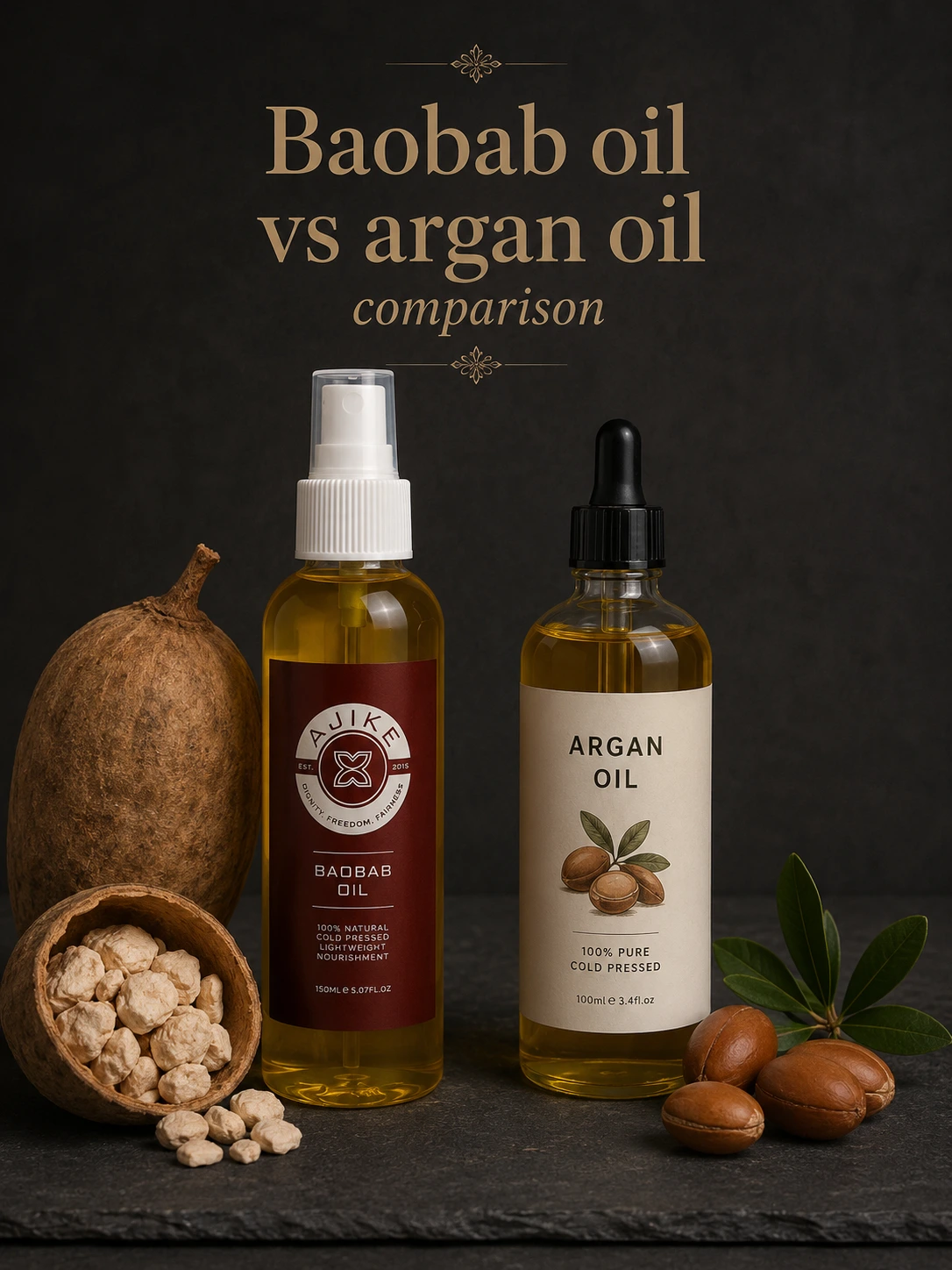
Both baobab oil and argan oil have legitimate claims to being among the best botanical oils available for skin and hair. Both come from Africa. Both are genuinely nutrient-rich. Both have attracted significant global attention in recent years. And both are frequently misrepresented: argan oil is often diluted, and baobab oil is often refined or confused with inferior products.
The question of which is better is more nuanced than most comparison articles suggest. The honest answer is that they are better at different things, for different skin types and concerns, and the right choice depends entirely on what you are trying to achieve.
This guide gives you the complete comparison. No marketing bias toward either oil. Just the nutrient profiles, the texture differences, the specific use cases where each excels, and a clear verdict framework you can actually use.
Read Also: Full baobab oil science: Baobab Oil Benefits for Skin and Hair - Complete Guide
Why This Comparison Matters
Two of the Most Talked About Botanical Oils in Skincare
Argan oil has been a staple of the premium skincare and hair care market for over a decade. It was one of the first African botanical oils to achieve global mainstream recognition, largely through its adoption in high-end hair care products and the growing interest in Moroccan beauty traditions. It now appears in everything from luxury serums to drugstore hair masques.
Baobab oil is later to mainstream global recognition but has a significantly longer history of use in African communities. The baobab tree grows across sub-Saharan Africa, and the oil pressed from its seeds has been used for skin and hair care across the region for generations. As interest in African botanical ingredients has grown globally, baobab oil has begun appearing in premium formulations and standalone oils.
Why Most Comparisons Online Get It Wrong
Most online comparisons between these two oils make one or more of the following errors: they compare refined versions of both oils rather than cold pressed versions, which means neither oil is showing its full nutrient profile; they focus on marketing claims rather than documented chemical composition; or they provide a simple verdict without the nuance needed to make the comparison useful.
A comparison between refined argan oil and cold pressed baobab oil is not an apples-to-apples comparison. And a comparison based on marketing language rather than fatty acid profiles and vitamin content tells you nothing useful about how the oils will actually perform for different skin types and concerns.
What You Should Actually Be Comparing
For a useful comparison, you need to look at: the actual chemical composition of each oil (fatty acid profile, vitamin content, antioxidant compounds), the texture and absorption properties that determine real-world usability, how each oil performs for specific skin types and concerns rather than in general, and the quality and sourcing considerations that affect whether what you are buying actually contains what the label claims.
Where Each Oil Comes From
Argan Oil: From the Argan Tree in Morocco
Argan oil is pressed from the kernels of the argan tree, Argania spinosa, which grows almost exclusively in the Sous Valley region of southwestern Morocco. The tree is adapted to the harsh, semi-arid climate of this region and has developed significant drought resistance. The UNESCO-protected biosphere reserve in the Sous-Massa region is home to some of the most productive argan forests.
Argan oil production is closely associated with the Amazigh (Berber) women's cooperatives of Morocco, who have traditionally extracted argan oil by hand using stone grinding. These cooperatives remain central to authentic argan oil production, and their economic role is a significant factor in the sustainability of argan oil production.
Baobab Oil: From the Baobab Tree in Sub-Saharan Africa
Baobab oil comes from the seeds of the baobab tree, Adansonia digitata, which grows across sub-Saharan Africa from Senegal in the west through Ghana, Nigeria, and across to Ethiopia and Tanzania in the east. Unlike the argan tree's restricted geographic range, the baobab grows across a broad territory, which means there are more potential production sources but also more variability in quality.
The baobab is one of the most culturally significant trees in Africa: the Tree of Life across many cultures, providing food (the vitamin-C-rich fruit pulp), medicine (bark and leaves), and cosmetic ingredients (the seed oil) to communities across the continent for as long as anyone can remember. The oil production model is primarily community-based collection from wild trees, similar to how shea nuts are collected across the savannah belt.
Wild Harvested vs Cultivated: How Each Is Sourced
Both argan and baobab oil come primarily from wild trees rather than cultivated plantations, though for different reasons. Argan trees can be and are cultivated, but the most prized traditional argan oil comes from the wild trees of the Sous Valley. Baobab trees are rarely cultivated commercially because of the 20 to 40-year maturity period before the tree begins producing fruit.
The wild-harvested nature of both oils means their quality is inherently connected to the environmental conditions of the specific region and the care taken during harvesting and processing. Wild-harvested oils also support the communities that have traditionally managed and relied on these trees.
Why Origin and Processing Method Change Everything
Both oils can be cold pressed or refined, and the difference between the two versions of each oil is as significant as the difference between the two oils themselves. Cold pressed argan oil, produced through mechanical pressing without chemical solvents or heat, retains its full vitamin E content, the minor compounds like ferulic acid and polyphenols, and a more complete fatty acid profile. Refined argan oil, bleached and deodorised, loses a portion of these compounds.
The same applies to baobab oil. Cold pressed baobab oil retains its vitamins A, D, E, and F and its full fatty acid profile. Refined or refined baobab oil loses the heat-sensitive vitamin A and polyunsaturated fatty acids that are most therapeutically relevant. Any comparison between these oils needs to specify the grade of each.
The Nutrient Profile: What Is Actually in Each Oil
Nutrient | Baobab Oil (Cold Pressed) | Argan Oil (Cold Pressed) |
Oleic Acid (Omega-9) | 33-38% | 43-49% |
Linoleic Acid (Omega-6) | 28-36% (very high) | 12-16% (moderate) |
Alpha-Linolenic Acid (Omega-3) | 3-5% | <1% (trace) |
Palmitic Acid | 20-28% | 12-16% |
Vitamin E (Tocopherols) | Significant, lower than argan | Very high (one of highest in any oil) |
Vitamin A (Carotenoids) | Present (meaningful) | Trace only |
Vitamin D | Present | Not present |
Vitamin F (EFAs) | High (linoleic + ALA) | Moderate (linoleic only) |
Squalene | Trace | Present (notable) |
Ferulic Acid | Minor | Present (documented) |
Comedogenicity | Rating 2 | Rating 0 |
Fatty Acid Breakdown: Oleic, Linoleic and Beyond
The most fundamental difference in the fatty acid profiles of these two oils is the oleic-to-linoleic acid ratio. Argan oil is oleic-dominant, with oleic acid making up approximately 43 to 49 percent and linoleic acid at 12 to 16 percent. Baobab oil is more balanced, with oleic acid at 33 to 38 percent and linoleic acid at a notably higher 28 to 36 percent.
Oleic acid penetrates the skin more readily and provides richer emollient moisturisation. Linoleic acid supports skin barrier integrity, ceramide synthesis, and is specifically relevant to acne-prone skin where linoleic acid deficiency in sebum is documented. The higher oleic acid in argan makes it slightly more penetrating and more emollient. The higher linoleic acid in baobab makes it more relevant to barrier repair and acne management.
Vitamin E Content Comparison
This is argan oil's standout property. Cold pressed argan oil has one of the highest vitamin E concentrations of any commonly used botanical oil, significantly higher than baobab oil. Vitamin E (tocopherols) are fat-soluble antioxidants that protect the skin's lipid barrier against free radical damage from UV radiation and environmental pollution. This high vitamin E content is argan oil's primary anti-aging mechanism and the reason it remains one of the most effective antioxidant protective oils available.
Baobab oil has meaningful vitamin E content but at lower concentrations than argan. What baobab oil provides that argan does not is a broader multi-vitamin profile: vitamins A, D, and F are present in baobab at meaningful concentrations and are essentially absent in argan. The choice between these oils from a vitamin perspective is therefore not simply about which has more vitamin E, but which vitamin profile is most relevant to your specific skin concerns.
Vitamins Unique to Baobab Oil: A, D and F
The presence of meaningful vitamin A (beta-carotene and carotenoids), vitamin D, and vitamin F (essential fatty acids, specifically the alpha-linolenic acid fraction that argan lacks) in baobab oil is what gives it a more complete multi-vitamin profile than argan oil. Vitamin A supports skin cell renewal and helps address hyperpigmentation over time. Vitamin D supports scalp health and skin barrier immunity. Vitamin F essential fatty acids are critical for ceramide synthesis and barrier integrity.
These vitamins are not found in argan oil at therapeutically meaningful concentrations. For skin concerns where these specific vitamins are most relevant, baobab oil provides them where argan does not.
Sterols and Antioxidant Compounds in Both Oils
Both oils contain phytosterols, the plant-derived sterol compounds that support skin barrier function and have anti-inflammatory properties. Argan oil is particularly noted for its squalene content, a naturally occurring lipid found in human sebum that provides very effective surface-level moisturisation and antioxidant protection. Baobab oil contains phytosterols but at lower squalene concentrations than argan.
Argan oil also contains ferulic acid, a phenolic antioxidant compound that is particularly effective at neutralising UV-induced free radical damage and has synergistic effects with vitamin E. This combination of high vitamin E, squalene, and ferulic acid gives argan oil an exceptionally strong antioxidant profile that baobab oil's broader vitamin range does not fully replicate.
Which Oil Has the More Complete Nutrient Profile
This depends on what complete means for your purposes. Argan oil has the more concentrated antioxidant profile, with its exceptional vitamin E, squalene, and ferulic acid content. Baobab oil has the more diverse vitamin profile, with A, D, E, and F present simultaneously. Neither is objectively more complete. They are differently complete, suited to different applications and skin concerns.
Texture, Absorption and Skin Feel
How Argan Oil Feels on the Skin
Cold pressed argan oil has a golden amber colour, a mild nutty scent, and a slightly more emollient feel than baobab oil. It absorbs fairly quickly but leaves a faint smooth, slightly satiny residue that many people find pleasant and conditioning. On the hair, it provides a noticeable smoothing effect. On the skin, it gives a healthy sheen that is comfortable for most skin types.
How Baobab Oil Feels on the Skin
Cold pressed baobab oil has a golden to amber colour, a mild sweet-earthy scent, and a slightly lighter, drier feel than argan oil. It absorbs more quickly and leaves less surface residue. On the skin, it gives a matte to slightly lustrous finish rather than the satiny sheen of argan. On the hair, it conditions effectively without the heavier coating feel of oils with more oleic acid.
Which Absorbs Faster
Baobab oil absorbs marginally faster than argan oil. Both absorb faster than heavier oils like castor oil or avocado oil. The difference between baobab and argan in absorption speed is subtle rather than dramatic. For most people, both oils are comfortable within 2 to 3 minutes of application on slightly damp skin.
Which Leaves Less Residue
Baobab oil leaves less surface residue than argan oil after absorption. For those who find argan oil's faint satiny finish uncomfortable, particularly on oily or combination skin, baobab oil's drier finish is the better choice. For those who prefer the slightly richer feel of argan oil's finish, particularly for dry skin or evening facial use, argan's slight residue is a positive quality.
Which Works Better Under Makeup
Baobab oil, by a clear margin, works better under makeup. Its drier, faster-absorbing finish provides a smoother, more matte base for foundation and other makeup products. Argan oil's slightly more emollient residue can cause makeup to slide or reduce its longevity on some skin types. For morning use under makeup, baobab oil is the significantly better choice for both oily and dry skin types.
Baobab Oil vs Argan Oil for Dry Skin
How Each Oil Addresses Dry Skin Differently
Argan oil addresses dry skin primarily through its oleic acid content, which penetrates the skin's lipid bilayer and delivers lasting moisturisation to the deeper layers of the stratum corneum. Its squalene content mimics the skin's own lipids and provides excellent surface-level emolliency. For immediate, noticeable surface moisturisation and a comfortable feel on dry skin, argan oil has a slight sensory advantage.
Baobab oil addresses dry skin through multiple mechanisms: emollient support from its fatty acid profile, barrier repair from its linoleic acid and essential fatty acid content (which supports ceramide synthesis), and gentle cell renewal from its vitamin A content that improves the skin's long-term moisture retention capacity. For the most common cause of persistent dry skin, which is a compromised skin barrier rather than simply insufficient surface oil, baobab oil's barrier-supportive properties provide more comprehensive support.
Which Provides Longer Lasting Moisture
For immediate moisture that is rich and comfortable, argan oil has a slight edge due to its higher oleic acid content. For longer-term improvements in the skin's own ability to retain moisture, baobab oil's ceramide-supporting essential fatty acids and its vitamin A cell renewal support work on the barrier's underlying structure. In practice, consistently using either oil correctly produces good results for dry skin. The difference is in the mechanism rather than the magnitude of improvement for most users.
Which Is Better for Very Dry and Dehydrated Skin
For very dry skin that needs intensive emollient support: argan oil provides a richer, more emollient feel that very dry skin often responds well to immediately. For dehydrated skin where the underlying problem is barrier dysfunction: baobab oil's barrier-repair essential fatty acids and vitamin A support address the cause rather than just the symptom. In practice, combining a humectant (hyaluronic acid or glycerine) with baobab oil as a sealant produces excellent results for both very dry and dehydrated skin.
Which Works Better Layered Over a Moisturiser
Both oils work well as a sealing layer applied over a moisturiser. For this application, baobab oil's lighter texture makes it less likely to interfere with the moisturiser beneath it or feel too heavy in combination. Argan oil, with its slightly richer feel, can create a heavier combined effect on skin that is already well-moisturised. For the layering approach, baobab oil is generally the more comfortable choice.
Baobab Oil vs Argan Oil for Oily and Acne-Prone Skin
Comedogenicity Comparison
Argan oil has a comedogenicity rating of 0, making it non-comedogenic and unlikely to cause breakouts for any skin type. Baobab oil has a rating of 2, placing it in the low-comedogenic category. On paper, argan oil's rating of 0 gives it an advantage for acne-prone skin. In practice, both ratings are in the low range where real-world differences for most acne-prone people are minimal.
Linoleic Acid Content and Why It Matters for Acne
This is where baobab oil has a clear advantage for acne-prone skin. Acne-prone sebum is characteristically deficient in linoleic acid relative to oleic acid. Applying a high linoleic acid oil topically supplements this deficiency and may help normalise sebum composition over time, reducing comedone formation.
Baobab oil contains 28 to 36 percent linoleic acid. Argan oil contains 12 to 16 percent. For the specific mechanism of linoleic acid supplementation in acne-prone skin, baobab oil is significantly more targeted than argan. This is why, despite argan oil's lower comedogenicity rating, baobab oil is the more appropriate choice for acne-prone skin where linoleic acid normalisation of sebum is a relevant goal.
Which Is Less Likely to Clog Pores
Argan oil, technically, with its rating of 0 compared to baobab's 2. But this difference in rating is small and the practical difference in real-world use, with correct application technique and appropriate amounts, is minimal for most people. If you have extremely reactive acne-prone skin and have had problems with oils rated 2 in the past, argan oil's rating of 0 is a meaningful advantage. For most acne-prone skin, either is appropriate.
Which Is Better for Balancing Oily Skin
Baobab oil, for the same reason it is better for acne-prone skin: the higher linoleic acid content has a more direct relationship with sebum composition normalisation. The drier finish of baobab oil is also more practical and comfortable on already-oily skin. Argan oil is appropriate for oily skin too, but baobab oil is the more targeted choice.
Read Also: Full guide: Baobab Oil for Acne-Prone Skin - Is It Safe to Use?
Baobab Oil vs Argan Oil for Anti-Aging
How Each Oil Addresses Fine Lines and Wrinkles
Both oils address skin aging through antioxidant protection, but through different primary compounds. Argan oil's exceptional vitamin E content, combined with squalene and ferulic acid, provides among the strongest single-oil antioxidant protection available. This antioxidant action neutralises the free radicals that break down collagen and elastin, the primary structural proteins responsible for skin firmness and the formation of fine lines and wrinkles.
Baobab oil's approach to fine lines is through multiple channels: vitamin A supporting skin cell renewal that gradually improves surface texture and reduces the accumulation of fine surface lines, vitamin E providing antioxidant protection, and alpha-linolenic acid reducing the chronic skin inflammation that drives accelerated aging through matrix metalloproteinase activation and collagen breakdown.
Collagen Support Comparison
Vitamin A is the most studied topical ingredient for collagen support, through its role in stimulating fibroblast activity and collagen synthesis. Baobab oil's vitamin A content (in the form of beta-carotene) provides gentle, consistent fibroblast support for collagen production at concentrations that are not aggressive but are meaningful over consistent, long-term use.
Argan oil provides minimal vitamin A and does not have a meaningful direct fibroblast-stimulating effect. Its anti-aging benefit is almost entirely through antioxidant protection of existing collagen from free radical degradation rather than supporting new collagen production.
Which Is Better for Mature and Aging Skin
This depends on the primary anti-aging concern. For antioxidant protection and UV damage prevention, which is the most important daily anti-aging measure: argan oil's superior vitamin E and squalene content makes it the stronger choice. For improving visible texture, skin tone evenness, and supporting ongoing collagen production: baobab oil's vitamin A content provides what argan cannot. Many people with mature skin benefit from using both: baobab oil in the evening for cell renewal and overnight repair, argan oil in the morning for daytime antioxidant protection.
Which Provides Better Antioxidant Protection
Argan oil, clearly. The combination of very high vitamin E, meaningful squalene, and ferulic acid creates a synergistic antioxidant profile that is difficult to match with a single alternative oil. Ferulic acid in particular enhances the effectiveness of vitamin E at neutralising UV-induced free radicals. This antioxidant combination is argan oil's strongest and most unique property.
Baobab Oil vs Argan Oil for Hair
Which Is Better for Dry and Damaged Hair
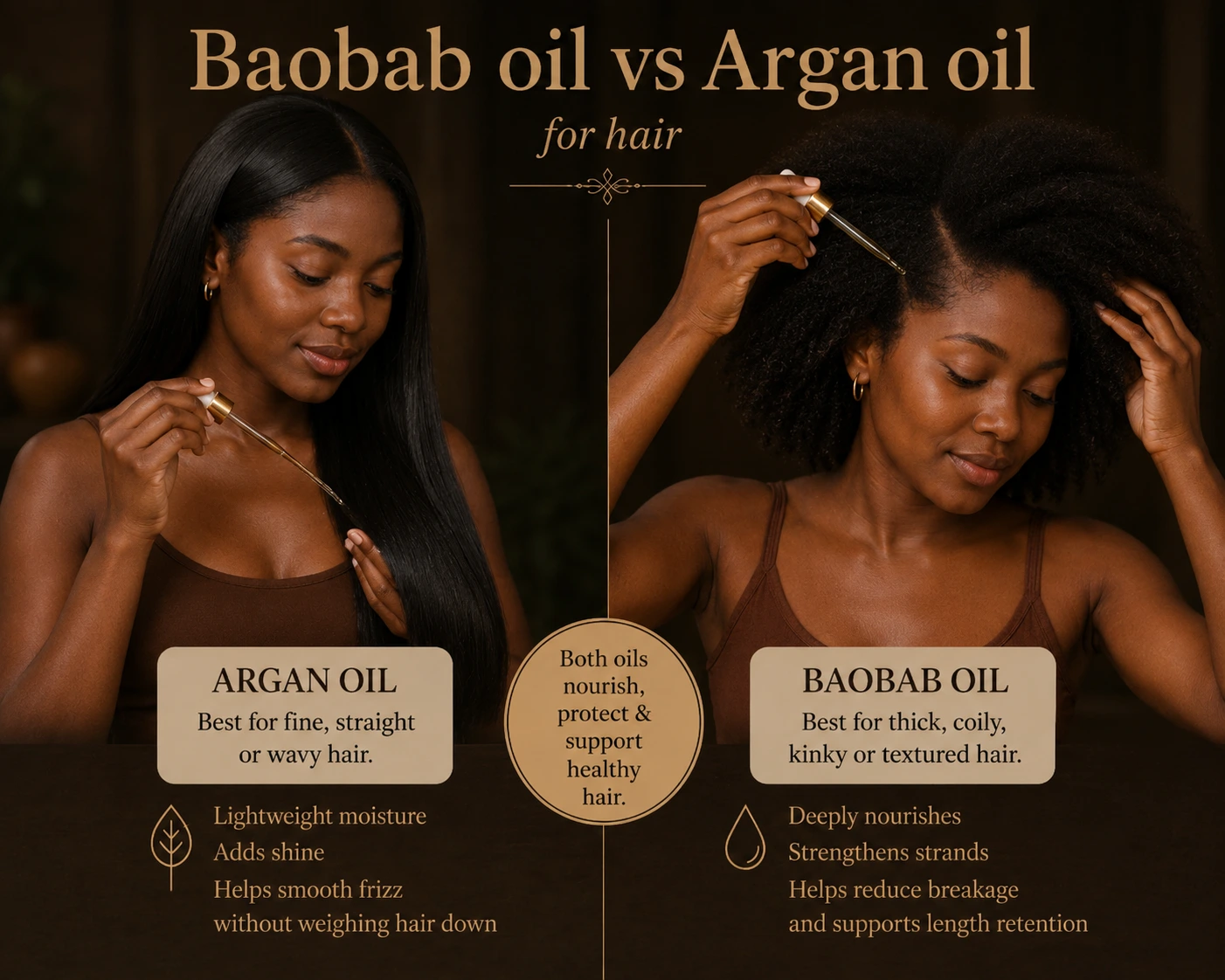
For dry and chemically damaged hair, baobab oil's higher linoleic acid content and its essential fatty acid profile provide better long-term structural support for the hair strand. Its oleic acid penetrates the hair cortex, and its vitamin content supports hair strand health from within. For immediate conditioning and smoothing of dry hair, argan oil's richer feel and higher oleic content produce a more immediate sensory improvement.
Many people with dry and damaged hair find that using baobab oil as a pre-shampoo treatment for its penetrating conditioning and argan oil as a post-wash finishing serum for its smoothing and antioxidant properties produces the best combined result.
Which Works Better for Natural and Textured Hair
Baobab oil is better suited to natural and textured hair as a daily sealant and scalp treatment. Its light texture is critical here: natural hair, particularly 4B and 4C hair, is easily weighed down by heavier oils. Baobab oil provides effective moisture sealing without the heaviness and buildup that argan oil, with its slightly richer texture, can cause with daily use on very coily hair.
Argan oil works well for natural hair as an occasional finishing treatment or as a component of a hair oil blend, but for daily sealing use in a LOC or LCO routine, baobab oil's lighter texture is more practical.
Which Is Better for Locs and Dreadlocks
Baobab oil. Locs are particularly sensitive to product buildup, and argan oil's slightly heavier finish accumulates more readily inside the compressed loc structure over repeated applications. Baobab oil's drier finish is less likely to create the sticky internal buildup that makes locs stiff, dull, and difficult to manage.
Which Is Better for Fine and Low-Porosity Hair
For fine and low-porosity hair, both oils need to be used in very small amounts because of the hair's tendency to become weighed down. Baobab oil's marginally lighter, drier finish is slightly preferable for these hair types, though the difference is small when the amounts are appropriate for both. For low-porosity hair specifically, applying either oil to wet hair in a warm environment maximises absorption.
Which Causes Less Buildup Over Time
Baobab oil causes less buildup with regular use than argan oil, primarily because of its slightly lighter, drier finish. Over weeks of daily application, argan oil can create a light accumulation on the hair surface that requires occasional clarifying. Baobab oil's lighter texture minimises this buildup, making it more suitable for high-frequency use.
Baobab Oil vs Argan Oil for Different Skin Tones
How Each Oil Performs on Melanin-Rich Skin
Both oils are appropriate for melanin-rich skin. The question of performance on dark skin tones largely comes down to which properties are most relevant to the specific concerns of melanin-rich skin: hyperpigmentation, post-inflammatory marks, and the need for gentle, non-irritating ingredients that do not trigger additional pigmentation.
Both oils have non-irritating profiles that are appropriate for melanin-rich skin. Neither contains the harsh actives that can cause post-inflammatory hyperpigmentation in dark skin when used incorrectly.
Which Supports Even Skin Tone Better
Baobab oil, through its vitamin A content. Vitamin A supports skin cell renewal, which over consistent use gradually reduces the accumulation of hyperpigmented surface cells that cause uneven tone and dullness. Argan oil's vitamin A content is too low to contribute meaningfully to this effect. For even skin tone support from a daily oil, baobab oil is the more appropriate choice.
Which Is Better for Dark Spots and Hyperpigmentation
Baobab oil is more directly relevant for dark spots and hyperpigmentation, again through its vitamin A content and its anti-inflammatory alpha-linolenic acid, which reduces the ongoing inflammatory signals that continue to stimulate melanocyte activity after an inflammatory event. Neither oil is a primary treatment for established hyperpigmentation, but as a supportive daily oil used alongside targeted treatments, baobab oil's properties are more directly relevant.
Read Also: Dark spots guide: African Black Soap for Hyperpigmentation and Dark Spots on Dark Skin
Price, Availability and Value Comparison
Why Argan Oil Is More Widely Available
Argan oil achieved mainstream beauty industry adoption well before baobab oil. It is now produced at large commercial scale, with established supply chains, quality standards, and a global distribution network. This commercial maturity means argan oil is widely available at a range of price points, from very inexpensive (almost certainly diluted or refined) to premium (genuine cold pressed from quality producers).
Baobab oil is available globally but at lower volumes and through fewer mainstream retail channels. It tends to appear in natural and specialty beauty retailers rather than mass-market supermarkets. This limited availability can be a practical disadvantage for those who want a readily accessible product.
Why Baobab Oil Tends to Be Less Adulterated
Argan oil's high demand and premium price have made it a target for adulteration. Various studies and investigative reports have found that a significant proportion of commercially available argan oil is diluted with cheaper carrier oils including sunflower, olive, or paraffin oil, often without disclosure. The global scale of argan oil production makes quality control more challenging.
Baobab oil, produced at smaller commercial scale with less widespread consumer awareness of what it should look and smell like, is less frequently adulterated. This is partly because the market for it is smaller and the economic incentive for adulteration is proportionally lower. A low-priced baobab oil is still a red flag for dilution, but the adulteration problem is less systemic than in the argan oil market.
How to Tell If Either Oil Has Been Diluted or Refined
Cold pressed argan oil is a golden amber to dark amber colour with a distinctive mild, nutty scent. A very pale or golden-yellow argan oil may indicate dilution. No scent indicates deodorisation through refining. Genuine cold pressed argan oil has a specific, identifiable smell that is absent from refined versions.
Cold pressed baobab oil is a golden to amber colour with a mild, sweet-earthy scent. Very pale or colourless baobab oil indicates refinement or dilution. No scent indicates refining. For both oils: if the price seems too good relative to comparable quality products, dilution is the most likely explanation.
Which Offers Better Value for What You Get
At comparable quality (genuine cold pressed, verified sourcing), baobab oil tends to offer more diverse nutritional value per millilitre: four vitamins (A, D, E, F) versus argan's primary single vitamin (E). Argan oil's antioxidant profile is stronger in its specific compounds (vitamin E, squalene, ferulic acid), but baobab's multi-vitamin breadth covers more bases.
For pure antioxidant anti-aging value, argan oil is among the best value single oils available. For versatility across skin concerns including acne, eczema, hyperpigmentation, and barrier repair, baobab oil's broader profile offers more application flexibility.
Argan Oil Alternative: When to Switch and Why
Reasons People Look for an Argan Oil Alternative
The most common reasons people search for an argan oil alternative are: they have been using argan oil and want to address a concern it is not fully meeting (often acne-prone skin that needs more linoleic acid support, or skin that needs more direct barrier repair), they want a lighter oil for summer or for oily skin use, they have become concerned about argan oil adulteration in the products they have been buying, or they want to explore African botanical oils beyond the most widely known option.
Why Baobab Oil Is the Most Comparable Switch
Of all the botanical oils available, baobab oil is the most structurally similar to argan oil in terms of use case. Both are light, quick-absorbing oils with premium positioning in the market. Both work for a wide range of skin and hair types. The key differences are baobab's higher linoleic acid content (better for acne and barrier repair) and argan's higher vitamin E content (better for antioxidant protection). Switching from argan to baobab produces a comfortable transition with a few noticeable property differences rather than a dramatically different experience.
What to Expect When You Make the Switch
If you switch from argan to baobab, you will notice: a slightly drier, lighter finish after application, faster absorption, less surface sheen, and for acne-prone users, potentially improved sebum balance over 4 to 8 weeks. You may miss argan's slightly richer antioxidant feel if antioxidant protection was your primary reason for using argan. Both oils perform well for general moisturisation, so the transition is straightforward for most people.
Can You Use Both Oils Together
Yes, and for many skin types and concerns, using both together is actually the optimal approach. A mixture of two parts baobab oil to one part argan oil combines baobab's higher linoleic acid content with argan's superior vitamin E and squalene content. The resulting blend covers both the barrier-repair and the antioxidant protection dimensions more effectively than either oil alone.
Alternatively, use each oil for its specific strength: baobab oil in the evening for cell renewal and barrier repair support, argan oil in the morning for daytime antioxidant protection. Or baobab oil as the daily scalp and hair sealant, argan oil as the occasional hair finishing serum. These purposeful combinations use each oil where it excels.
African Botanical Oils Beyond Baobab and Argan
Marula Oil: Another African Botanical Worth Knowing
Marula oil is pressed from the seeds of the marula tree (Sclerocarya birrea), which grows across southern and eastern Africa. It has a high oleic acid content (approximately 70 to 78 percent), giving it a very rich, deeply penetrating emollient feel. Its vitamin E content is moderate, and it absorbs well despite its high oleic content.
Marula oil is particularly well-suited to mature, very dry, and dehydrated skin. It is heavier than both baobab and argan oil, with a richer feel, and it is not the ideal choice for oily or acne-prone skin. Ajike uses marula oil in our Nightly Face Moisturiser with Hyaluronic Acid and Marula and our Marula and Baobab Anti-Breakage shampoo and conditioner range.
Neem Oil: For Specific Skin Concerns
Neem oil from the neem tree (Azadirachta indica), which grows across South and Southeast Asia and across Africa, has powerful antibacterial, antifungal, and anti-inflammatory properties from its content of nimbidin, nimbin, and azadirachtin. It has a comedogenicity rating of 1 and a very high linoleic acid content. However, its strong scent and intense concentration of active compounds make it unsuitable as a general facial oil. It works best as a targeted spot treatment or scalp treatment rather than an all-over oil.
Palm Kernel Oil: The Traditional West African Staple
Palm kernel oil is extracted from the kernel inside the fruit of the oil palm (Elaeis guineensis). It is a traditional cooking and skincare oil across West Africa and is one of the core ingredients in African black soap alongside shea butter. It is high in saturated fatty acids (primarily lauric acid) which give it a high comedogenicity rating (4-5 for some sources) that makes it unsuitable as a facial oil for acne-prone skin. For African black soap and body care formulations, it remains an important traditional ingredient.
Why African Botanical Oils Are Having a Global Moment
The growing global interest in African botanical ingredients is driven by multiple converging factors: increased consumer awareness of ingredient origin and community impact, genuine scientific interest in the unusual nutritional profiles of African plants that evolved in high-UV, nutritionally demanding environments, growing criticism of the Eurocentric bias in mainstream beauty formulation, and the outstanding performance of ingredients like shea butter and baobab oil when compared directly with global alternatives.
This is not simply a trend. The nutritional complexity of African botanical oils reflects the demanding environments in which these plants evolved. Baobab oil's four-vitamin profile exists because the baobab tree needed exceptional UV protection and antioxidant reserves to survive the African savannah. These evolutionary adaptations translate directly into exceptional performance in human skincare.
The Honest Verdict: Which Oil Should You Choose?
Summary: Neither oil is universally better. The right choice depends on your specific skin type, primary concerns, and how you intend to use it.
Choose Baobab Oil If...
- You have acne-prone or oily skin and want the linoleic acid normalisation benefit
- Your primary concern is skin barrier repair or eczema management
- You want a lighter, drier-finish oil for under makeup or daily use on oily skin
- You use oil for natural, textured, or loc hair on a daily basis
- You want a multi-vitamin oil covering A, D, E, and F simultaneously
- You want an oil that is versatile across skin and hair use cases
- You are interested in the skin tone and hyperpigmentation support from vitamin A
Choose Argan Oil If...
- Your primary skincare concern is antioxidant protection against UV and environmental aging
- You have dry or mature skin and want the richest emollient feel of these two oils
- You want the highest vitamin E concentration available in a single oil
- You use oil primarily as a hair finishing serum on fine or medium hair
- You want the squalene content for surface-level skin mimicry
- You prefer the slightly richer sensory experience of a more emollient oil
Use Both If...
- You want the antioxidant strength of argan in the morning and the vitamin A and barrier-repair of baobab in the evening
- You use oil for both skin and hair and want to optimise for each context
- You have combination concerns: anti-aging plus acne, or dry skin plus hyperpigmentation
- You blend them for a custom oil that combines baobab's linoleic richness with argan's vitamin E and squalene
The One Situation Where Neither Is the Best Answer
For very oily, highly reactive acne-prone skin that breaks out even from low-comedogenic oils: consider rosehip oil (rating 1, very high linoleic acid) or hemp seed oil (rating 0, approximately 55 to 65 percent linoleic acid) as alternatives with even higher linoleic content and lower comedogenicity than baobab oil. Both address the linoleic acid deficiency in acne-prone sebum more directly than either baobab or argan.
Ajike Pure Baobab Oil: The African Botanical Choice
100 Percent Pure, Cold Pressed, Wild Harvested
Ajike Pure Baobab Oil is 100 percent cold pressed baobab oil. No dilution with carrier oils. No synthetic additives. No refined or adulterated product. The natural golden amber colour and mild characteristic scent confirm the cold pressed, unrefined character. This is baobab oil at its most potent, with the complete four-vitamin profile and full fatty acid composition intact.
Why We Back Baobab Oil Over Any Other Single Oil
Of all the single botanical oils we work with, baobab oil is the one we recommend most broadly. Its four-vitamin profile, its versatility across skin types from oily to very dry, its appropriateness for both skin and hair use, its suitability for baby skin, its light texture that makes it accessible to people who have previously avoided oils entirely, and its genuine therapeutic depth make it our core recommendation for anyone seeking a multipurpose botanical oil.
This is not a commercial claim. We also sell argan oil products and would recommend argan if it was the better choice for a specific situation. For breadth of application and therapeutic depth across the widest range of skin and hair types, baobab oil is the more versatile choice.
How to Use Ajike Baobab Oil for Skin and Hair
For skin: 2 to 3 drops to slightly damp skin after cleansing. Morning for antioxidant and barrier support. Evening as the final sealing step after any serums. Alone or layered over a moisturiser. For all skin types. For hair: 2 to 3 drops as a post-wash sealant on damp hair. 3 to 5 drops as a pre-shampoo treatment. 2 to 3 drops to the scalp with massage. For all hair types including fine, low-porosity, natural, textured, and locs.
Where to Start If You Are New to Baobab Oil
If you are new to baobab oil and want to see what it does for your skin: start with the skin application. Cleanse in the evening, apply 2 to 3 drops of Ajike Pure Baobab Oil to slightly damp facial skin as your only moisturiser for 2 to 3 weeks. Monitor the results. If you are already using a moisturiser you like, add 2 to 3 drops of baobab oil over it as the final sealing step. Either approach will give you a clear sense of what the oil does for your particular skin within a few weeks.
One Pure Oil For Skin, Hair & Baby Care
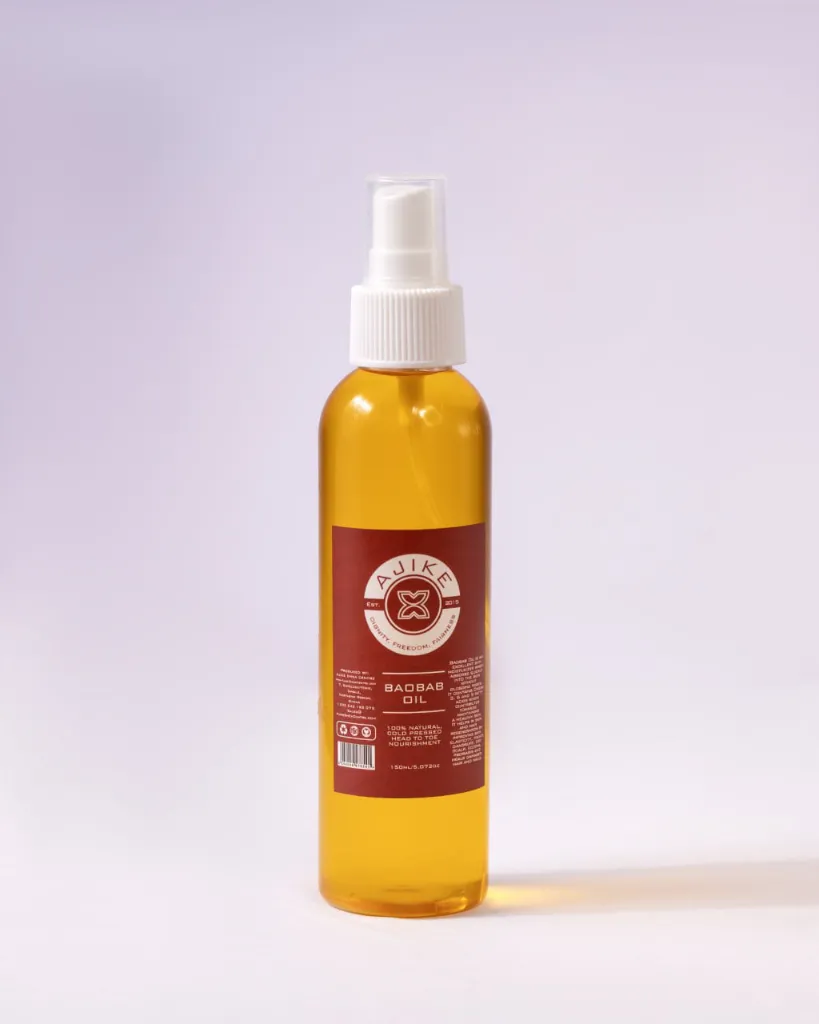
Pure Baobab Oil
100% cold pressed baobab oil with no additives. Wild harvested in West Africa and naturally rich in Vitamins A, D, E & F. A lightweight everyday oil for all skin types, all hair types and even babies.
One Pure Oil For Skin, Hair & Baby Care
Pure Baobab Oil
100% cold pressed baobab oil with no additives. Wild harvested in West Africa and naturally rich in Vitamins A, D, E & F. A lightweight everyday oil for all skin types, all hair types and even babies.
Frequently Asked Questions
For some applications, yes. For others, argan oil is better. Baobab oil is better for: acne-prone skin (higher linoleic acid), barrier repair and eczema (essential fatty acids), skin tone improvement (vitamin A), natural and textured hair as a daily sealant, and locs. Argan oil is better for: pure antioxidant protection (superior vitamin E and squalene), mature skin focused on UV damage prevention, and occasional hair finishing on fine or medium hair. Neither is universally better.
Yes. A blend of two parts baobab oil to one part argan oil combines baobab's higher linoleic acid with argan's superior vitamin E. This blend is appropriate for dry to combination skin as a daily facial oil or body oil, and for hair as a pre-shampoo or finishing treatment.
For oily, acne-prone, and combination skin: baobab oil, for its higher linoleic acid content, its lighter drier finish, and its better performance under makeup. For mature, very dry skin focused on antioxidant protection: argan oil, for its superior vitamin E and squalene content. For general normal skin: either is appropriate. Results may vary depending on skin type.
Yes. For most applications where argan oil is used, baobab oil is a direct and comparable alternative with a different emphasis: lighter texture, higher linoleic acid, broader vitamin profile, with lower vitamin E than argan. The switch is seamless for most skin and hair types. For pure antioxidant anti-aging focus where argan's vitamin E is the primary reason for using it, baobab oil is a less direct substitute for that specific application.
This depends on the skin type and concern. Baobab oil for its versatility and multi-vitamin profile across most skin types. Argan oil for antioxidant anti-aging protection. Shea butter for intensive barrier repair and eczema. Marula oil for very dry and mature skin. Neem oil for targeted antibacterial and anti-inflammatory treatment. African botanical oils collectively offer a more diverse and therapeutically complete toolkit than most other regional botanical oil traditions.
Baobab oil absorbs marginally faster and leaves a slightly drier finish. Both oils absorb considerably faster than heavy oils like castor oil or avocado oil. The practical difference between baobab and argan in absorption speed is subtle. Both are absorbed within 2 to 3 minutes when applied correctly in small amounts to slightly damp skin.
Our latest content
Check out what's new in our company !