
Start writing here...
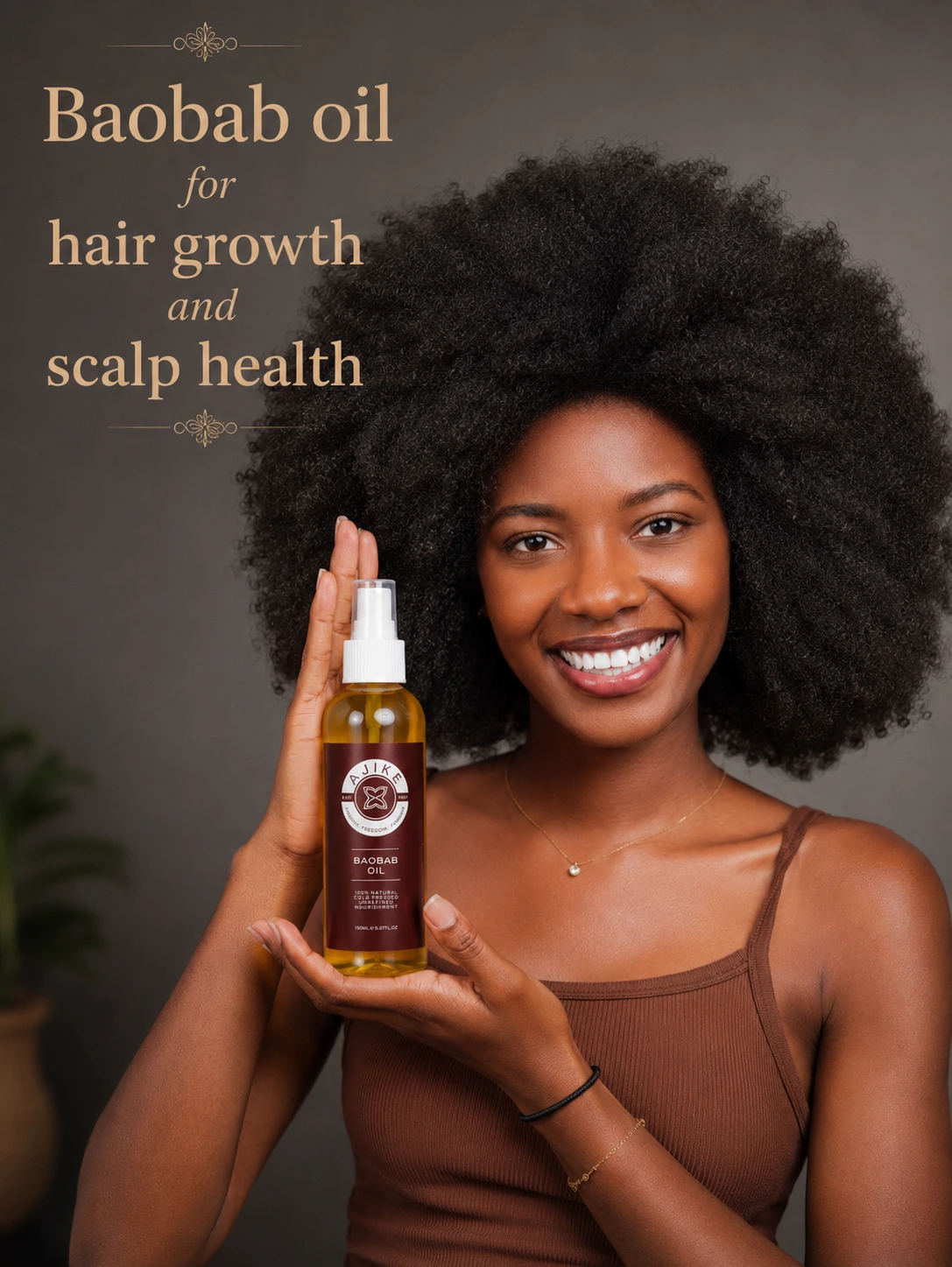
The question of whether any oil actually grows hair is one of the most searched and most misunderstood topics in natural hair care. The short answer is that no oil makes hair grow faster if the hair follicles are functioning normally. But that is only the beginning of the conversation.
Hair growth is limited by what happens at the scalp level: follicle health, scalp blood circulation, scalp inflammation, and the conditions in the scalp environment that either support or inhibit the growth cycle. An oil that supports a healthier scalp environment supports the conditions in which hair can grow to its full genetic potential. And an oil that reduces breakage means the hair that grows stays on your head longer, which produces longer hair even without accelerating the growth rate itself.
Baobab oil works in both of these directions. This guide explains exactly how, what to expect, and how to use it effectively across different hair types.
Read Also: Full baobab oil overview: Baobab Oil Benefits for Skin and Hair - Complete Guide
Understanding Hair Growth Before Talking About Oils
How the Hair Growth Cycle Actually Works
Human hair grows in a cycle with three distinct phases. The anagen phase is the active growth phase, during which the hair follicle is actively producing new hair cells and the hair shaft is lengthening. Anagen can last anywhere from 2 to 7 years depending on genetics. This is the phase that determines your maximum potential hair length.
The catagen phase is a transitional phase lasting 2 to 3 weeks, during which the follicle shrinks and detaches from the blood supply. The telogen phase is the resting phase, lasting approximately 3 months, at the end of which the old hair is shed and the follicle returns to anagen. At any given time, approximately 85 to 90 percent of your hair follicles are in anagen, 1 to 2 percent in catagen, and 10 to 15 percent in telogen.
Hair grows at approximately 1 to 1.5 centimetres per month on average, though this varies by individual and is largely genetically determined. This rate is not significantly affected by topical products, including oils.
What Scalp Health Has to Do with Hair Growth
While topical oils cannot change the genetically determined growth rate, the scalp environment significantly affects whether the follicle can grow hair to its full potential within that rate. Scalp inflammation, chronic folliculitis, significant sebum buildup, or poor scalp circulation can prematurely push follicles from anagen into telogen, shortening the active growth phase and producing shorter hair at any given time.
A healthy scalp environment, characterised by good blood circulation, a balanced microbiome, minimal inflammation, and clean follicle openings, allows each follicle to complete its full anagen phase, producing the maximum length the follicle is capable of. This is the mechanism by which scalp health support translates to visible hair growth improvement.
Why Most Hair Growth Claims Are Misleading
Most products that claim to accelerate hair growth do so by improving the conditions that allow existing hair to grow to its full potential and reduce the breakage that removes hair faster than it grows. These are genuine and meaningful benefits. But they are not the same as making hair grow faster at the cellular level.
An oil that reduces scalp inflammation, improves circulation, and reduces hair breakage will, over months of consistent use, produce noticeably more length and fullness than not using it. This is real, observable improvement. Calling it hair growth support is accurate. Claiming it makes hair grow faster than its genetic rate is not.
What Oils Can and Cannot Do for Hair Growth
Oils can: nourish the scalp skin, reduce scalp inflammation, support scalp blood circulation through massage, reduce hair strand breakage by improving moisture and flexibility, protect hair from mechanical and environmental damage, and remove or prevent scalp buildup that can clog follicle openings.
Oils cannot: accelerate the genetically determined growth rate, reverse hereditary hair loss (androgenetic alopecia), create new follicles where none exist, or produce results equivalent to pharmaceutical hair growth treatments like minoxidil or finasteride. If you have significant hair loss rather than simply slow growth or high breakage, a dermatologist is the appropriate starting point, not a topical oil.
Why Baobab Oil Is Well Suited to Hair and Scalp Care
The Fatty Acid Profile That Makes It Effective
Baobab oil's fatty acid composition is unusually well-suited to hair and scalp use. Oleic acid (33 to 38 percent) is a monounsaturated fatty acid with a molecular structure that allows it to penetrate the hair shaft cortex, providing internal conditioning that improves hair flexibility and reduces brittleness. Linoleic acid (28 to 36 percent) is an omega-6 essential fatty acid important for scalp health and the integrity of the follicle wall. Alpha-linolenic acid (3 to 5 percent) provides anti-inflammatory support relevant to scalp health.
The combination of a penetrating oleic-dominant fraction and a high linoleic acid content gives baobab oil both surface sealing and genuine internal conditioning properties that few other oils achieve simultaneously.
Vitamin A: Supporting Scalp Cell Renewal
The scalp is skin. It undergoes the same cell turnover cycle as the skin elsewhere on the body. When scalp cell turnover is sluggish or unbalanced, the result can be the accumulation of dead skin cells that block follicle openings, contribute to dandruff, and create an environment that is less conducive to healthy hair growth.
The vitamin A content of cold pressed baobab oil, in the form of beta-carotene and carotenoids, supports normal scalp cell renewal at a gentle, consistent rate. This contributes to a cleaner, more balanced scalp surface without the irritation risk that concentrated retinoid treatments carry.
Vitamin E: Antioxidant Protection for the Scalp
The scalp is exposed to the same UV radiation, pollution, and oxidative stressors as the facial skin, but it is often neglected in antioxidant care. Oxidative damage at the scalp level can contribute to follicle miniaturisation and premature follicle ageing in susceptible individuals. The tocopherols in baobab oil provide antioxidant protection to the scalp skin that reduces this oxidative damage with consistent application.
Vitamin F: Why This Is the Fatty Acid Hair Needs Most
Vitamin F, the collective term for essential fatty acids including linoleic and alpha-linolenic acid, is critical for the integrity of the follicle wall and the health of the scalp skin barrier. Deficiency in essential fatty acids is associated with dry, flaking scalp and increased hair loss. The essential fatty acid content of baobab oil directly addresses this at the scalp level.
For hair, linoleic acid is particularly important for the integrity of the lipid layer that coats each hair strand, helping the strand retain moisture and resist breakage. Baobab oil's high linoleic acid content makes it one of the best choices for this purpose among commonly available botanical oils.
Lightweight Enough to Use Without Weighing Hair Down
One of baobab oil's most practically important hair properties is its light texture. Many oils beneficial for hair health, including castor oil and coconut oil, have a heavy or thick consistency that weighs hair down, particularly fine or low-porosity hair, and creates buildup over time. Baobab oil has a light, dry-finish consistency that sits comfortably on the hair without excessive weight or buildup.
This lightness makes baobab oil appropriate for daily use as a sealant or scalp oil without the accumulation issues that heavier oils cause, particularly for those who wash their hair less frequently or who have hair that is prone to product buildup.
How Baobab Oil Penetrates the Hair Shaft
Not all oils penetrate the hair shaft. Oils with a high oleic acid content and a smaller molecular structure are more likely to penetrate into the hair cortex rather than simply coating the surface. Baobab oil's oleic acid fraction meets these criteria, providing some degree of internal conditioning alongside its surface-sealing properties.
This penetration is not equivalent to a deep conditioning treatment with a protein or a genuine penetrating conditioning agent. It is a moderate penetration that, over consistent use, contributes to improved hair flexibility and reduced brittleness. Oils that remain entirely on the hair surface provide only coating, not internal conditioning.
Baobab Oil for Scalp Health
Dry Scalp vs Dandruff: Understanding the Difference First
These two conditions look similar on the surface but have different causes and require different approaches. Dry scalp is a scalp skin condition characterised by insufficient moisture and lipid production by the scalp's sebaceous glands, leading to tightness, itching, and small dry white flakes. It is the scalp equivalent of dry skin.
Dandruff (seborrhoeic dermatitis) is caused by the overgrowth of the Malassezia yeast that naturally lives on the scalp. When Malassezia overgrows, it produces oleic acid as a metabolic byproduct, which irritates the scalp and triggers accelerated skin cell turnover, producing the characteristic larger, oilier flakes of dandruff. Dry scalp responds well to emollient oils like baobab. Dandruff requires antifungal management as well, and while baobab oil can help soothe the scalp, the yellow shea butter with burututu root, or a dedicated antifungal treatment, is more appropriate for managing Malassezia overgrowth specifically.
How Baobab Oil Addresses Dry Scalp
For dry scalp, baobab oil addresses the condition through two mechanisms. The fatty acid profile provides emollient support to the dry scalp skin, reducing tightness and itching. The essential fatty acid content (linoleic acid and alpha-linolenic acid) supports the scalp skin barrier integrity that, when compromised, leads to increased water loss and the dry, flaking conditions.
Applied to the scalp 30 to 60 minutes before washing, or used as a leave-in scalp treatment in small amounts between washes, baobab oil gradually improves the scalp's moisture retention and reduces the severity of dry scalp symptoms. Results are cumulative rather than immediate.
Scalp Inflammation and How Baobab Oil Helps
Scalp inflammation, whether from seborrhoeic dermatitis, contact dermatitis, or general scalp irritation, disrupts the normal hair growth cycle by potentially pushing follicles prematurely into the telogen phase. Chronic scalp inflammation is associated with increased hair shedding.
The alpha-linolenic acid content of baobab oil provides anti-inflammatory support through its role as a precursor to anti-inflammatory eicosanoids. The vitamin E content provides antioxidant protection against the oxidative stress that drives scalp inflammation. Applied consistently as a scalp oil, baobab oil helps moderate the inflammatory environment that can interfere with healthy hair growth.
Improving Blood Circulation Through Scalp Massage with Baobab Oil
Scalp massage, regardless of the oil used, has documented benefits for hair growth through improved blood circulation to the scalp. A study published in the journal Stem Cells Translational Medicine found that regular scalp massage increased hair thickness in men with alopecia over a 24-week period. The mechanical stimulation of scalp massage increases blood flow to the dermal papilla, the vascular structure at the base of the hair follicle that supplies the nutrients needed for hair cell production.
Using baobab oil as the medium for scalp massage serves two purposes: the oil reduces friction, making massage more comfortable and more thorough, and the oil's nutrients are delivered directly to the scalp during the massage. A 4 to 5 minute scalp massage with baobab oil before washing, 2 to 3 times per week, provides meaningful scalp circulation support over time.
Scalp Buildup and How to Clear It Before Applying Oil
Applying oil to a scalp with significant product buildup is counterproductive. The oil seals the buildup in place rather than nourishing the scalp beneath. Before using baobab oil as a scalp treatment, ensure the scalp is free from excessive buildup from previous products, hard water mineral deposits, or accumulated dead skin cells.
A gentle clarifying wash with our Marula and Baobab Anti-Breakage Shampoo, or a scalp scrub with sugar and a light oil, before your baobab oil scalp treatment session removes buildup and creates a clean scalp surface that the oil can actually reach and nourish.
How Often to Apply Baobab Oil to the Scalp
For dry scalp: 2 to 3 times per week as a pre-wash treatment. Apply to the scalp, massage for 4 to 5 minutes, leave for 30 to 60 minutes, then wash. Alternatively, apply a very small amount as a leave-in scalp treatment between washes on the driest areas.
For general scalp health and hair growth support: once a week pre-wash treatment with scalp massage is sufficient for most people. More frequent application does not necessarily produce faster results and can contribute to buildup if not thoroughly washed out.
Baobab Oil for Hair Breakage
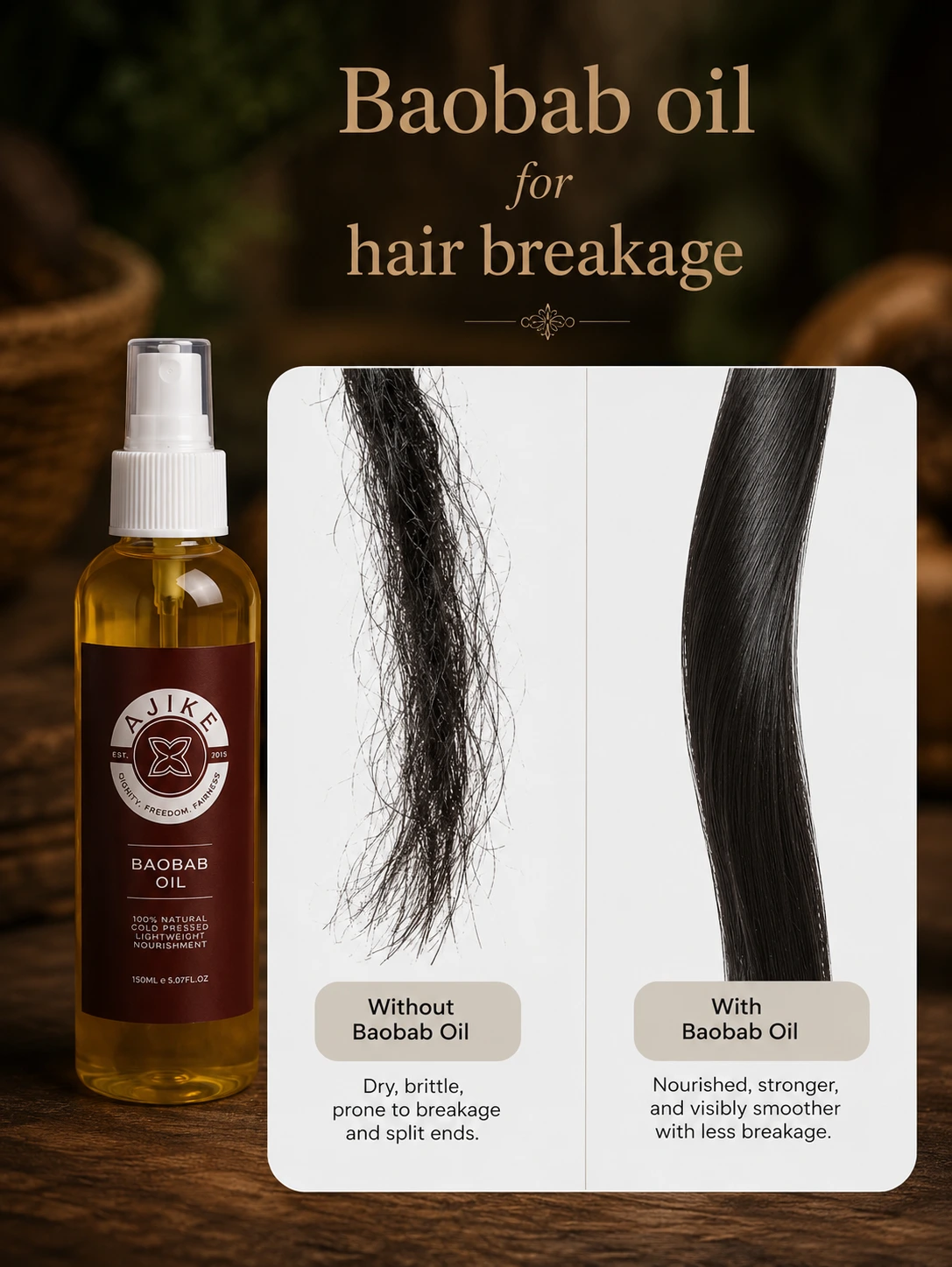
What Causes Hair Breakage in Natural and Textured Hair
Hair breakage is distinct from hair loss. Hair loss involves the hair falling from the follicle with the root attached. Breakage is the snapping of the hair shaft itself, midway along the strand, due to mechanical stress, dryness, or structural damage.
Natural and textured hair is inherently more prone to breakage than straight hair because of its structure. The coils and kinks in 3C, 4A, 4B, and 4C hair create points of structural stress along the strand. These points of curvature are where breakage most commonly occurs, particularly when the hair is dry and lacks flexibility. Every time a dehydrated, brittle coil is manipulated, combed, or stretched, it risks snapping at these stress points.
How Baobab Oil Reduces Breakage at the Strand Level
Baobab oil reduces breakage through two mechanisms. First, as a surface sealant applied after washing and conditioning on damp hair, it seals the moisture from the conditioning process into the hair strand, keeping the strand hydrated and flexible between washes. Well-hydrated hair is significantly more elastic and resistant to the snapping that causes breakage.
Second, the oleic acid fraction of baobab oil penetrates into the hair cortex, providing internal conditioning that improves the hair's own elasticity at a structural level. Hair that has been regularly conditioned with a penetrating oil is genuinely more flexible and stronger than hair that has only had surface coating.
The Protein-Moisture Balance Connection
Healthy hair requires a balance of protein and moisture. Hair is primarily made of keratin, a protein. When that protein structure is intact, the hair is strong and resilient. When it is damaged by heat, chemical processing, or environmental stress, the protein structure is compromised, making the hair weak and prone to breakage.
Oils like baobab oil address the moisture side of this balance, sealing hydration into the strand and maintaining flexibility. They do not address the protein side. If your hair is highly damaged from chemical processing or significant heat damage, protein treatments (using products containing hydrolysed proteins) alongside baobab oil moisturisation will be more effective than baobab oil alone. The protein rebuilds the structural integrity, and the baobab oil maintains the moisture balance alongside it.
Using Baobab Oil as a Protective Sealant
Applied as the last step of your wash day routine, after all water-based products have been applied to damp hair, baobab oil seals the moisture in. The key is the order: water or water-based leave-in first, cream or butter second (if using), oil last. Applying oil before water-based products blocks them from entering the hair strand. Applying oil last seals everything inside.
For the LOC method: Liquid (water or leave-in), Oil (baobab oil, 2 to 3 drops through the hair), Cream (leave-in cream or butter). For the LCO method: Liquid, Cream, then Oil. Both are effective; the choice depends on your hair's porosity and how it responds to each sequence.
Pre-Shampoo Treatment: How and Why It Works
A pre-shampoo (pre-poo) treatment with baobab oil before washing provides intensive conditioning that is partially preserved through the shampooing process. The oil coats the hair shaft before the shampoo comes into contact with it, reducing the degree to which the shampoo's surfactants strip the hair's natural lipids and the conditioning from any previous treatment.
Apply 3 to 5 drops to each section of dry or slightly damp hair from root to tip. Focus particularly on the ends, which are the oldest and most fragile part of the hair. Twist or braid each section after oiling. Leave for 30 to 60 minutes, or overnight. Then shampoo and condition as normal. The hair will feel noticeably more moisturised and less tangled after washing than without the pre-poo treatment.
Baobab Oil for Natural Hair
Why Natural and Textured Hair Loses Moisture Faster
The coil structure of natural and textured hair prevents the natural sebum produced by the scalp from travelling down the hair shaft as effectively as it does in straight hair. In straight hair, gravity and the smooth hair surface allow sebum to coat the strand naturally from root to tip. In coily hair, the sebum accumulates at the scalp and base of the hair but does not distribute evenly along the shaft. The result is that the mid-lengths and ends of natural and textured hair are chronically under-moisturised relative to the roots.
This structural reality means natural hair requires consistent, deliberate external moisture support that is then sealed in with an oil. Without consistent sealing, moisture evaporates from the hair strand rapidly, particularly in dry environments or during winter.
How Baobab Oil Seals Moisture into Coily and Kinky Hair
For 4A, 4B, and 4C hair types, baobab oil applied after a water-based leave-in on damp hair creates a thin lipid seal around each coil that significantly slows moisture evaporation from the strand. The light texture of baobab oil is particularly suited to these tight curl patterns, which are easily weighed down by heavier oils.
The application technique matters: distribute 2 to 3 drops between palms, then work through sections of damp hair from mid-length to ends, fingertip-coiling or shingling through the sections to ensure even distribution. Avoid applying too much directly to the scalp area unless you are doing a dedicated scalp treatment.
Shrinkage and How Baobab Oil Helps Manage It
Shrinkage is the reduction in apparent hair length that occurs when natural and textured hair is in its natural coiled state versus when it is stretched or straightened. Shrinkage of 50 to 75 percent is not unusual for 4C hair. Shrinkage itself is not a problem. It is a sign of healthy hair elasticity and moisture. The issue arises when people try to fight shrinkage in ways that cause damage.
Baobab oil does not prevent shrinkage, nor should it. What it does is support the moisture retention that keeps the hair in its most healthy, elastic, protected coiled state. Well-moisturised and sealed hair tends to have more defined curl patterns and slightly less extreme shrinkage than dry, dehydrated hair. The baobab oil is supporting the moisture, which in turn supports the coil pattern.
Using Baobab Oil in the LOC and LCO Method
The LOC method (Liquid, Oil, Cream) and LCO method (Liquid, Cream, Oil) are moisture layering techniques commonly used in natural hair care to maximise and extend the moisture retention between wash days. Baobab oil works in both methods.
In the LOC method: start with a water-based leave-in or simply wet hair, apply 2 to 3 drops of baobab oil through the hair to seal the initial moisture, then layer a cream or butter over the oil. This sequence provides a thin oil seal between the water layer and the cream, with the cream providing an additional barrier on top.
In the LCO method: start with water or leave-in, apply the cream directly over the wet hair, then seal with baobab oil as the final step. For low-porosity hair that finds cream application before oil more effective, LCO is typically the better sequence.
Baobab Oil as a Daily Moisturising Sealant for Natural Hair
Between wash days, natural hair benefits from daily or every-other-day moisture refreshing. A light mist of water or a diluted leave-in spray to the hair, followed by 1 to 2 drops of baobab oil worked through the hands and applied to the hair, provides a quick daily refresh that maintains moisture levels without overloading the hair with product.
This daily sealing approach is particularly effective for 4B and 4C hair that loses moisture quickly in dry environments. The baobab oil's light texture means it does not accumulate in the way that heavier daily sealants do, making it sustainable for daily use between wash days without requiring frequent clarifying washes.
Baobab Oil for Locs and Dreadlocks
The Specific Moisture Needs of Locs
Locs have a unique structure that creates specific moisture challenges. Mature locs are tightly compressed hair fibres that are more difficult to moisture-penetrate than loose hair. The interior of a loc can be significantly dryer than the outer surface, and this internal dryness contributes to brittleness and breakage at the loc shaft.
At the same time, locs are prone to product buildup because the compressed structure traps product residue inside the loc over time, creating a sticky interior accumulation that is difficult to fully remove even with washing. This buildup can eventually contribute to thinning at the loc base and scalp issues if left unaddressed.
Why Most Oils Cause Buildup in Locs
Heavy oils with high saturated fatty acid content, such as castor oil, coconut oil, and heavy butters, are particularly problematic for locs because they penetrate the compressed loc structure poorly and accumulate on the surface and outer fibres. With repeated application, this accumulation traps dirt and debris, creates a heavy coating that reduces the loc's flexibility, and eventually requires intensive clarifying treatments to remove.
How Baobab Oil Behaves Differently in Locs
Baobab oil's light, fast-absorbing texture makes it significantly less prone to buildup in locs than heavier alternatives. Its oleic acid content gives it some penetrative capacity into the compressed loc structure, providing moisture that reaches the interior fibres rather than simply coating the surface. And because it absorbs more completely into the hair, the residue left on the loc surface between applications is minimal.
Over consistent use, baobab oil helps maintain the moisture balance in locs without creating the accumulation that leads to the heavy, dull appearance and reduced flexibility of oil-overloaded locs.
How to Apply Baobab Oil to Locs Without Residue
Apply baobab oil to locs by placing 1 to 2 drops in your palm, rubbing hands together lightly, then running your hands along each loc from base to tip. The goal is a thin, even coating rather than a saturating application. The locs should look slightly more lustrous but not obviously oily or wet.
Alternatively, for a more targeted scalp application, apply drops directly to the scalp between locs and massage gently. This nourishes the scalp without adding product to the locs themselves. This approach is particularly appropriate if your locs are already well-moisturised and you are targeting scalp health specifically.
How Often to Oil Locs with Baobab Oil
For daily maintenance: 1 to 2 drops worked through the hands and applied to all locs provides a light daily moisture seal. For intensive scalp treatment: apply to the scalp between locs, massage for 3 to 4 minutes, leave for 30 to 60 minutes, then wash with a residue-free shampoo. Once a week or every two weeks for intensive scalp treatment, daily light oiling for moisture maintenance.
How to Use Baobab Oil on Hair: Complete Application Guide
Application Method | Amount and Timing | Best For |
Pre-Shampoo Treatment | 3-5 drops per section, 30-60 min before washing | Breakage, dry hair, damaged hair, all natural hair types |
Post-Wash Sealant | 2-3 drops total on damp hair, last step | Moisture retention, LOC/LCO method, all types |
Daily Scalp Oil | 2-3 drops to scalp, massage 4-5 mins | Scalp health, circulation, dry scalp, hair growth support |
Hot Oil Treatment | 4-6 drops, warm gently, 20-30 min with heat | Intensive conditioning, dry/high-porosity hair |
Daily Moisturiser Refresh | 1-2 drops through hands, applied to hair | Between wash days, locs, shrinkage management |
Split End Treatment | 1 drop, focused on ends only | Ends protection, chemically treated hair, fine hair |
As a Pre-Shampoo Treatment
Divide dry or slightly damp hair into sections. Apply 3 to 5 drops of baobab oil to each section, distributing from roots to ends. Twist or loosely braid each section after application. Cover with a shower cap or plastic cap, optionally applying gentle warmth from a hooded dryer or warm towel for 15 to 20 minutes to improve penetration. Leave for at least 30 minutes and up to overnight before shampooing and conditioning as normal.
As a Post-Wash Sealant on Damp Hair
After washing and conditioning, section damp hair. Apply all water-based leave-in products first. Then take 2 to 3 drops of baobab oil in your palms, rub together lightly, and work through each section from mid-length to ends. Follow with cream or butter if using the LOC method. Style as normal. The baobab oil seals the moisture from the leave-in into the hair strand.
As a Daily Scalp Oil
Part the hair to expose the scalp. Apply 1 to 2 drops directly to the scalp along the parting. Use fingertips to massage in small circular movements for 4 to 5 minutes, working systematically across the scalp. Re-part to reach new sections. The massage is as important as the oil: the mechanical stimulation improves scalp blood flow independently of any benefit from the oil itself.
As a Hot Oil Treatment
For a hot oil treatment, place 4 to 6 drops of baobab oil in a small bowl and set the bowl in warm water for a few minutes until the oil is comfortably warm but not hot. Test the temperature on your wrist. Apply the warmed oil to sections of dry or damp hair from root to tip. Cover with a plastic cap and apply gentle heat from a hooded dryer or warm towel for 20 to 30 minutes. The warmth slightly swells the hair cuticle, allowing better penetration of the oil. Follow with a gentle shampoo and condition.
Mixed with Other Oils for a Custom Blend
Baobab oil blends well with other botanical oils for a customised hair oil. Effective combinations include: baobab oil and castor oil (the castor oil adds thickness and coating weight for coarser hair types, while the baobab provides the light nutrients), baobab oil and rosemary essential oil diluted at 2 to 3 drops per 10ml (rosemary has documented scalp circulation benefits), or baobab oil and our Hair and Scalp Luxury Oil blend for an enhanced treatment.
For Hair Ends and Split End Prevention
The ends of the hair are the oldest, most fragile, and most moisture-depleted part of the strand. Applying 1 drop of baobab oil focused specifically on the ends as the last step in any hair routine provides targeted protection for the most vulnerable part of the hair. For those trying to retain length, ends care is as important as any other part of the hair routine.
Baobab Oil for Different Hair Types
Fine and Low-Porosity Hair
Fine hair has a smaller diameter and is more easily weighed down by heavy products. Low-porosity hair has a tightly sealed cuticle that resists moisture absorption and product penetration. For both types, baobab oil's light, fast-absorbing texture is a significant advantage over heavier oils.
For fine and low-porosity hair: use 1 to 2 drops maximum for the full head of hair. Apply to damp or wet hair rather than dry hair, as the water helps lift the cuticle slightly and allows better penetration on low-porosity hair. Focus primarily on the ends. Avoid heavy scalp application that can make fine hair appear flat.
Medium and Normal Porosity Hair
Medium and normal porosity hair has the most flexibility in application method and amount. The cuticle opens and closes normally in response to moisture and products, allowing oils to penetrate and provide both surface and some internal conditioning. Baobab oil works well for this hair type in all application methods described above. 2 to 3 drops for the full head is generally appropriate.
Thick, Coarse and High-Porosity Hair
High-porosity hair has a more open, more damaged, or structurally more porous cuticle that absorbs products quickly but loses moisture just as quickly. Thick and coarse hair has a larger diameter and needs more product to achieve effective coverage. For high-porosity and coarse hair, a slightly larger amount of baobab oil (3 to 5 drops) may be appropriate, and the oil can be layered with a heavier butter or cream to create a more substantial sealing layer.
For high-porosity hair specifically, the pre-shampoo treatment with baobab oil is particularly beneficial: it provides a conditioning oil layer before washing that reduces the degree to which the highly porous cuticle loses additional moisture and condition during the wash process.
Chemically Treated and Relaxed Hair
Chemical relaxers and colour treatments alter the hair's protein structure and increase porosity, making the hair more fragile and more prone to breakage. Baobab oil's combination of internal conditioning from oleic acid and moisture sealing from its overall fatty acid profile is particularly beneficial for chemically treated hair.
Apply baobab oil as a pre-shampoo treatment every wash day for chemically treated hair, and as a post-wash sealant in the LOC or LCO method. The protein-moisture balance is especially important for relaxed hair: use baobab oil alongside protein treatments rather than as a substitute for them.
Transitioning Hair
Transitioning hair, the period of growing out chemical relaxers while maintaining natural new growth, creates a unique challenge: two different textures of hair on the same strand, with the line of demarcation between them being the weakest point and most likely to break. Managing the moisture balance at the line of demarcation is critical for retaining length through a transition.
Baobab oil applied as a pre-shampoo treatment and a post-wash sealant, with particular attention to the line of demarcation, helps maintain flexibility at this most vulnerable point and reduces the breakage that transitions are notorious for. Protective styles during the transition also significantly reduce the mechanical stress on the line of demarcation.
How Long Before You See Results on Hair and Scalp
Week 1 and 2: What Changes First
The most immediate and noticeable change in the first two weeks is in how the hair feels and behaves. Hair that has been regularly sealed with baobab oil retains moisture better between wash days. If you are using it as a pre-shampoo treatment, the hair will feel more moisturised and less tangled after washing than without the pre-poo. For scalp application, the scalp may feel less tight and itchy within the first few applications if dry scalp was present.
Visible length change is not expected in the first two weeks. Hair grows approximately 1 to 1.5 cm per month, and changes in hair growth environment take time to translate into visible results.
Week 3 and 4: Scalp and Strand Improvements
By weeks 3 and 4, most consistent users notice that their hair is retaining length better between trims. The moisture sealing effect reduces breakage, and hair that was previously snapping at the ends begins to retain more length. Scalp health improvements from regular oil massages become more noticeable: less tightness, less flaking, and potentially reduced shedding if scalp inflammation was a contributing factor.
Month 2 and Beyond: Hair Strength and Growth Environment
By month 2, the cumulative effect of consistent moisture sealing and scalp support becomes more visible. Hair that has been consistently sealed and protected looks thicker, fuller, and longer than it did without the routine. Scalp health improvements, if scalp inflammation or dryness was present, are well established. Users who were experiencing significant breakage often notice a meaningful reduction in the amount of hair left in combs, brushes, and on clothing.
These results continue to compound with consistent practice. At month 3 and beyond, the combination of reduced breakage and a supported scalp environment produces visible length retention that looks, to an outside observer, like the hair is growing faster. It is not. The hair is simply being retained.
What Affects How Fast You See Results
- Hair type and porosity: low-porosity hair takes longer to show moisture benefits as the cuticle requires specific conditions (warmth, wet hair) for optimal product penetration
- Consistency of application: weekly pre-poo with daily sealing produces faster results than occasional use
- Baseline hair condition: significantly damaged or chronically dry hair shows more dramatic improvement than already-healthy hair
- Scalp health: those with scalp conditions (dry scalp, seborrhoeic dermatitis) see faster scalp results when these conditions are actively addressed
- Use alongside appropriate protein treatments: for damaged hair, protein-moisture balance accelerates improvement
- Protective styling: reduces mechanical breakage, amplifying the effect of the baobab oil moisture retention
Ajike Products That Use Baobab Oil for Hair
Ajike Pure Baobab Oil: For Scalp and Strand Use
Our Pure Baobab Oil is 100 percent cold pressed baobab oil with no additives, the purest form for direct scalp and hair use. This is the product for pre-shampoo treatments, scalp massage, the oil step in the LOC or LCO method, and all direct application techniques described in this guide. The dark amber glass bottle protects the oil from light degradation.
Seal In Moisture From Scalp To Ends
Pure Baobab Oil
100% cold pressed baobab oil with no additives. Ideal for scalp massage, pre-shampoo care, post-wash sealing, locs and all hair types.
View Product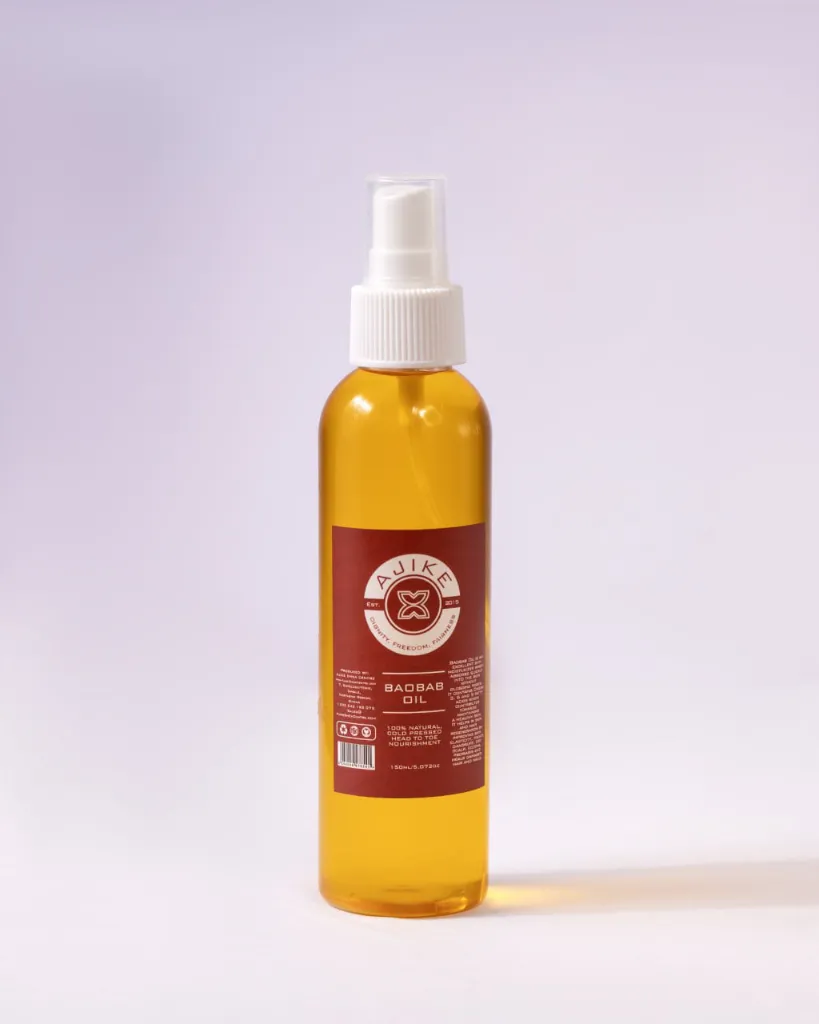
Seal In Moisture From Scalp To Ends
Pure Baobab Oil
100% cold pressed baobab oil with no additives. Ideal for scalp massage, pre-shampoo care, post-wash sealing, locs and all hair types.
View Product
Ajike Hair and Scalp Luxury Oil: A Baobab-Based Blend
Our Hair and Scalp Luxury Oil uses baobab oil as the base, blended with additional botanical oils and a curated essential oil complex designed to support scalp health and hair growth. The rosemary component in the blend has clinical evidence for scalp circulation support comparable in one published study to 2 percent minoxidil over 6 months. This blend is our most targeted product for hair growth support specifically.
Ajike Marula and Baobab Anti-Breakage Shampoo
Our Anti-Breakage Shampoo combines the cleansing action of a gentle surfactant system with marula and baobab oil integrated into the formula, which means the cleansing step also delivers some oil nourishment to the hair shaft rather than stripping it entirely. For hair prone to breakage, a shampoo that cleans without complete lipid stripping reduces the breakage that can occur during the wash step itself.
Ajike Marula and Baobab Anti-Breakage Conditioner Range
Our Anti-Breakage Conditioner and Leave-In Conditioner are formulated with marula and baobab oil as key conditioning agents. The conditioner provides the main conditioning and detangling step after shampooing. The leave-in extends this conditioning through the styling process. Both work best when followed by Ajike Pure Baobab Oil as the sealing step in the LOC method.
How to Build a Complete Baobab Hair Routine with Ajike
A complete Ajike baobab oil hair routine for natural hair:
- Pre-poo (30-60 min before washing): Ajike Pure Baobab Oil to sections of dry hair, scalp massage included
- Shampoo: Ajike Marula and Baobab Anti-Breakage Shampoo, gentle lather, 1 to 2 minutes
- Condition: Ajike Marula and Baobab Anti-Breakage Conditioner, 3 to 5 minutes, detangle, rinse
- Leave-in: Ajike Marula and Baobab Leave-In Conditioner to damp hair
- Seal (LOC/LCO): Ajike Pure Baobab Oil, 2 to 3 drops, through mid-lengths and ends
- Scalp (between washes): Ajike Hair and Scalp Luxury Oil to scalp, 2 to 3 times per week with massage
Ajike Pure Baobab Oil: Wild Harvested and Cold Pressed
Where Our Baobab Oil Comes From
Ajike's baobab oil is wild harvested and cold pressed in West Africa from baobab trees growing in their natural savannah environment. The same environmental conditions that produce the baobab tree's exceptional vitamin and fatty acid profile in the skin application context are directly relevant for hair and scalp use: the vitamin A supports scalp cell renewal, the vitamin E provides antioxidant scalp protection, and the high linoleic acid content supports follicle wall integrity.
Why Cold Pressed Matters for Hair Use Specifically
The polyunsaturated fatty acids in baobab oil, particularly linoleic and alpha-linolenic acid, are heat-sensitive. Refining through high-temperature deodorisation degrades these fatty acids and reduces the vitamin A content. For hair use, where these specific compounds are among the most therapeutically relevant properties, cold pressed is the only extraction method that preserves the full nutrient profile.
A pale or colourless baobab oil for hair use is giving you the emollient properties of the remaining saturated fats but very little of the vitamin and essential fatty acid content that makes cold pressed baobab oil distinctively effective.
100 Percent Pure: No Dilution, No Additives
Our baobab oil is not diluted with cheaper carrier oils and contains no synthetic additives, fragrances, preservatives, or silicones. For hair use where product buildup is a concern, knowing that every ingredient in the formula is pure baobab oil means there are no hidden ingredients contributing to accumulation on the hair or scalp. One ingredient. Everything it does is from the baobab itself.
Suitable for All Hair Types Including Fine and Low-Porosity
The light, fast-absorbing texture of Ajike Pure Baobab Oil makes it one of the few botanical oils genuinely suitable for fine and low-porosity hair alongside the coarser, higher-porosity hair types it is more commonly associated with. Fine hair users who have found every other oil too heavy, buildup-inducing, or flat-producing on their hair will find baobab oil behaves differently.
Start with 1 to 2 drops for fine hair. Adjust upward based on how the hair responds. Apply to wet or very damp hair. These simple adjustments make baobab oil as appropriate for fine, low-porosity hair as for any other type.
Frequently Asked Questions
Baobab oil supports the scalp health conditions that allow hair to grow to its full genetic potential, and it reduces breakage so that the hair that does grow is retained rather than lost. It does not accelerate the genetically determined growth rate of the hair follicle. The visible result, over consistent use, is more length and fullness because the hair is growing in a healthier environment and breaking less. This is genuine improvement. It is not the same as a pharmaceutical hair growth stimulant.
For hair growth support specifically: apply 2 to 3 drops to the scalp in sections, massage for 4 to 5 minutes in small circular movements, 2 to 3 times per week. This scalp massage with baobab oil improves scalp circulation and delivers the oil's vitamin and fatty acid nutrients directly to the follicle environment. Combine with Ajike Hair and Scalp Luxury Oil for a more targeted blend that includes rosemary and other scalp circulation-supporting botanicals.
Yes. A light application of baobab oil to damp hair before bed, covered loosely with a silk or satin bonnet or pillowcase, provides overnight moisture sealing that is particularly effective for natural and textured hair that loses moisture quickly. Use a small amount (1 to 2 drops for a light treatment) to avoid excess transfer to the bonnet or pillow.
Daily to every other day as a light moisture sealant on natural hair. Once weekly as a pre-shampoo treatment. Two to three times per week for scalp massage. The frequency depends on which application method you are using and your hair's specific needs. There is no upper limit that would cause damage, but applying too much too frequently can cause buildup even with a light oil.
Yes. Baobab oil's light texture and fast absorption make it one of the better oils for locs because it provides conditioning and moisture sealing without the heavy buildup that causes locs to become stiff, dull, and heavy over time. Apply 1 to 2 drops per loc for maintenance, or use as a scalp oil between locs for scalp health without adding product to the locs themselves.
For dry scalp: apply 2 to 3 drops directly to the scalp between hair sections, massage gently for 4 to 5 minutes, and leave for 30 to 60 minutes before washing. The massage supports scalp circulation, and the oil's fatty acids and vitamins nourish the dry scalp skin. For ongoing dry scalp management, do this 2 to 3 times per week as a pre-wash scalp treatment.
Our latest content
Check out what's new in our company !