
Start writing here...
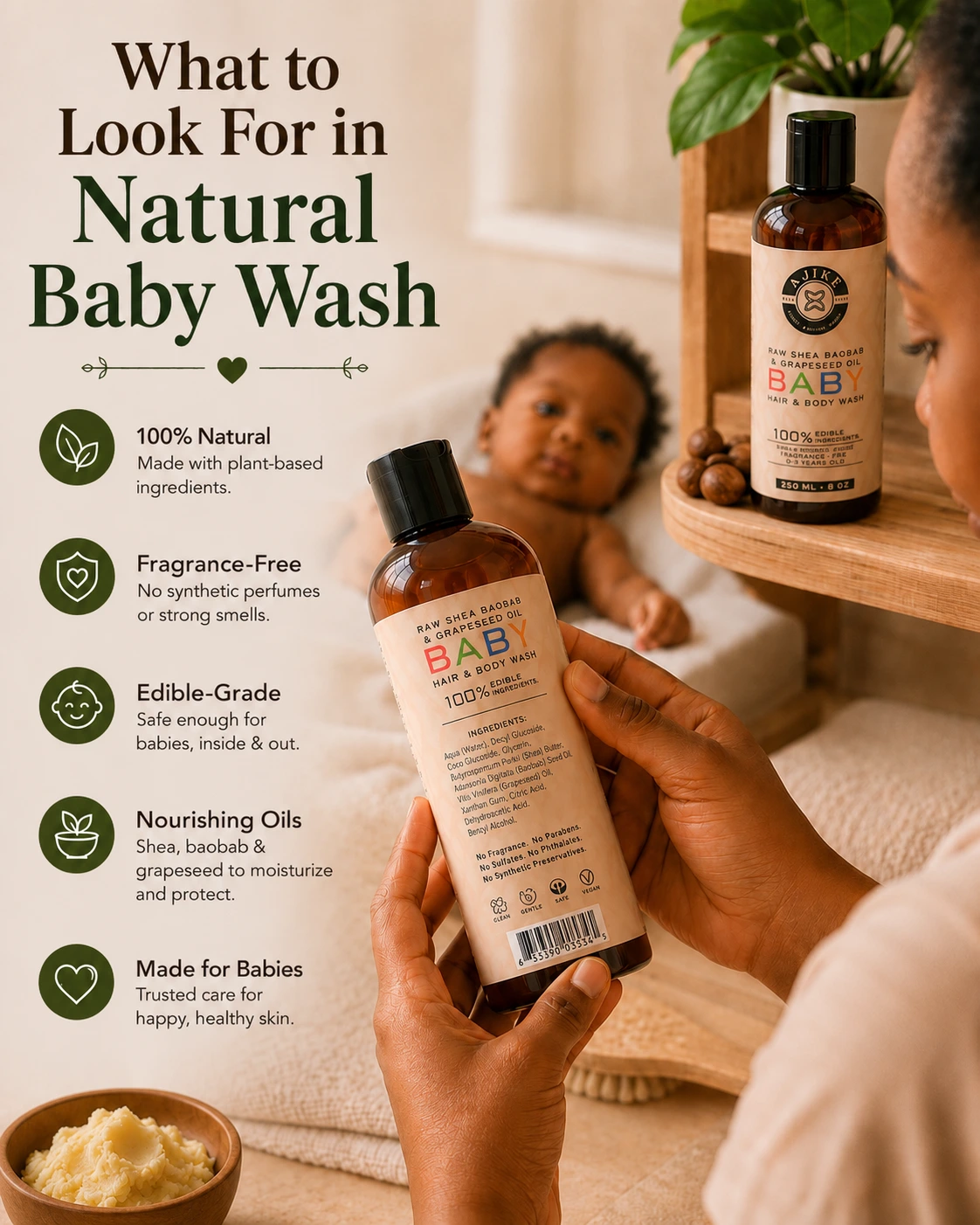
Most parents spend time reading the front of baby wash bottles. They look for the words natural, gentle, and hypoallergenic. They look for reassuring images of infants. They look for the paediatrician-tested seal. Very few turn the bottle around and read the ingredient list.
The front of the bottle is marketing. The ingredient list on the back is the actual content of the product. And in the baby wash category, there is often a significant gap between what the front promises and what the back reveals.
This guide gives you the practical knowledge to read that back label accurately: which ingredients to avoid and why, which are genuinely beneficial for baby skin, how to understand the surfactant system that does the actual cleaning, and what a genuinely safe baby wash should contain.
Read Also: Complete baby skincare foundation: Natural Baby Skincare - Why Edible-Grade Ingredients Are the Safest Choice →
Why Baby Wash Ingredients Deserve More Attention Than They Get
Why Baby Wash Is One of the Riskiest Product Categories for Hidden Irritants
Baby wash occupies a specific risk category in infant skincare because it is a surfactant-containing, water-based product used multiple times per week on a baby whose skin barrier is at its most immature. Water-containing products require preservation. Surfactants have variable irritation profiles. The combination of a stripping cleansing mechanism and a preservation system creates multiple potential exposure points in a single product.
Additionally, baby wash is used at a moment of increased skin permeability: during or after warm water bathing, when the stratum corneum is temporarily more permeable than at other times. Any irritating or sensitising ingredient in a baby wash is being applied at exactly the moment when the skin is most likely to absorb it.
How Frequent Use Amplifies the Risk of Any Problematic Ingredient
The risk of any cosmetic ingredient is not determined solely by its inherent toxicity or irritation potential. It is also a function of frequency of exposure. An ingredient that produces a minimal reaction on a single exposure may produce a sensitisation reaction with repeated exposure over months. Baby wash used daily from birth produces hundreds of applications in the first year of life.
Fragrance compounds are the clearest example of this exposure-sensitisation relationship. A single exposure to a fragrance chemical rarely produces a reaction. Repeated daily exposure over months to the same fragrance compounds can establish a sensitisation in the immune system that then produces increasingly significant reactions on subsequent exposure, not just to that product but to any product containing the same fragrance chemicals.
Why Newborn and Infant Skin Absorbs More Than Adult Skin
The developing skin barrier of newborns and infants is more permeable than adult skin. The stratum corneum is thinner. The cell junctions are less tight. The acid mantle is less acidic and therefore less effective at resisting penetration. The higher surface-area-to-weight ratio means that relative to body weight, a baby's total topical exposure from a full-body wash is proportionally much greater than the equivalent for an adult.
Ingredients that remain safely on the surface of adult skin may penetrate to systemic levels in infant skin during the period of barrier immaturity. This is not a theoretical concern. It has been documented for some preservatives and for fragrances in neonatal skincare studies.
Why Regulatory Approval Does Not Mean Safe for Sensitive Baby Skin
In most markets, baby wash is regulated as a cosmetic, not as a pharmaceutical. Cosmetic regulations require that ingredients are safe under normal use conditions, a standard developed with adult skin use in mind. The specific vulnerabilities of infant skin, including higher absorption rate, developing acid mantle, immature immune system, and oral contact with skin, are not factors that cosmetic safety assessments are designed to fully account for.
A product can legally carry a newborn-safe claim while containing ingredients that paediatric dermatology guidelines recommend avoiding for infants. Regulatory approval establishes a floor, not a ceiling. For baby products, the floor of regulatory compliance is not high enough, which is why independent label reading is necessary.
The Ingredients to Avoid in Baby Wash
Ingredient Category | Specific Names to Watch For | Primary Concern |
Sulfate Surfactants | Sodium lauryl sulfate, sodium laureth sulfate | Strips acid mantle, disrupts developing barrier |
Synthetic Fragrance | Parfum, Fragrance (anywhere on list) | Most common contact allergen; lifelong sensitisation risk |
MIT / MCI | Methylisothiazolinone, methylchloroisothiazolinone | Most reactive preservatives; contact dermatitis association |
Parabens | Methylparaben, propylparaben, butylparaben | Endocrine disruption debate; conservative exclusion for babies |
Formaldehyde Releasers | DMDM hydantoin, imidazolidinyl urea, diazolidinyl urea | Release formaldehyde; sensitiser and potential carcinogen |
PEGs / Polysorbates | PEG-anything, polysorbate-20, polysorbate-80 | Penetration enhancers that increase absorption of other ingredients |
Artificial Colours | CI numbers, FD&C colours, D&C colours | No function in baby wash; unnecessary sensitisation risk |
Sodium Lauryl Sulfate and Sodium Laureth Sulfate: The Barrier-Stripping Surfactants
SLS and SLES create heavy lather and effective cleansing by aggressively disrupting the lipid barrier of the skin surface. For an adult, the skin barrier recovers relatively quickly from this disruption. For a newborn whose acid mantle is in the process of developing and whose barrier function is at its most immature, repeated SLS exposure can significantly impair the normal progression of barrier development.
Research specifically examining surfactant effects on newborn skin has identified pH-neutral or slightly acidic, low-irritation surfactant systems as the appropriate choice for infant cleansers. SLS fails both criteria: its pH is higher than infant skin's natural range, and its irritation potential is among the highest of commonly used surfactants.
Synthetic Fragrance: The Single Biggest Risk in Baby Wash
Synthetic fragrance compounds are the most common cause of contact dermatitis in cosmetics across all age groups. In the infant age group, the concern extends beyond immediate contact reactions to the longer-term risk of immune sensitisation. The immune system is actively developing in infancy, and the patterns of immune tolerance and reactivity being established during this period are influenced by the allergens the developing immune system encounters.
Repeated exposure to fragrance compounds during infancy can establish sensitisation patterns that persist throughout life, producing fragrance allergy in adults that began with infant exposure. Because the specific fragrance compounds that are most commonly sensitising are not required to be individually listed (they may all be listed collectively under parfum or fragrance), a parent reading a baby product label cannot know which sensitising chemicals are present or at what concentration.
Methylisothiazolinone and Methylchloroisothiazolinone: The Most Reactive Preservatives
MIT and MCI are biocide preservatives that became widely used in baby products in the early 2000s. By the mid-2010s, a wave of contact dermatitis cases attributable to these preservatives led to regulatory restrictions in the EU, where they were banned from rinse-off products. Their use in some markets continues, and they may appear in baby wash products not subject to EU restrictions.
MIT in particular is an extremely potent contact allergen. The concentrations that provide effective preservation in a product are at or above the concentrations shown to cause sensitisation in patch testing. For a product used on baby skin from birth, the presence of MIT or MCI is a disqualifying concern.
Parabens: Why the Debate Is Not Over for Baby Products
The paraben debate in cosmetics has evolved significantly since the initial concerns about endocrine disruption were published in the early 2000s. Regulatory bodies in most markets have concluded that parabens at typical cosmetic concentrations are safe for adult use. The debate is not fully resolved, however, particularly for the longer-chain parabens (butylparaben, isobutylparaben) which have demonstrated more significant endocrine activity in vitro, and particularly for infant exposure where the developing endocrine system may be more susceptible.
The conservative approach for baby products, appropriate when the evidence is uncertain and the population is particularly vulnerable, is to choose paraben-free formulations where effective paraben-free alternatives exist. For baby wash, several effective preservation systems do not require parabens.
DMDM Hydantoin and Formaldehyde-Releasing Preservatives
DMDM hydantoin, imidazolidinyl urea, diazolidinyl urea, and several other preservatives work by releasing small amounts of formaldehyde over time to prevent microbial growth in the product. Formaldehyde is a known contact allergen and a classified carcinogen at higher concentrations. The concentrations released by these preservatives in cosmetic products are very low, but for a product used daily from birth, the cumulative exposure is meaningfully higher than for a product used occasionally.
For baby products where the preserved formula will be used multiple times per week for the first several years of life, the conservative approach of excluding formaldehyde-releasing preservatives is warranted. Safe alternatives exist and are used in well-formulated natural baby washes.
Cocamidopropyl Betaine: Why Gentle-Sounding Does Not Mean Safe for Babies
Cocamidopropyl betaine (CAPB) is an amphoteric surfactant often positioned as a mild, gentle alternative to SLS in baby and sensitive skin products. It genuinely is milder than SLS in terms of skin stripping. However, CAPB is itself a significant contact allergen, having been named allergen of the year by the American Contact Dermatitis Society in 2004. It is more accurately described as a mild but potentially sensitising surfactant rather than a safe one.
For baby skin in the critical sensitisation period of infancy, even a mild allergen present in a daily-use product is a meaningful concern. There are gentler alternatives, specifically coco glucoside and decyl glucoside, that do not carry the same allergen profile.
PEGs and Polysorbates: Penetration Enhancers in Baby Products
Polyethylene glycols (PEGs) and polysorbates are emulsifiers and solubilisers present in many cosmetic formulations. Their relevant concern for baby products is not direct toxicity but their function as penetration enhancers: they increase the permeability of the skin to other ingredients, effectively increasing the absorption of everything else in the formula through the skin barrier.
For baby skin that is already more permeable than adult skin, applying a penetration enhancer as part of a routine cleanser increases the systemic exposure of every other ingredient in the formula. If other ingredients in the formula are themselves of concern, PEGs and polysorbates amplify the exposure to those ingredients.
Artificial Colours: No Function, Real Risk
Artificial colours (listed as CI numbers, FD&C dyes, or D&C dyes on cosmetic ingredient lists) serve no function in a baby wash beyond making it look more appealing to parents in the bottle. They contribute no cleansing benefit, no skin benefit, and no preservation. They do contribute a sensitisation risk for no reason.
Any baby wash containing artificial colouring agents has made a deliberate choice to include an unnecessary ingredient with a sensitisation profile. This choice is a marketing decision rather than a formulation necessity. Avoid any baby wash with artificial colours.
Propylene Glycol: When a Humectant Becomes an Irritant
Propylene glycol is a humectant and solvent used in many cosmetic formulations. At low concentrations it is generally well tolerated. At higher concentrations, it is a known contact irritant that can cause skin reactions, particularly on sensitive or compromised skin. In baby wash formulas where it appears high on the ingredient list, indicating a higher concentration, its presence is a concern for sensitive infant skin.
Alcohol (Denatured): Why It Undoes Everything a Baby Wash Should Do
Denatured alcohol (alcohol denat.), isopropyl alcohol, and ethanol are drying, barrier-disrupting ingredients with no appropriate place in baby wash formulas. They are sometimes present as solvents or as antimicrobial agents in baby wipes, some baby wash products, and hand sanitisers. On baby skin at bath time, when the skin is already more permeable from warm water exposure, alcohol-containing products cause maximum disruption.
The Ingredients Worth Looking For in Baby Wash
Coco Glucoside and Decyl Glucoside: The Gentlest Plant-Derived Surfactants
Coco glucoside and decyl glucoside are non-ionic surfactants derived from coconut and glucose through enzymatic or chemical synthesis. They are biodegradable, have a pH close to the skin's natural range (unlike the more alkaline SLS), and have an excellent safety and tolerability profile that has been specifically evaluated for infant skincare. They are the gentlest effective surfactant options available.
The cleansing action of coco glucoside and decyl glucoside is less aggressive than SLS, which means they produce less lather. Parents accustomed to heavily lathering products may find them initially underwhelming. The lather level of a surfactant reflects its foam-producing chemistry, not its cleansing effectiveness. Gentle surfactants with lower lather produce effective and more skin-appropriate cleansing for infant use.
Shea Butter: Conditioning and Barrier Support in a Wash Format
Shea butter in a rinse-off wash format contributes emollient conditioning to the cleansing step, partially offsetting the lipid loss that even gentle surfactants produce during washing. A shea butter-containing baby wash leaves the skin in a better post-wash state than a wash with surfactants only, reducing the degree to which the subsequent moisturising step needs to compensate for cleansing-related dryness.
The conditioning shea butter in a rinse-off product is not equivalent to applying shea butter as a leave-in treatment, and parents should still apply a post-wash moisturiser to slightly damp skin. But the presence of shea butter in the formula does meaningfully improve the overall skin outcome of the washing step.
Baobab Oil: Vitamins in the Cleansing Step
Cold pressed baobab oil in a rinse-off baby wash provides a partial delivery of baobab oil's vitamins A, D, E, and F during the washing step. While the vitamins that rinse off with the wash water do not provide the same concentrated benefit as a leave-in application of pure baobab oil, their presence in the wash formula contributes to a more nutritive cleansing step than plain surfactant and water.
Calendula Extract: Traditional Soothing for Sensitive Skin
Calendula officinalis flower extract is a well-documented traditional botanical with anti-inflammatory and skin-soothing properties from its flavonoid, carotenoid, and polysaccharide content. In a baby wash formula, calendula extract provides soothing action for any scalp or skin irritation present at bath time, and its safety profile for infant skincare has been specifically evaluated and found to be appropriate.
Sunflower Oil: Ceramide-Supporting Emollient in Baby Wash
Sunflower seed oil in a rinse-off format, like shea butter, provides partial emollient conditioning during the cleansing step. Its high linoleic acid content is specifically relevant for eczema-prone baby skin, where ceramide deficiency drives the barrier dysfunction. Even the partial delivery of linoleic acid during the wash step contributes to the overall essential fatty acid environment of the skin surface.
Sodium Cocoyl Glutamate: Amino Acid-Derived Surfactant Worth Knowing About
Sodium cocoyl glutamate is an anionic surfactant derived from coconut oil and glutamic acid, an amino acid. Unlike SLS, which is also anionic, sodium cocoyl glutamate has a pH that is much closer to the skin's natural range and a significantly lower irritation potential. It provides good cleansing effectiveness while being much gentler on the developing skin barrier than SLS. When you see it on a baby wash ingredient list, it is a positive indicator of a thoughtfully formulated product.
Aloe Vera: Lightweight Soothing Without the Occlusive Weight
Aloe vera (Aloe barbadensis leaf juice) provides lightweight soothing and hydration in a wash format without the occlusive weight of butters and oils. Its mucilage polysaccharides provide a gentle film on the skin surface that reduces irritation during the cleansing process. In a rinse-off format its effect is transient, but for a baby with sensitive skin it contributes to a more comfortable wash experience.
Understanding Surfactants: The Most Important Decision in Baby Wash
What a Surfactant Does and Why Baby Wash Cannot Work Without One
A surfactant is an amphiphilic molecule with a water-attracting head and an oil-attracting tail. This dual nature allows surfactants to emulsify the oils, sebum, and oil-soluble impurities on the skin surface into the wash water, where they can be rinsed away. Without surfactants, water alone cannot remove the oil-based components of normal skin surface contamination.
All effective baby washes contain at least one surfactant. The question is not whether a baby wash contains surfactants but which surfactants it contains and at what concentration. The gentleness of the surfactant system is the single most important determinant of whether a baby wash supports or disrupts the developing infant skin barrier.
The Spectrum from Harsh to Gentle: How to Rank What You See on a Label
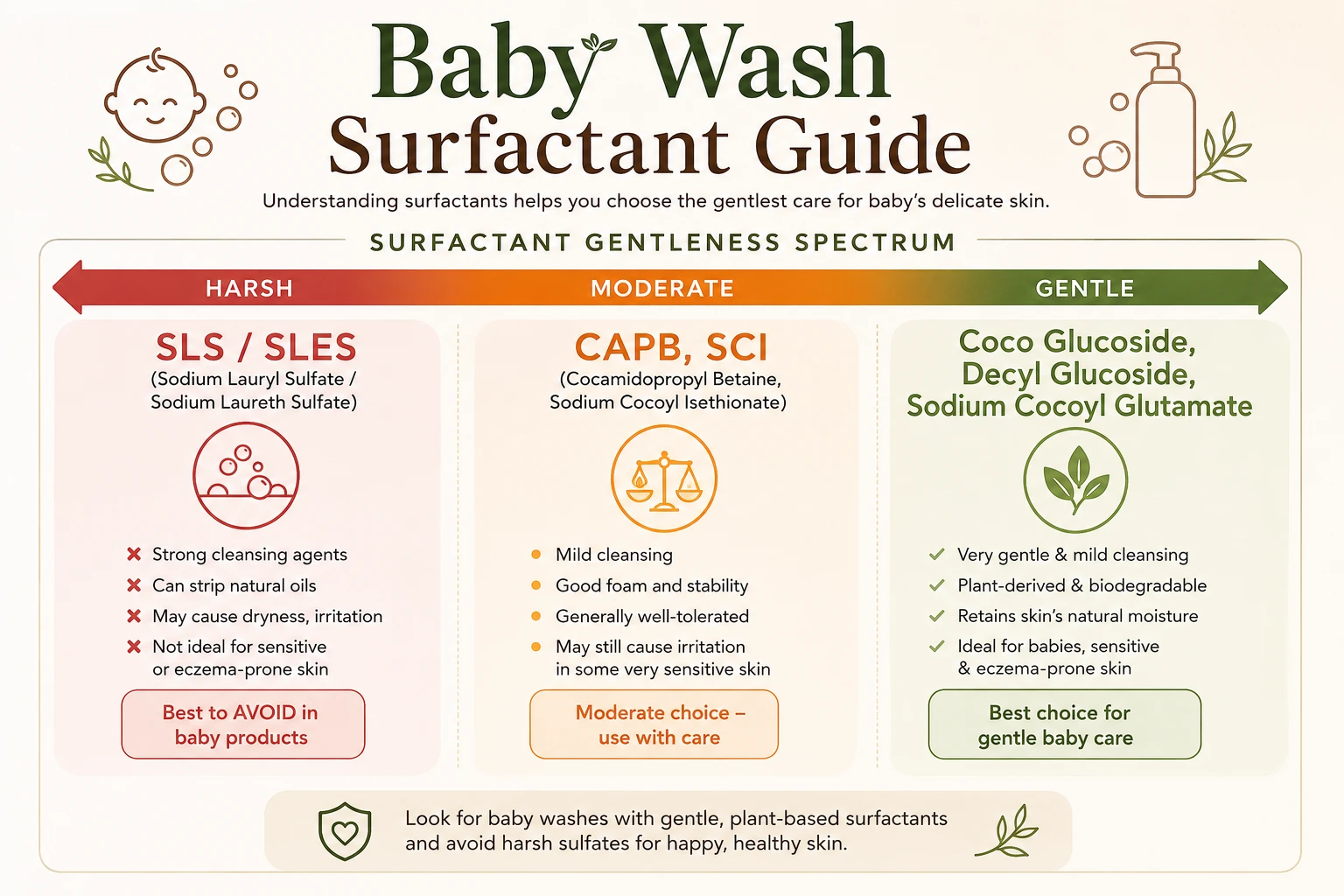
The surfactant spectrum from most to least aggressive, in practical terms for baby wash assessment: sodium lauryl sulfate (most aggressive) at one extreme, through sodium laureth sulfate (somewhat less aggressive but still stripping), through cocamidopropyl betaine (mild but a sensitiser), through sodium cocoyl isethionate and other intermediate options, to decyl glucoside, coco glucoside, and sodium cocoyl glutamate at the gentle end.
A baby wash whose ingredient list leads with coco glucoside or decyl glucoside as the primary surfactant is in the gentlest category. A baby wash whose primary surfactant is sodium laureth sulfate or sodium lauryl sulfate, however it is positioned on the packaging, is not appropriate for regular infant use.
Why Amphoteric Surfactants Are Better Than Anionic Surfactants for Baby Skin
Surfactants are classified by the charge of their active portion. Anionic surfactants (SLS, SLES, sodium cocoyl isethionate) carry a negative charge and are generally more aggressive in their stripping action. Amphoteric surfactants (cocamidopropyl betaine and some glucoside-derived surfactants) carry both positive and negative charges depending on the pH, which gives them a more adaptable and generally less irritating interaction profile with the skin surface.
Non-ionic surfactants (coco glucoside, decyl glucoside), which carry no charge, tend to be the gentlest of all. For baby wash formulas, a primary non-ionic or amphoteric surfactant system, rather than an anionic system, produces the most appropriate cleansing profile for infant skin.
How to Identify the Gentlest Surfactant Option When Reading a Label
Look at the first five to seven ingredients. In a baby wash, one or more of the first few ingredients will typically be surfactants (they often include the word glucoside, glutamate, isethionate, or betaine in their name). If the first surfactant you see contains the word lauryl or laureth and sulfate, the formula is SLS or SLES based. If the first surfactants you see are coco glucoside, decyl glucoside, or sodium cocoyl glutamate, the formula uses the gentlest available options.
Why Multiple Gentle Surfactants Together Are Better Than One Harsh One Alone
Formulators sometimes combine multiple gentle surfactants rather than relying on a single harsher option because gentle surfactants, used together, can achieve equivalent cleansing effectiveness to a single harsh surfactant while maintaining the lower irritation profile of each individual gentle component. This is synergistic formulation: the combination is more effective than the sum of the individual parts.
A baby wash that lists coco glucoside, decyl glucoside, and sodium cocoyl glutamate as its surfactant system is using this multi-gentle approach, which produces both effective cleansing and appropriate skin compatibility for infant use.
How to Read a Baby Wash Label Step by Step
The INCI System: What Those Long Chemical Names Actually Mean
INCI (International Nomenclature of Cosmetic Ingredients) is the standardised system used globally to name cosmetic ingredients. Every ingredient in a baby wash will be listed under its INCI name, which is often a scientific or Latin name rather than a common name. The standardisation means the same ingredient will always appear under the same INCI name regardless of country or manufacturer.
Key INCI names to recognise: Aqua or Aqua Purificata (water), Butyrospermum parkii (shea butter), Adansonia digitata oil (baobab oil), Helianthus annuus seed oil (sunflower oil), Parfum or Fragrance (synthetic fragrance), Paraffinum liquidum (mineral oil), Sodium lauryl sulfate or Sodium laureth sulfate (SLS/SLES). Memorising or keeping a reference list of the most important safe and unsafe INCI names is the most reliable approach to label reading.
Why Ingredients Are Listed in Descending Order of Concentration
By law in most markets, cosmetic ingredients must be listed in descending order of concentration, with the ingredient present in the highest amount listed first. Water (Aqua) is almost always the first ingredient in a water-containing wash. The first three to five ingredients after water define the character and function of the product. If a beneficial ingredient like shea butter appears very near the bottom of a long list, it is present in a very small, possibly cosmetically insignificant concentration.
The position of the primary surfactant on the ingredient list is particularly informative: if SLS appears in positions 2 or 3, the formula is primarily built on that harsh surfactant. If coco glucoside appears in position 2, the formula is built on a gentle surfactant.
How to Find the Hidden Fragrance in an Unscented Product
An unscented product may contain fragrance chemicals added specifically to create a neutral scent by masking other odours in the formula. This is different from fragrance-free, which means no fragrance chemicals of any kind have been added. To check for hidden fragrance in an unscented product: look for the word Parfum or Fragrance on the ingredient list, look for specific fragrance chemicals that are individually listed (linalool, limonene, citronellol, geraniol, benzyl alcohol are among the most common individually listed fragrance allergens), and look for botanical extracts that are known to contribute fragrance (chamomile, lavender, neroli, ylang ylang) in products that still claim to be fragrance-free.
How to Spot Preservatives That Are Not Listed Obviously
Preservatives in cosmetics are typically listed by their full INCI name, which is useful once you know what to look for. The preservatives to scan specifically for in baby wash ingredient lists are: phenoxyethanol (a commonly used preservative, generally considered safer than parabens but still a concern in high-frequency baby products), benzyl alcohol (a preservative that doubles as a fragrance compound, meaning it may appear in unexpected contexts), sodium benzoate and potassium sorbate (naturally derived preservatives generally considered acceptable for baby products), and any of the formaldehyde releasers listed earlier.
The Five-Second Label Scan That Identifies Most Problematic Products
A practical rapid scan for a baby wash you are considering: check position 2 or 3 for SLS or SLES (disqualifying if present), check anywhere on the list for Parfum or Fragrance (disqualifying), check for methylisothiazolinone or methylchloroisothiazolinone (disqualifying), check for CI numbers or FD&C/D&C colour designations (disqualifying), and check for any paraben names (methylparaben, propylparaben, butylparaben — disqualifying for the most conservative approach).
A product that passes all five checks is not guaranteed to be safe, but one that fails any check should be set aside in favour of alternatives.
Why the Front of the Packaging Tells You Almost Nothing
Natural, organic, gentle, hypoallergenic, dermatologist-tested, paediatrician-approved: these are all unregulated claims in most markets, meaning there is no mandatory standard a product must meet to carry them. A product can contain SLS and synthetic fragrance and still be marketed as gentle and natural, because there is no legal definition of these terms in cosmetics. The front of the packaging is advertising. The ingredient list is information. Always go to the ingredient list.
Natural vs Commercial Baby Wash: A Practical Comparison
What Commercial Baby Wash Typically Contains and Why
The majority of commercially available baby washes, including market-leading brands positioned as gentle or for newborns, contain some combination of: water as the primary ingredient, a sodium laureth sulfate or SLES-based surfactant system (gentler than SLS but still problematic for regular infant use), synthetic fragrance added for consumer appeal, synthetic preservatives (often phenoxyethanol or paraben-based), and small concentrations of botanical extracts positioned as key marketing ingredients despite their low concentration.
These formulas are designed primarily for commercial appeal, mass production economics, and a shelf life of 2 to 3 years. The ingredient choices reflect these priorities rather than the specific needs of infant skin.
What a Genuinely Natural Baby Wash Should Contain
A genuinely natural baby wash that meets the edible-grade standard should contain: water as the primary ingredient, coco glucoside or decyl glucoside as the primary surfactant, a safe natural preservation system (phenoxyethanol at very low concentrations, sodium benzoate and potassium sorbate, or a proprietary natural preservation system), and beneficial botanical ingredients like shea butter, baobab oil, sunflower oil, or calendula extract for conditioning. The ingredient list should be short. Every ingredient should have a clear function. Nothing should appear that cannot pass the edible-grade test.
Why Price Does Not Reliably Indicate Ingredient Quality
A premium price does not guarantee better ingredients. Some of the most expensive baby washes on the market contain synthetic fragrance and SLES. Some modestly priced natural baby washes use genuinely gentle surfactant systems and edible-grade ingredients. Price reflects brand positioning, packaging, and marketing investment as much as ingredient quality.
The only reliable indicator of ingredient quality is the ingredient list itself.
The Greenwashing Problem in Natural Baby Products
Greenwashing in baby products takes several forms: featuring natural ingredients prominently on the front of packaging while they are present only in trace concentrations, using the word natural as a marketing claim without any standardised meaning, reformulating products to remove one controversial ingredient while retaining others that are similarly problematic, and displaying natural imagery and botanical graphics on products that contain primarily synthetic ingredients.
For parents trying to navigate the natural baby wash market, the greenwashing problem means that neither the packaging aesthetics nor the brand positioning are reliable guides. Only the ingredient list provides information that is both legally required to be accurate and directly relevant to the safety of the product for infant use.
How to Verify Claims Before You Buy
For any baby wash you are considering: read the full ingredient list before purchasing (online ingredient lists are available for most products on the manufacturer website or through databases like INCI Decoder). Cross-reference any unfamiliar ingredients against the EWG Skin Deep database for safety ratings. Check specifically for the disqualifying ingredients identified in this guide. If you cannot access the full ingredient list for a product, do not purchase it for infant use.
Fragrance-Free Baby Wash: Why This Is Non-Negotiable
What Synthetic Fragrance Actually Is and Why Manufacturers Use It
The word fragrance or parfum on a cosmetic ingredient list refers to a proprietary blend of scent chemicals that may contain anywhere from a handful to several hundred individual chemical compounds. These compounds are not required to be individually disclosed, allowing manufacturers to protect their proprietary formulations. In practice, this also means that parents cannot know which specific fragrance chemicals they are exposing their baby to, only that some are present.
Manufacturers use synthetic fragrance in baby products for several commercial reasons: fragrance makes the product more pleasant to use, creating a positive sensory association for the parent; fragrance masks the natural odour of other ingredients; and many parents associate a certain scent with cleanliness and freshness, driving purchase decisions.
The Difference Between Fragrance-Free and Unscented
Fragrance-free means the formula contains no added fragrance compounds. The product may still have a natural smell from its plant-based ingredients, such as the mild scent of shea butter or calendula, but this is not added fragrance. Unscented means the product has been formulated to have a neutral or odourless smell, which may have been achieved by adding fragrance chemicals specifically to mask other scents in the formula. An unscented product may contain fragrance chemicals.
For baby wash, fragrance-free is the appropriate standard. Do not rely on the scent of the product or the word unscented to confirm the absence of fragrance chemicals. Read the ingredient list and check for parfum or fragrance in any position.
How Fragrance Sensitisation in Infancy Creates Lifelong Allergies
The immune system is most actively establishing its patterns of tolerance and reactivity in early infancy. During this period, repeated exposure to the same allergenic compound can more readily establish a lasting sensitisation than the same exposure in an older immune system. Fragrance compounds are among the most common contact allergens in the human environment, appearing not just in cosmetics but in household cleaning products, air fresheners, and many other everyday products.
An infant sensitised to specific fragrance compounds during the window of high immune plasticity in infancy may carry that sensitisation throughout life, producing contact dermatitis reactions when encountering those compounds in any product in adult life. The preventable lifelong consequence of early fragrance exposure is the most compelling argument for fragrance-free baby products.
Why Natural Fragrance Is Not a Safe Alternative in Baby Wash
Natural fragrance, sometimes listed as natural parfum, natural fragrance, or natural essential oil blend, is still fragrance for purposes of infant skincare safety. Many of the most potent contact allergens identified in synthetic fragrance are also present in natural essential oils. Linalool and limonene, two of the most common contact allergens in fragrance products, are present in dozens of natural essential oils including lavender, bergamot, lemon, and orange.
The natural origin of a fragrance compound does not reduce its potential to cause sensitisation. For baby wash, fragrance-free means no added scent of any kind, natural or synthetic.
What Baby Wash Should Smell Like If It Is Genuinely Fragrance-Free
A genuinely fragrance-free baby wash with plant-based ingredients will have a faint, mild natural scent from its botanical components. Shea butter has a mild, nutty scent. Sunflower oil has a very faint, clean scent. Calendula has a very subtle floral note. These are not fragrance additions. They are the natural odour of the edible-grade plant ingredients.
The product will not smell like baby powder, lavender, vanilla, or any other defined, pleasant scent. If a product claiming to be fragrance-free has a recognisable, pleasant, defined scent, it almost certainly contains fragrance despite the claim. Trust the ingredient list over the scent.
Baby Wash for Specific Skin Concerns
Baby Wash for Eczema-Prone Skin: What the Formula Must and Must Not Contain
For eczema-prone baby skin, the baby wash requirements are the strictest of any skin type. The formula must be: completely fragrance-free (no natural or synthetic fragrance), sulfate-free (no SLS or SLES), MIT and MCI free, paraben-free, and free from any ingredient with a known or potential sensitisation profile. The surfactant system should be non-ionic (coco glucoside or decyl glucoside).
Beneficial additional ingredients for eczema-prone baby skin include sunflower oil (high linoleic acid for ceramide support) and calendula extract (anti-inflammatory soothing). The formula should be as simple as possible. For eczema-prone baby skin, fewer ingredients means fewer potential triggers.
Baby Wash for Cradle Cap: Gentle Scalp Cleansing Without Stripping
For babies with cradle cap, the baby wash needs to clean the scalp effectively enough to remove the loose scales that follow oil treatment, without stripping the scalp so aggressively that it triggers compensatory sebum overproduction that worsens the condition. The gentle coco glucoside-based surfactant system in the Ajike Shea Baobab Baby Hair and Body Wash is appropriate for this use case.
Apply the wash to the scalp, work into a gentle lather over the pre-treated scale areas, and rinse thoroughly. The thorough rinse is particularly important for cradle cap areas where scale residue and oil residue from the pre-wash treatment both need to be removed.
Baby Wash for Diaper Area: Extra Gentleness Where Skin Is Most Exposed
The diaper area skin is more frequently in contact with irritants than any other part of the baby's body. When cleaning the diaper area during bathing, the baby wash used should be the gentlest possible formula, as this area's barrier is most frequently compromised. A coco glucoside-based formula with no fragrance, no SLS, and no synthetic preservatives is the appropriate choice.
Plain warm water for between-bath diaper area cleaning is generally preferable to baby wipes for sensitive or rash-prone diaper skin. If wipes are needed, use fragrance-free, alcohol-free wipes or plain warm water with cotton wool.
Baby Wash for Newborns in the First Month: The Most Conservative Approach
For the first four weeks of life, plain warm water baths are appropriate and sufficient for most healthy full-term newborns. The skin is transitioning from the amniotic fluid environment and the developing barrier is at its most immature. If a baby wash is used, it should be the most minimal formula available: water, coco glucoside or decyl glucoside, and nothing else.
The Ajike Shea Baobab Baby Hair and Body Wash, while formulated for the most sensitive baby skin, can be used in very small amounts from birth. For the first few weeks, however, parents should feel confident that plain water is entirely sufficient.
Baby Wash for Dark-Skinned Babies: Why Fragrance Risk Is Even Higher
Dark-skinned babies are at higher risk for certain consequences of fragrance exposure in skincare products. Fragrance-triggered contact dermatitis on dark skin is more likely to produce post-inflammatory hyperpigmentation, where the healed reaction leaves a darker mark that can persist for months. In a baby whose skin is actively developing and whose melanocytes are highly responsive to inflammatory signals, fragrance-triggered reactions can produce hyperpigmentation that is not present on lighter skin.
Additionally, the visual signs of contact dermatitis on dark skin may not be detected as quickly as on lighter skin (appearing grey or hyperpigmented rather than the bright red that parents typically associate with an allergic reaction), meaning the exposure continues for longer before the problem is identified. For dark-skinned babies, the fragrance-free standard is even more important to implement from the start.
How to Use Baby Wash Safely Regardless of the Formula
How Often to Wash a Baby and Why Less Is Usually More
For a healthy newborn, full immersion baths are appropriate 2 to 3 times per week rather than daily. Between baths, top-and-tail cleaning (face, neck, hands, and diaper area with warm water) is sufficient for maintaining cleanliness without the cumulative barrier disruption that daily full baths produce. From around 3 months onward, daily brief baths are appropriate for most babies, but even then the principle of brief, lukewarm water exposure followed by immediate moisturisation applies.
More frequent washing does not produce cleaner or healthier baby skin. The skin's acid mantle and barrier function need time between washes to recover and rebuild. Overwashing, particularly with a harsh formula, is a direct cause of dry baby skin and can contribute to eczema development in predisposed babies.
Water Temperature That Protects Rather Than Strips Baby Skin
Bath water for babies should be lukewarm, approximately 37 to 38 degrees Celsius, comfortably warm when tested on the adult wrist or elbow but not hot. Hot water removes more oil from the skin surface than lukewarm water, increases the skin's post-bath reactivity, and raises the skin temperature in a way that can trigger itching in eczema-prone babies. The temperature difference between hot and lukewarm water may seem small, but its impact on infant skin is meaningful.
How to Rinse Thoroughly Enough to Remove All Residue
Surfactant residue left on baby skin continues its barrier-disrupting action after the bath. For babies with skin folds, natural hair, and areas where product can accumulate, thorough rinsing requires more deliberate attention than for adults. Use gentle clean water flow to rinse all body creases, the neck folds, the armpits, behind the ears, and the diaper area. Rinse until the skin feels clean and does not have any slippery or slightly soapy sensation.
Why the Post-Wash Moisturising Step Is Part of the Baby Wash Decision
The baby wash and the post-wash moisturiser function as a system. Even a gentle, well-formulated baby wash temporarily reduces the skin's lipid content during cleansing. The post-wash moisturiser applied to slightly damp skin within three minutes of bathing restores this lipid content and seals in the surface moisture before it evaporates. Choosing a gentle wash and then not moisturising is a partial solution. The complete routine is wash, pat to slightly damp, moisturise immediately.
How to Patch Test a New Baby Wash Before First Full Use
Before using a new baby wash on the baby's full body for the first time, apply a small amount to the inner forearm skin, leave for the duration of a normal wash (2 to 3 minutes), rinse, and monitor the test area for 24 to 48 hours. Any redness, rash, or increased dryness in the test area suggests the product should not be used. For eczema-prone baby skin, patch test on an area of eczema-affected skin rather than healthy skin, as the response on compromised barrier skin may differ.
Ajike Shea Baobab Baby Hair and Body Wash: What Is in It and Why
The Edible-Grade Standard That Guides Every Ingredient Choice
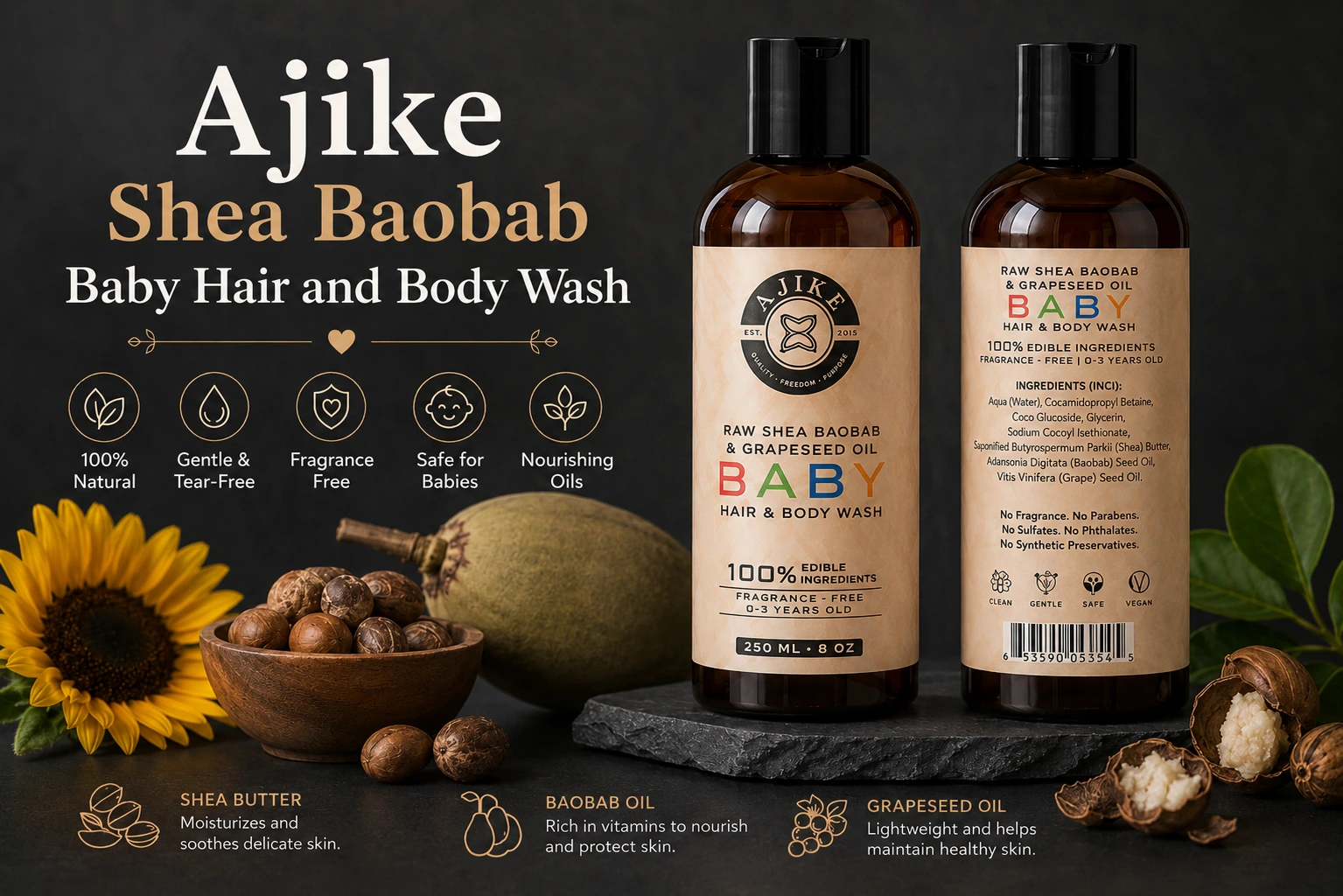
Every ingredient in the Ajike Shea Baobab Baby Hair and Body Wash meets the edible-grade safety standard: shea butter, baobab oil, coco glucoside, and the other plant-based components of the formula are all ingredients that could, in principle, be safely consumed. This standard automatically excludes all synthetic fragrances, all synthetic preservatives, mineral oil, artificial colours, and every other category of ingredient that has been identified in this guide as inappropriate for infant use.
The Surfactant System: Plant-Derived, Gentle, Effective
The primary surfactant in the Ajike Baby Hair and Body Wash is coco glucoside, a non-ionic surfactant derived from coconut and glucose with a pH profile appropriate for infant skin and a safety record that is specifically positive for infant use. The surfactant system is designed to clean effectively without the degree of barrier disruption that SLS or SLES-based systems produce.
For parents concerned about the lower lather level compared to conventional baby washes: the reduced foam reflects the chemistry of gentler surfactants, not a reduction in cleansing effectiveness. Effective cleansing does not require heavy lather.
Shea Butter and Baobab Oil in a Rinse-Off Format: What They Contribute
The shea butter in the Ajike Baby Wash provides emollient conditioning during the cleansing step, reducing the net lipid loss from the wash and leaving the skin in a more conditioned state after bathing than a surfactant-only formula. The baobab oil contributes its multi-vitamin profile to the cleansing step, with vitamins A, D, E, and F present in the formula even though it is a rinse-off product. Together, these ingredients represent the edible-grade conditioning philosophy applied to the cleansing context.
Fragrance-Free and Preservative-Free: What That Means in Practice
The Ajike Baby Hair and Body Wash contains no added fragrance of any kind, natural or synthetic. The mild natural scent of the product comes from the shea butter and baobab oil themselves, not from added scent. The formula is preserved through formulation and packaging design that does not require a synthetic preservative system, allowing the preservative-free label to be applied accurately.
Suitable from Birth: How the Formula Was Designed for the Most Sensitive Skin
The formula of the Ajike Baby Hair and Body Wash was developed specifically for use from birth, with the strictest possible ingredient standards applied from the design stage. The assessment of each ingredient's appropriateness used the edible-grade standard as the primary filter, then evaluated the specific suitability of each ingredient for neonatal and infant skin. The result is a formula that is appropriate for the most sensitive baby skin at any age.
How to Use the Ajike Baby Wash as Part of a Complete Baby Routine
Bath time routine: fill the bath with lukewarm water (37 to 38 degrees). Use a small amount of Ajike Shea Baobab Baby Hair and Body Wash in your hand, not poured directly onto the baby, to create a light lather. Cleanse the baby gently, starting with the less sensitive areas and ending with the diaper area. Rinse thoroughly. Pat the baby dry leaving the skin slightly damp. Apply Ajike Baby Moisturiser to the full body within three minutes. Apply Ajike Baby Diaper Ointment to the diaper area. This complete routine cleanses, protects, and moisturises using only edible-grade plant ingredients throughout.
Frequently Asked Questions
The most important things to look for: a gentle non-ionic surfactant system as the primary surfactant (coco glucoside, decyl glucoside, or sodium cocoyl glutamate rather than SLS or SLES), no synthetic fragrance listed as parfum or fragrance anywhere on the ingredient list, no methylisothiazolinone (MIT) or methylchloroisothiazolinone (MCI), no parabens, and no artificial colours. These five checks identify most problematic products quickly. Additional positive indicators: plant-based conditioning ingredients (shea butter, baobab oil, sunflower oil, calendula), a short ingredient list, and a genuinely fragrance-free formula.
Check the current ingredient list for the specific product in your market, as formulations vary by region and have been updated multiple times. As a general assessment principle: look for parfum or fragrance on the ingredient list (present in many formulations), check the surfactant system (many formulations use SLES), and check for cocamidopropyl betaine (present in many formulations). These findings would place the product below the standard recommended in this guide for infant use. Always use the specific product's current ingredient list rather than general brand assessments.
Traditional baby wash and baby shampoo are often formulated as the same product with two-in-one applications. Dedicated baby shampoo formulas may be slightly adjusted for scalp and hair use, but for most baby washes positioned as hair and body washes, the formula is intended to work for both purposes. The Ajike Shea Baobab Baby Hair and Body Wash is formulated to be safe and effective for both hair and body cleansing.
No. Adult shampoos are formulated for adult scalp and hair, which has different sebum production, pH balance, and barrier maturity from infant skin. Most adult shampoos contain fragrance, SLS or SLES, and other ingredients inappropriate for infant use. The Ajike Peppermint, Rosemary and Tea Tree Shampoo, formulated for natural hair scalp health, is appropriate for older children and adults but is not the appropriate choice for babies under 12 months.
Signs of a reaction to a baby wash: new redness, rash, or dry patches appearing specifically where the wash product contacted the skin, the baby seems more irritable than usual during or after bathing, skin that was clearing shows worsening rash after a wash, or eczema patches flaring after a wash change. Discontinue the product, cleanse with plain warm water, and monitor. If the reaction is severe or the baby seems in distress, seek medical attention.
Our latest content
Check out what's new in our company !