
Start writing here...
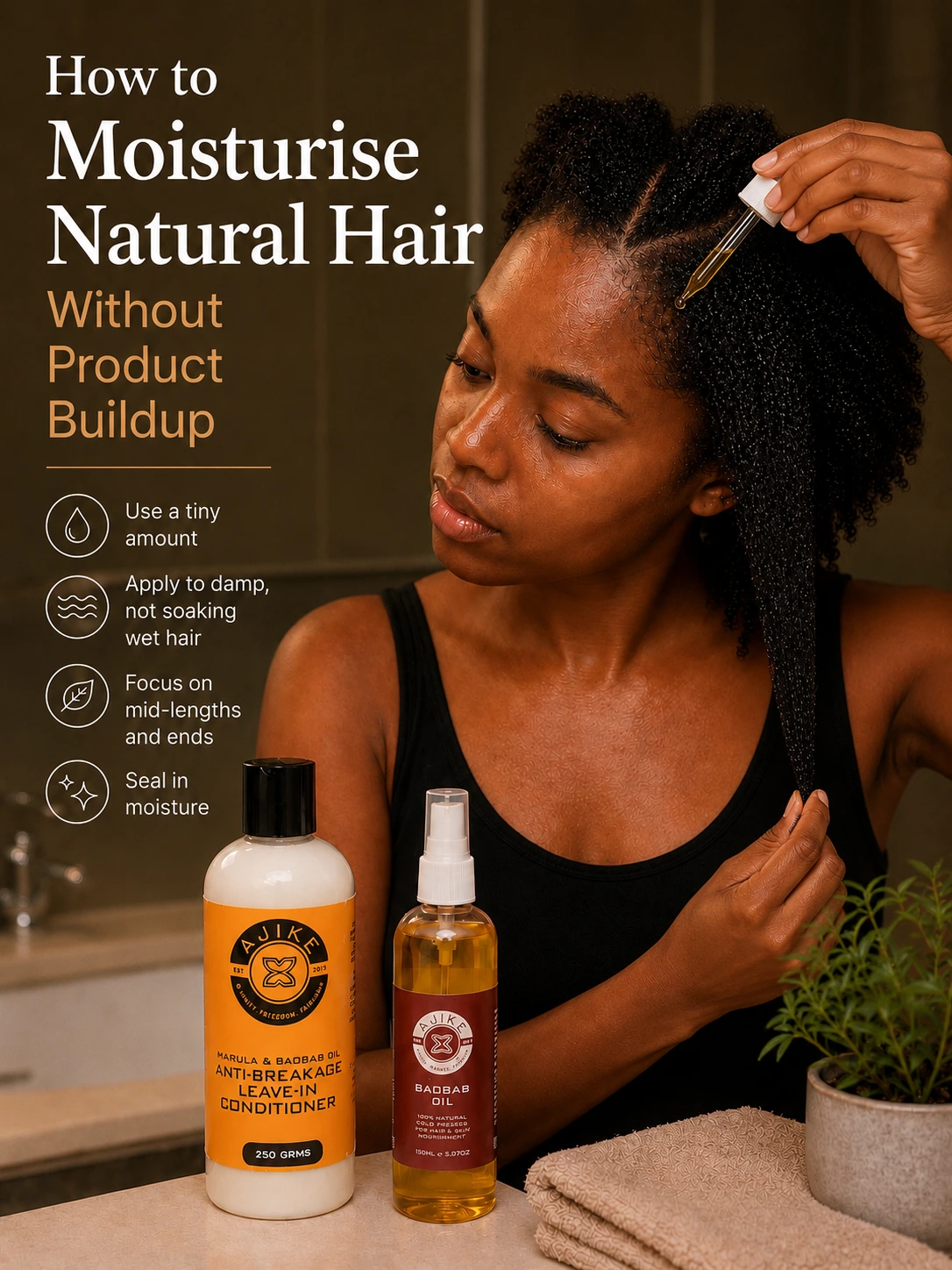 Ask most natural hair wearers what their biggest frustration is and the answer is usually some version of the same thing: the hair is dry, they add more product to fix the dryness, and after a few days the hair is dry again but now also has product buildup sitting on top of it. So they add more product. The buildup gets worse. The dryness remains.
This is the buildup-dryness cycle, and it is one of the most common reasons natural hair care routines fail. The products that are supposed to solve the problem end up being part of the problem. Understanding why this happens is the first step to building a routine where genuine moisture and buildup-free hair are not competing outcomes.
This guide covers the specific mechanisms behind buildup on natural hair, which products and techniques cause it, and how to achieve the moisture retention natural hair needs without the accumulation that undermines every product you apply.
Read Also: Full natural hair foundation: Natural Hair Care with African Botanicals - Complete Guide →
Why Natural Hair Struggles with Both Dryness and Buildup Simultaneously
How Coily and Kinky Hair Loses Moisture Faster Than Any Other Hair Type
The coil and kink structure of 4A, 4B, and 4C natural hair creates a physical barrier to natural moisture distribution. In straight hair, the scalp sebum travels from the scalp down the length of the strand relatively easily along the smooth, cylindrical surface. In coily and kinky hair, the tight curl and kink structure means sebum accumulates at the scalp and the base of the hair but does not coat the mid-lengths and ends naturally.
The result is hair that is chronically under-moisturised at the ends and mid-lengths regardless of how much the scalp produces, combined with a high surface area exposed to the environment that allows moisture to evaporate faster than it would from straight hair. This structural moisture loss is the root cause of natural hair dryness and it means the hair genuinely needs consistent external moisture application.
Why the Attempt to Fix Dryness Often Creates Buildup
When natural hair feels dry, the instinctive response is to add more product. More leave-in conditioner. More oil. More butter. The additional product temporarily adds the sensation of moisture through surface coating or emolliency. But if the product is not actually penetrating the hair shaft and delivering water-based moisture, it sits on the surface. The next application sits on top of the previous layer. The accumulation grows.
The hair feels progressively heavier and more coated. But the interior of the hair strand is still dry, because the surface layer of accumulated product is preventing water from entering. The hair looks moisturised. The cuticle feels coated. But stretch the strand and it will snap quickly, because there is no genuine internal moisture providing the elasticity that prevents breakage.
The Buildup-Dryness Cycle Most Natural Hair Routines Get Stuck In
Week one: hair is washed and properly moisturised. Products applied correctly. Hair feels good. By day three, hair is beginning to feel dry. Product is added to refresh. Day five: another application. By wash day, the hair has multiple layers of product from multiple refreshes, and the scalp and hair feel heavy and dull. The wash removes surface product but may not fully remove deeper buildup. The next week starts with a compromised baseline.
Over weeks and months of this pattern, the baseline amount of buildup on the hair progressively increases. Moisture becomes harder and harder to get into the hair because the buildup layer becomes a more effective barrier. The dryness worsens. The response is to add more product. The cycle tightens.
What Buildup Actually Is and Why It Makes Dryness Worse
Product buildup on natural hair is an accumulated layer of product residue, typically a mixture of waxy substances from heavy oils and butters, polymer deposits from silicones and styling agents, mineral deposits from hard water, and dead skin cells and environmental debris trapped by the sticky product layer. This accumulation forms on the hair cuticle and, over time, in the spaces between the cuticle scales.
The accumulated layer does not simply sit neutrally on the hair. It is hydrophobic, meaning it repels water. When you apply a water-based leave-in conditioner or mist damp hair with water on a hair that has significant buildup, the water beads on the surface and evaporates rather than entering the hair shaft. The buildup layer is actively preventing the moisture you are trying to apply from reaching the interior of the hair strand where it is needed.
Understanding What Causes Product Buildup on Natural Hair
Heavy Oils and Butters That Coat Rather Than Penetrate
Not all oils behave the same way on natural hair. Oils with high saturated fatty acid content, including coconut oil (high in lauric acid), castor oil (high in ricinoleic acid), and avocado oil (high in palmitic acid), have larger molecular structures and a tendency to coat the hair surface rather than penetrating into the cortex. Applied repeatedly without thorough washing between applications, these oils accumulate as a progressive coating that reduces the hair's ability to absorb water.
Light, penetrating oils like baobab oil and argan oil, with their higher unsaturated fatty acid content and smaller molecular structures, absorb more efficiently into the hair shaft and are significantly less prone to surface accumulation. For daily use on natural hair, the oil choice matters as much as the quantity.
Silicones: The Most Common and Least Obvious Buildup Ingredient
Silicones are synthetic polymers that coat the hair shaft to create a smooth, glossy appearance and a soft tactile feel. They are present in most commercial hair care products, including many marketed as natural or for natural hair. The coating they create is highly effective at eliminating frizz and creating the appearance of moisturised, defined hair. It is also waterproof.
Silicone buildup is the least visible and most insidious form of natural hair buildup because the hair looks and initially feels good under the silicone coating. The problem becomes apparent over time as the coating thickens and begins to prevent real moisture from entering. Some silicones (water-soluble silicones like PEG-modified silicones) can be removed with gentle cleansers. Most silicones (dimethicone, cyclopentasiloxane, amodimethicone) require sulfate shampoos to remove fully, creating the silicone-sulfate dependency cycle.
Glycerine in Dry Climates: When a Humectant Works Against You
Glycerine is a humectant: it attracts water from the surrounding environment and from the skin and hair into itself. In humid climates, glycerine in hair products draws moisture from the air into the hair strand, which is genuinely beneficial for moisture retention. In dry climates with low relative humidity, there is insufficient moisture in the air for glycerine to draw from. Instead, it draws moisture from the interior of the hair strand outward, effectively increasing moisture loss rather than retention.
In very dry climates or in centrally heated indoor environments in winter, high-glycerine leave-in conditioners and products can actually worsen hair dryness even when applied consistently. If you live in a low-humidity environment and your hair consistently feels drier in winter despite regular moisturising, glycerine in your products may be a contributing factor.
Layering Too Many Products: When More Becomes Less
Every product applied to natural hair requires the hair to absorb it, or it sits on the surface. The hair has a finite absorptive capacity per application. When more products are layered than the hair can absorb in the time between applications, the excess sits on the surface and begins to accumulate. The fifth product in a layering routine is almost always excess that cannot be meaningfully absorbed.
The most effective natural hair routines use the minimum number of products necessary to achieve adequate moisture: a water or water-based leave-in, one oil, and optionally one butter or cream as a sealant. Three products maximum for most hair types. Four is occasionally justified for very dry or high-porosity hair. Five or more products in a layering routine is almost always creating more buildup than moisture.
Hard Water Mineral Deposits on Natural Hair
Hard water contains elevated concentrations of calcium and magnesium ions that deposit on the hair shaft during washing. These mineral deposits make the hair feel rough and porous, increase tangling and breakage, and create a coating that reduces the hair's ability to absorb moisture. Hard water mineral buildup is often confused with product buildup because the effects are similar, but the cause is different and the solution is different.
Hard water buildup is removed by acidic rinses (apple cider vinegar diluted in water) that dissolve the mineral deposits, or by using a chelating shampoo that contains EDTA or citric acid to bind and remove mineral ions from the hair. If your hair feels consistently rough and dry even on wash day immediately after using what should be sufficient moisture, hard water may be the underlying issue.
How to Know If You Have Buildup Right Now
Signs of product buildup: the hair feels heavy and dense beyond what the hair volume alone explains. Products applied to the hair seem to sit on the surface and do not absorb. Water applied to the hair beads and runs off rather than soaking in. The hair looks dull or has a whitish or greasy film visible on the strands. The hair smells slightly stale even after a regular wash. Coils lose definition despite consistent product application.
The quickest test: wet a clean strand of your hair with plain water and watch what happens. If the water soaks in within a few seconds and the hair darkens visibly with moisture absorption, buildup is minimal. If the water beads on the hair surface and runs off without being absorbed, there is significant buildup creating a hydrophobic barrier.
The Difference Between Moisturised Hair and Product-Coated Hair
What Genuinely Moisturised Natural Hair Looks and Feels Like
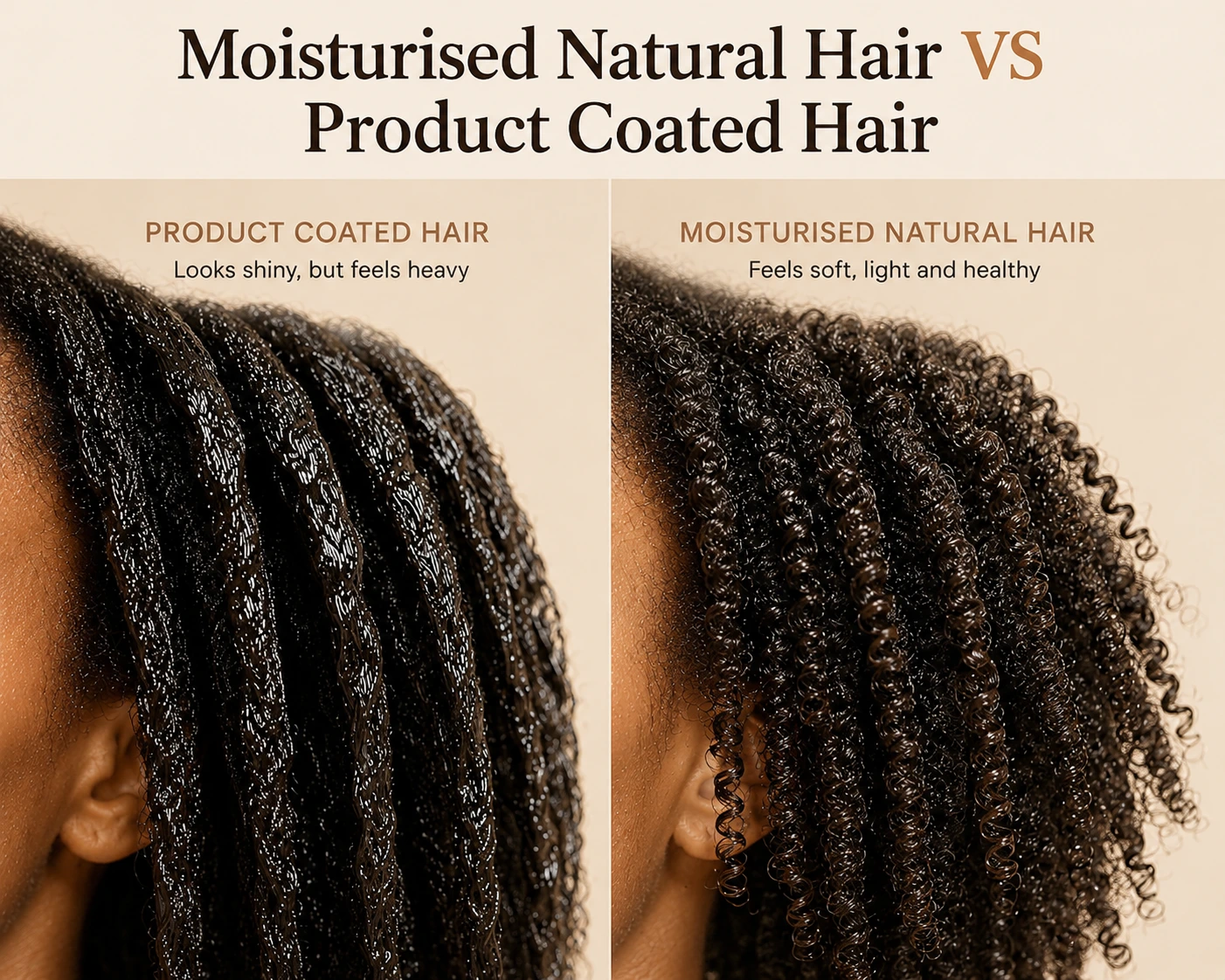
Genuinely moisturised natural hair has a springiness and elasticity that is distinctive. When you press a coil and release it, it bounces back. When you stretch a strand gently and release, it returns to its coiled shape. The hair feels light and pliable rather than heavy and stiff. Coils and curls are defined without appearing weighted down. The shine, if present, is a natural-looking sheen rather than a greasy gloss.
The most reliable indicator of genuine moisture is the stretch test: take a clean, damp strand and stretch it gently. Adequately moisturised hair will stretch 20 to 30 percent of its length before returning to shape. Hair that snaps immediately under minimal tension is dry, regardless of how shiny or coated it appears.
What Product-Coated Hair Looks and Feels Like
Product-coated hair has a heavy, weighted feeling. The coils may be defined but appear pressed down rather than springy. The hair may look glossy or shiny in a greasy way rather than a natural-sheen way. When touched, the hair may feel slightly sticky or tacky rather than smooth. Products applied to coated hair sit visibly on the surface rather than being absorbed. The hair may feel stiff or hard when dry.
Heavy coated hair also tends to pick up more lint, dust, and environmental debris than hair with minimal product load, because the sticky surface layer acts as a trap for airborne particles. If you consistently find lint and debris in your hair between washes, heavy product coating is almost certainly contributing.
Why Coated Hair Still Feels Dry Even When It Looks Shiny
The interior of a hair strand that is coated with a hydrophobic product layer can be severely dehydrated while the exterior appears glossy and apparently moisturised. The coating prevents water from reaching the interior during both daily exposure to the environment and during deliberate moisturising attempts. The hair looks conditioned because the surface is coated with a smoothing agent. The interior is dry because the same coating prevents moisture from entering.
This is why adding more product to coated, dry hair does not solve the dryness. The additional product adds to the coating without penetrating through it. The solution is to remove the coating first (clarifying wash), then reintroduce genuine moisture to a clean, receptive hair surface.
How to Tell the Difference in Your Own Hair
After your next wash, while the hair is still damp and clean and product-free, note how it feels and behaves. This is the baseline. The hair has no product coating at this moment and any dryness you feel is genuine hair dryness rather than product-coating masking dryness. This gives you an accurate sense of your hair's actual moisture level before you begin applying products.
Compare how the hair feels on day three or four between washes, after multiple product applications. If it feels heavier and more laden but similarly dry in terms of stretch and flexibility, you are experiencing product accumulation without genuine moisture improvement. If it feels lighter and more flexible than it did on wash day, your products are genuinely moisturising the hair rather than just coating it.
Choosing Products That Moisturise Without Building Up
Water-Based Products First: Why Water Belongs in Your Leave-In
The only ingredient that provides genuine moisture to the hair strand is water. Not oil. Not butter. Not glycerine. Water. All the other moisturising ingredients in a hair care routine work by either introducing water into the hair (water-based leave-ins and mists), helping the hair retain the water it has (sealing oils and butters), or making it easier for water to enter the hair (humectants in the right conditions).
A leave-in conditioner that lists water as the first ingredient is providing genuine moisture to the hair. A leave-in conditioner that lists oils, butters, or synthetic polymers as the first few ingredients is providing a surface treatment that feels moisturising but is not delivering water to the hair interior. Check the first three ingredients of your leave-in. If water is not first, the product is not providing genuine moisture.
Lightweight vs Heavy Oils: Which Ones Penetrate vs Which Ones Coat
The distinction between penetrating and coating oils is one of the most practically important choices in a natural hair moisture routine. Penetrating oils, primarily those with high oleic acid content and smaller molecular structures, enter the hair cortex to some degree rather than remaining entirely on the surface. Baobab oil, argan oil, and sweet almond oil are in this category.
Coating oils, primarily those with high saturated fatty acid content and larger molecular structures, remain largely on the hair surface. Coconut oil, castor oil, and avocado oil are in this category, though coconut oil has moderate penetration due to its lauric acid content. For daily moisturising sealing, penetrating oils provide conditioning with less surface buildup. Coating oils are better reserved for intensive pre-shampoo treatments where they will be washed out rather than left on the hair.
Baobab Oil: The Non-Buildup Oil for Daily Natural Hair Use
Baobab oil is the most appropriate oil for daily moisture sealing on natural hair specifically because its combination of oleic acid for penetration and linoleic acid for cuticle health produces genuine conditioning with minimal surface accumulation. Used daily in small amounts (1 to 2 drops for a full head of natural hair), baobab oil does not create the progressive coating that heavier oils accumulate over days of consecutive application.
When natural hair that has been using heavier oils switches to baobab oil for sealing, the difference in product load is noticeable within a week. The hair feels lighter and less coated, coil definition may improve, and the hair is more receptive to moisture because less of the surface is blocked by accumulated oil.
How Much Shea Butter Is Too Much for Natural Hair
Raw shea butter is one of the most effective moisture sealants for natural hair, particularly for 4B and 4C hair that loses moisture quickly. But it is easy to use too much. The correct amount for sealing moisture on natural hair is a piece no larger than a small pea, melted between palms until completely liquid, applied to slightly damp hair as the final sealing layer. This amount provides an effective moisture barrier without coating the hair heavily enough to cause buildup.
Many people use significantly more than this, applying what looks like a reasonable amount by volume rather than what is needed for effective coverage. The consequence is that the excess shea butter that cannot be absorbed sits on the hair surface and begins accumulating as buildup within days. For natural hair prone to product buildup, shea butter as an occasional intensive sealing step, once a week on wash day rather than daily, is often more effective than daily application of smaller amounts.
What to Look for on a Leave-In Conditioner Label
The best leave-in conditioners for buildup-prone natural hair list water as the first ingredient, have no silicones (avoid dimethicone, cyclopentasiloxane, amodimethicone, and ingredients ending in -cone, -conol, or -xane), contain light humectants like aloe vera, glycerine in appropriate concentrations, or panthenol, and include light botanical extracts or oils rather than heavy butters as conditioning agents.
Avoid leave-ins with the following as primary conditioning agents: protein hydrolysates at high concentrations (causes protein buildup for some hair types), heavy waxes, polyquaternium compounds at high concentrations (conditioning polymers that accumulate with repeated use), and any oil that solidifies at room temperature as a primary ingredient.
Ingredients That Are Consistently Worth Avoiding for Buildup-Prone Hair
- Silicones: dimethicone, cyclopentasiloxane, amodimethicone, cyclomethicone - these require sulfates to remove
- Mineral oil and petroleum jelly: do not penetrate hair, accumulate on surface, repel water
- Waxes: beeswax, carnauba wax, candelilla wax - do not wash out with gentle cleansers
- Heavy polyquaterniums: conditioning polymers that build up on the hair cuticle with repeated use
- Glycerine as the first or second ingredient in low-humidity environments
The LOC and LCO Method Done Correctly
Method | Sequence | Best For | Buildup Risk |
LOC | Liquid → Oil → Cream | High porosity: seals moisture quickly before evaporation | Lower — oil before cream is thinner layer |
LCO | Liquid → Cream → Oil | Low porosity: cream over liquid before sealing | Slightly higher — cream directly over liquid can sit on surface |
What the LOC Method Actually Is and What Each Layer Does
LOC stands for Liquid, Oil, Cream. The liquid layer (water or a water-based leave-in conditioner) delivers the actual moisture to the hair strand. The oil layer (applied immediately after the liquid, before the water has evaporated) seals the moisture inside the hair shaft by creating a thin lipid barrier on the cuticle surface. The cream or butter layer provides a final occlusive seal that slows evaporation further and adds surface emolliency.
Each layer has a specific function, and the layers work together as a system. Applying them out of order breaks the system. Oil before water prevents the water from entering the hair in the first place. Cream before oil creates a heavy surface layer that limits how much of the oil can reach the cuticle beneath it. The order is not arbitrary.
What the LCO Method Is and When It Works Better Than LOC
LCO reverses the positions of the oil and the cream, applying liquid first, then cream, then oil as the final seal. For low-porosity hair, whose tightly sealed cuticle can find it difficult to absorb a cream applied over an oil layer, applying the cream directly to the damp hair after the liquid allows better cream absorption before sealing with the oil.
Low-porosity hair often finds that the LOC method produces a heavy result, with the final cream layer sitting on the surface because the cuticle is already sealed by the oil layer beneath it. Switching to LCO, where the oil is the final step and the cream is applied directly to the slightly damp hair, often produces a lighter, better-absorbed result.
How to Choose Between LOC and LCO Based on Your Porosity
Try both methods on consecutive wash days and compare how the hair feels on day 3 after each. If the LOC result is better retained and the hair feels more flexible by day 3, LOC is the better match for your hair. If the LCO result feels lighter, less coated, and holds moisture equally well, LCO is the better match.
High-porosity hair almost always benefits more from LOC, where the oil seals moisture in quickly. Low-porosity hair often benefits more from LCO, where the cream can be absorbed before the final oil seal. Medium-porosity hair is flexible enough to use either method effectively.
How Much of Each Layer You Actually Need
Liquid layer: enough to make the hair damp but not dripping. A light leave-in mist or a small amount of leave-in conditioner distributed through sections. The hair should feel wet to the touch but not saturated. Oil layer: 1 to 2 drops of baobab oil for the full head, distributed by warming between palms. You should barely see any oil residue on your palms after distributing it through the hair. Cream or butter layer: a pea-sized amount of cream or a tiny piece of shea butter melted between palms, distributed through the mid-lengths and ends.
These amounts are smaller than most people use. The common instinct to add more produces better-looking results immediately but more buildup within days. Starting with minimal amounts and assessing after 24 hours is the more effective approach.
The Most Common LOC and LCO Mistakes That Cause Buildup
- Applying oil to completely dry hair: the oil cannot work with water to seal moisture if there is no moisture to seal
- Using too much of any layer: each excess product that cannot be absorbed adds to the surface accumulation
- Using a heavy cream or butter as the cream layer for daily LOC: reserve thick butters for weekly intensive sealing, use lighter creams for daily LOC
- Applying the same LOC routine daily regardless of whether the hair actually needs it: if the hair still feels moisturised, a refresh rather than a full LOC is sufficient
- Using a silicone-containing leave-in as the liquid layer: the silicone coating limits how much the oil layer can seal in
How to Tell If Your Layering Method Is Working
The most reliable assessment happens 48 to 72 hours after wash day. If the hair still feels flexible, has some spring in the coils, and is not significantly drier than it was on wash day, the method is working. If the hair feels heavy and coated by day 2 but is still flexible, the cream or butter layer is slightly excessive. If the hair feels dry by day 2 despite looking coated, there is buildup preventing moisture absorption and a clarifying wash is needed before the routine can work effectively.
How to Apply Products to Natural Hair Without Causing Buildup
Why Section Size Matters More Than Most People Realise
Working in smaller sections ensures that each section of hair receives an even, thin layer of product rather than a thick uneven distribution where some areas are over-saturated and others receive nothing. Smaller sections also allow you to assess more accurately how much product each section actually needs, which is usually less than you expect when working with large sections where the product amount is harder to gauge.
For a full head of natural hair in a moisturising routine: divide into 4 to 8 sections depending on density. Apply each product to one section at a time, completing all layers for that section before moving to the next. This approach ensures even coverage and prevents any section from drying out between product applications.
The Rake and Smooth Technique for Even Product Distribution
Apply a small amount of product to the palm, then rake the fingers through a section of hair from root to tip using a wide-tooth motion, distributing the product evenly through the length. Follow with a smoothing motion using the flat of the palm and fingers against the direction of the hair, then back again, to smooth the product evenly across the cuticle surface. This two-part technique ensures coverage without over-concentrating product at any point along the hair strand.
The rake distributes the product through the mass of the hair. The smooth ensures it contacts the individual strand surfaces evenly. Applying without smoothing produces uneven distribution where the product is concentrated in the outer layers of the section rather than reaching each strand individually.
Why Applying to Soaking Wet Hair Reduces the Amount You Need
The wetter the hair is at the point of leave-in application, the less leave-in conditioner is required to achieve adequate distribution and moisture. Very wet hair already has water distributed through the strand. The leave-in is providing conditioning compounds and additional moisture support. On very wet hair, a small amount of leave-in distributes evenly through the water already present and the total product load per strand is lower.
On damp or partially dry hair, the leave-in has to do more work to moisturise the strand, requires a larger amount to achieve adequate coverage, and is more likely to apply unevenly. Applying all products to soaking wet hair, straight from the shower or after a thorough water misting, is one of the most effective single changes for reducing total product use without sacrificing moisture.
How to Use Less of Everything and Get Better Results
The principle is simple and consistently underestimated: apply the minimum amount of each product that provides adequate coverage, assess after 24 to 48 hours, and only increase if genuinely needed. The hair's response over the following days is more informative than the immediate post-application feel.
Start with half the amount you currently use of each product. If the results on day 2 and 3 are comparable or better, that is your new baseline amount. If the hair is genuinely drier than before by day 2, increase slightly. Most people find that the minimum effective amount of each product is significantly less than what they have been using.
The Order That Ensures Each Layer Is Absorbed Before the Next One Goes On
Allow 30 to 60 seconds between applying the liquid layer and the oil layer. This brief interval is enough time for the liquid to begin being absorbed by the hair and for the water to start distributing through the hair shaft before the oil creates a sealing layer over it. Applying oil immediately over liquid that has not had any absorption time traps the liquid on the surface rather than sealing it inside.
Allow 30 seconds between the oil layer and the cream layer. Style or proceed to the next section immediately after the cream layer. Over-waiting between layers is not necessary, but under-waiting, specifically applying the oil before the liquid has touched the hair properly, reduces effectiveness.
Moisture Retention Between Wash Days
Why Daily Refreshing Is More Effective Than Weekly Overloading
Loading hair with excess product on wash day in an attempt to carry moisture through an entire week is less effective than maintaining moisture with light daily refreshing. Excess product on wash day creates the buildup-dryness cycle: heavy product load on day one, dryness by day three as moisture evaporates through or around the heavy product layer, nothing to refresh the moisture without adding more product.
Light daily refreshing, using minimal amounts of water and a drop of baobab oil, maintains moisture at a more consistent level through the week. The total product load across the week may be comparable, but the distribution across daily small applications prevents the heavy accumulation that a single large application creates.
How to Refresh Natural Hair Without Adding More Product
The most effective between-wash refresh for most natural hair on days when the hair is still reasonably moisturised is plain water. A fine mist spray bottle filled with water, applied lightly to the hair while fluffing or rearranging the style, reactivates the moisture already present in the hair and in the product layers without adding any new product. The existing sealing layer from the LOC routine continues to slow evaporation from the freshly re-moistened hair.
Water-only refreshing is particularly effective if the LOC routine on wash day was done correctly. If water refreshing does not hold for more than a few hours, the LOC routine itself needs adjustment, not the refresh technique.
The Water and Oil Refresh Method for Buildup-Free Daily Moisture
When a water-only refresh is insufficient and the hair needs more than reactivation, the water and oil refresh provides genuine moisture without significant product accumulation. Mist the hair lightly with water. Warm 1 to 2 drops of baobab oil between palms. Press palms lightly against the hair sections to distribute the oil over the already-damp hair surface. This minimal two-product refresh reseals moisture without adding buildup.
This is the maximum daily refresh that should be needed for well-maintained natural hair. If the hair requires more than this to feel adequately moisturised between washes, the wash day routine needs improvement rather than the between-wash routine needing more product.
Protective Styling as a Moisture Retention Strategy
Protective styles that tuck away the hair ends and minimise daily exposure to the environment significantly extend the period between necessary refreshes. Hair that is protected from the wind, sun, and fabric friction retains moisture dramatically longer than hair that is worn loose and exposed daily. A protective style installed with correct moisture levels can often go 5 to 7 days without needing a refresh, where the same hair worn loose might need daily attention.
The key is installing protective styles with the correct moisture level rather than trying to add more moisture inside a dry protective style. Get the moisture right on wash day, seal correctly, and then install the protective style. Attempting to add moisture through a protective style after it is installed is less effective.
How to Know When a Full Wash Is Needed vs When a Refresh Will Do
A refresh is sufficient when: the hair is slightly dry but responsive to moisture, the products used previously are a small quantity of clean ingredients, the hair smells fresh, and the scalp does not feel itchy or overloaded. A full wash is needed when: the hair feels heavy and coated despite refreshing attempts, products are sitting on the surface rather than being absorbed, the scalp feels itchy or has visible buildup, or more than 10 to 14 days have passed since the last full wash regardless of how the hair feels.
How to Remove Buildup Without Stripping Natural Hair
The Difference Between a Clarifying Wash and a Regular Wash
A regular wash with a sulfate-free shampoo removes the surface sebum, sweat, and light product residue from the most recent wash cycle. It does not remove accumulated silicones, wax, mineral deposits, or heavy oil buildup that has been building up over multiple wash cycles. A clarifying wash, using either a sulfate-containing shampoo or a dedicated clarifying formula, removes these accumulated deposits more thoroughly.
The consequence of this distinction is that natural hair that has significant buildup will not be effectively restored to a clean, moisture-receptive baseline by a regular sulfate-free wash. The buildup remains, the next round of moisturising products cannot penetrate effectively, and the routine continues to underperform. Recognising when a clarifying wash is needed rather than a regular wash is one of the most important diagnostic skills in natural hair care.
How Often to Clarify Depending on Your Product Usage
For a minimal, light-product routine using baobab oil and a water-based leave-in: clarifying once every 2 to 3 months is typically sufficient. Hard water areas may need clarifying monthly to manage mineral deposits regardless of product use.
For a heavier routine with multiple products, oils, and butters: monthly clarifying may be appropriate. For hair that uses silicone-containing products: clarifying with a sulfate-containing shampoo is needed whenever the silicone layer is thick enough to be causing product resistance, typically every 4 to 6 weeks.
Clarifying Without Sulfates: Gentle Approaches That Work
For natural hair that needs clarifying but wants to avoid sulfate shampoos, several gentler approaches can remove some types of buildup. Bentonite clay masks applied to the hair and scalp for 20 minutes draw out impurities and light buildup through their ionic charge. Apple cider vinegar rinses dissolve mineral deposits and help remove light product buildup while restoring the scalp's acid mantle. A baking soda paste applied to the hair and rinsed out can remove some product buildup, though it is alkaline and should be followed by an ACV rinse to restore pH balance.
These gentler approaches are effective for light to moderate buildup from natural products without silicones. For significant silicone buildup, a sulfate-containing shampoo used once for the clarifying wash is the most reliable option.
Apple Cider Vinegar Rinse: How and When to Use It
Dilute apple cider vinegar with water at a ratio of 1 part ACV to 4 to 5 parts water. After shampooing and before conditioning, apply the diluted ACV to the hair and scalp. Leave for 1 to 2 minutes, then rinse thoroughly with cool water. The acetic acid in the ACV dissolves mineral deposits, removes light product residue, and restores the hair's slightly acidic pH that helps the cuticle lie flat and reduces frizz.
Do not use undiluted apple cider vinegar on the hair. The concentrated acidity can cause scalp irritation and may cause temporary protein loss from the hair cuticle if used too frequently at high concentrations. The diluted rinse used monthly or after every clarifying wash is the appropriate application.
How to Deep Condition After a Clarifying Wash to Restore Moisture
A clarifying wash removes buildup but also removes the hair's natural oils and any beneficial product residue from previous applications. The hair after a clarifying wash is the cleanest and most porous it will be, which means it is the most receptive to conditioning compounds. Always follow a clarifying wash with a deep conditioning treatment using Ajike Marula and Baobab Anti-Breakage Conditioner applied with heat for 30 minutes.
This post-clarify deep condition is not optional. It is the step that prevents the clarifying wash from leaving the hair worse than before by providing intensive conditioning to hair that is maximally receptive to it.
Moisture Retention for Different Porosity Types
Low Porosity Hair: How to Moisturise Without Buildup Sitting on Top
Low-porosity hair's tightly sealed cuticle is the fundamental challenge for both moisture entry and product absorption. Warm water and heat open the cuticle slightly, making moisture application to soaking wet hair in a warm shower far more effective than application to damp, cooled hair. For low-porosity hair specifically, the shower or the period immediately after showering is the only window when the cuticle is significantly open.
Product choice is critical: low-porosity hair needs the lightest possible products that can penetrate the slightly-open cuticle. Baobab oil, applied immediately after a water or light leave-in in the warm shower, penetrates more effectively at this moment than any other time. Heavy butters applied to low-porosity hair outside the warm shower environment sit on top and cannot enter the closed cuticle.
High Porosity Hair: How to Stop Moisture Escaping Faster Than You Apply It
High-porosity hair has the opposite problem from low-porosity hair: the cuticle is too open, absorbing moisture rapidly but releasing it just as quickly. The challenge is not getting moisture in but keeping it there. A stronger sealing step is needed for high-porosity hair: the oil layer should be followed by a heavier cream or butter as the LOC cream step to create a more robust occlusive barrier.
High-porosity hair also benefits from protein treatments more frequently than other porosity types, as the open cuticle is often a result of structural damage to the hair shaft. Light protein treatments used alongside the moisture routine help temporarily fill the gaps in the cuticle structure, reducing the rate of moisture loss.
Medium Porosity Hair: Maintaining the Balance That Already Works
Medium-porosity hair is the most forgiving of the three porosity types for moisturising routine. The cuticle opens and closes normally, absorbing moisture at a reasonable rate and retaining it adequately between applications. For medium-porosity hair, the main goal is consistency: maintaining the same effective routine rather than frequently changing products and techniques that disrupt a balance that is already working.
The buildup risk for medium-porosity hair is primarily from over-application over time rather than from technique errors. Monitoring the total product load and clarifying when needed before buildup becomes significant is the key maintenance strategy.
Common Moisturising Mistakes That Always Lead to Buildup
Applying Products to Dry Hair Instead of Damp Hair
This is the single most impactful technique error in natural hair moisturising. Dry hair has a closed, compacted cuticle. Products applied to dry hair sit on the cuticle surface rather than being absorbed, because there is no water present to facilitate absorption and the cuticle is not in the slightly swollen, more permeable state that dampness creates. Every product applied to dry hair instead of damp hair is adding to the surface buildup rather than providing internal moisture.
If the hair is not damp when you want to moisturise between washes, mist it lightly with water and wait 30 seconds before applying any product. The investment of 30 seconds produces dramatically better moisture absorption and significantly less surface accumulation.
Using Too Many Products at Once
There is a ceiling to how much product any section of natural hair can absorb in a single application. Beyond that ceiling, every additional product is adding to the surface coating without providing additional benefit. Most natural hair needs three to four products maximum in a complete moisturising routine: water or a water-based leave-in, a light oil, and optionally a cream or butter as a final seal.
Products beyond this are providing marketing reassurance rather than haircare benefit. The temptation to add more products comes from the belief that more ingredients equals more benefit. In hair care, particularly for buildup-prone natural hair, more products equals more accumulation.
Not Rinsing Scalp Products from the Hair Length
Scalp oils, scalp treatments, and pre-wash treatments applied to the scalp need to be rinsed thoroughly during washing to prevent scalp treatment residue from travelling into the hair length and contributing to buildup there. When applying scalp oils between washes, use a directed application that targets the scalp rather than flooding the hair length with oil that was intended for the scalp.
Skipping the Clarifying Wash for Too Long
Regular clarifying is not optional for any natural hair routine. Even a minimal, light-product routine eventually builds up mineral deposits from hard water and the lightest accumulation of oil residue. Going more than 3 months without any clarifying wash allows progressive buildup to establish that gradually makes the entire routine less effective. The hair that feels perpetually dry despite a consistent moisturising routine almost always has a buildup problem that clarifying would resolve.
Buying More Products Instead of Fixing the Application Technique
This is the most expensive and least effective response to natural hair that is not responding to the current routine. If the technique is wrong, no product will perform optimally. If the application is on dry hair, no amount of product quality will overcome the absorption barrier of a dry, compact cuticle. If the products are applied in the wrong order, the system does not work regardless of individual product quality.
Before purchasing anything new, work through the technique: am I applying to damp hair? Am I using the correct amounts? Is the order correct? Is there buildup that needs to be cleared first? Answering these questions first consistently produces better results than adding another product to the routine.
Ajike Products That Moisturise Natural Hair Without Buildup
Ajike Pure Baobab Oil: The Lightweight Sealant That Does Not Accumulate
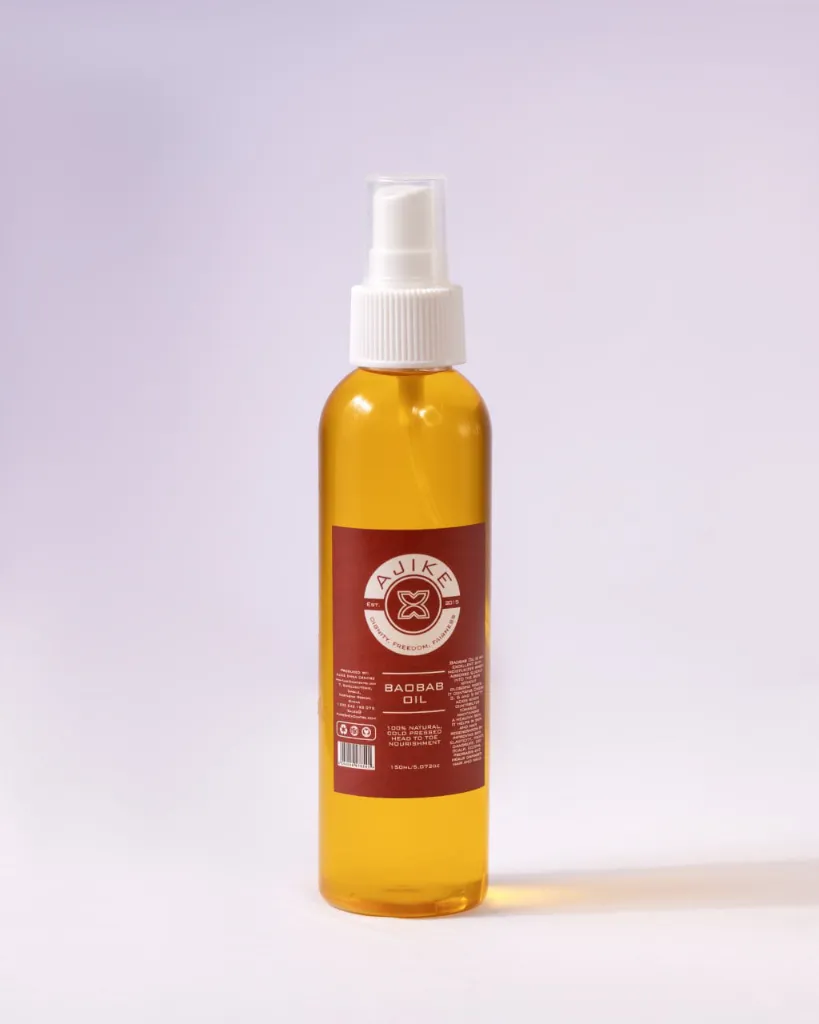
Among all the oils that work for natural hair sealing, baobab oil is the least likely to cause buildup. Its combination of penetrating oleic acid and barrier-supporting linoleic acid provides genuine conditioning with minimal surface residue. Applied in the correct amount, 1 to 2 drops warmed between palms and distributed through damp hair immediately after a water-based leave-in, it seals moisture effectively without adding a coating that accumulates over daily use.
Ajike Marula and Baobab Leave-In Conditioner: Water-Based Daily Moisture
Our Marula and Baobab Leave-In Conditioner is the foundation liquid layer for a buildup-free natural hair routine. Water-based, free from silicones and waxes, it delivers genuine moisture to the hair strand while the marula and baobab oil components provide conditioning without depositing heavy residue. Applied to soaking wet hair sections before the oil sealing step, it provides the moisture foundation that the entire LOC or LCO routine depends on.
Ajike Raw Unrefined Shea Butter: How to Use It Without the Buildup Problem
Raw shea butter works in a buildup-free natural hair routine when used correctly: a tiny pea-sized amount melted between palms until fully liquid, applied as the final occasional sealing step rather than a daily product, and only to the mid-lengths and ends rather than the full length of the hair. In this application, it provides intensive sealing without creating the heavy coating that excessive use produces. For daily sealing, baobab oil is more appropriate. For weekly intensive sealing at wash day, shea butter in minimal amounts is effective.
Ajike Marula and Baobab Anti-Breakage Shampoo: The Clarifying Option That Does Not Strip
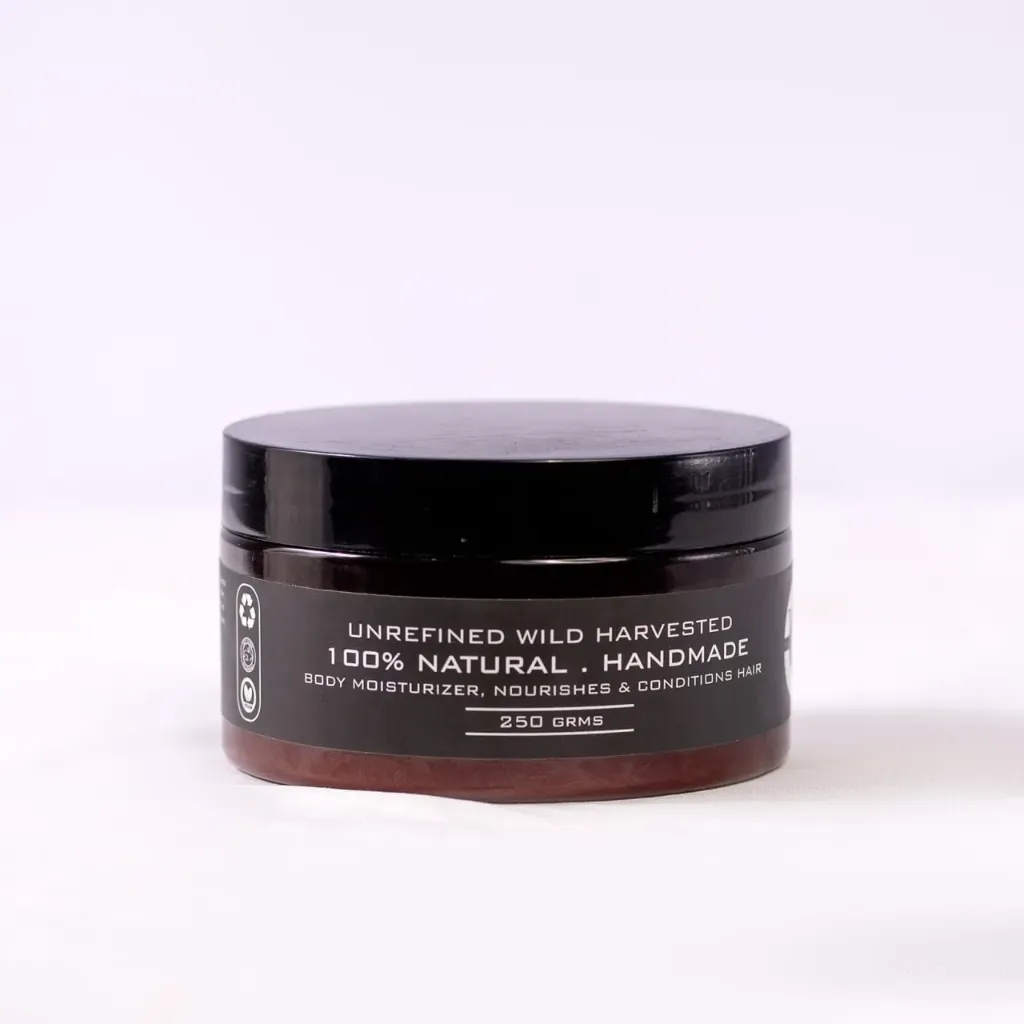
When the regular wash is not clearing enough buildup and the hair is beginning to resist moisture absorption, our Marula and Baobab Anti-Breakage Shampoo provides a slightly more thorough cleanse than a co-wash while still being gentler than a full clarifying treatment. For monthly clarifying of light to moderate buildup from natural products, this is the appropriate choice before reaching for a sulfate-based clarifying shampoo.
How to Build a Minimal Ajike Routine That Actually Works
Wash day (weekly): Ajike Marula and Baobab Anti-Breakage Shampoo to scalp, rinse. Ajike Marula and Baobab Anti-Breakage Conditioner with heat for 30 minutes, rinse. Ajike Marula and Baobab Leave-In Conditioner applied to soaking wet hair sections. Ajike Pure Baobab Oil, 1 to 2 drops warmed between palms, distributed through damp hair. Optional: tiny amount of raw shea butter to ends as final seal.
Between washes: water mist only on days when hair still feels moisturised. Water mist plus 1 drop baobab oil on days when hair needs refreshing. Nothing more. Monthly: ACV rinse after regular wash to remove mineral deposits. Every 2 to 3 months or when moisture absorption feels impaired: full clarifying wash followed by deep conditioning.
Frequently Asked Questions
The most likely causes are: applying products to dry rather than damp hair, product buildup creating a hydrophobic barrier that prevents moisture absorption, using products that coat rather than penetrate (silicones, heavy saturated oils), sealing without first applying a water-based moisture layer, or hard water mineral deposits blocking moisture absorption. Identify which of these applies to your routine before adding more products.
The water bead test: wet a clean strand of your hair with plain water. If the water beads on the surface rather than soaking in quickly, there is significant buildup creating a hydrophobic coating. Other signs: hair feels heavy and coated, products sit on the surface, hair picks up lint easily, coil definition is reduced despite consistent moisturising, and hair smells slightly stale even after washing.
Yes. Baobab oil is one of the most appropriate oils for daily moisture sealing on natural hair because it is light enough to use daily without accumulating as buildup, penetrating enough to provide genuine conditioning through its oleic acid content, and its high linoleic acid content supports cuticle health. Applied in minimal amounts (1 to 2 drops) to damp hair after a water-based leave-in, it provides effective sealing without the heavy coating that causes buildup with heavier oils.
For a minimal routine with light products: every 2 to 3 months. For heavier product routines or hard water areas: monthly. For silicone-containing product users: every 4 to 6 weeks with a sulfate-containing shampoo. After clarifying, always follow with deep conditioning to restore moisture to hair that has been more thoroughly cleansed than usual.
High-porosity hair: LOC, where sealing with oil immediately after the liquid layer prevents rapid moisture loss through the open cuticle. Low-porosity hair: LCO, where the cream applied directly over the liquid before the oil seal often absorbs better than when applied over the oil layer. Medium-porosity hair: either works effectively, try both and use the one that leaves your hair more moisturised on day 3.
Our latest content
Check out what's new in our company !