
Start writing here...
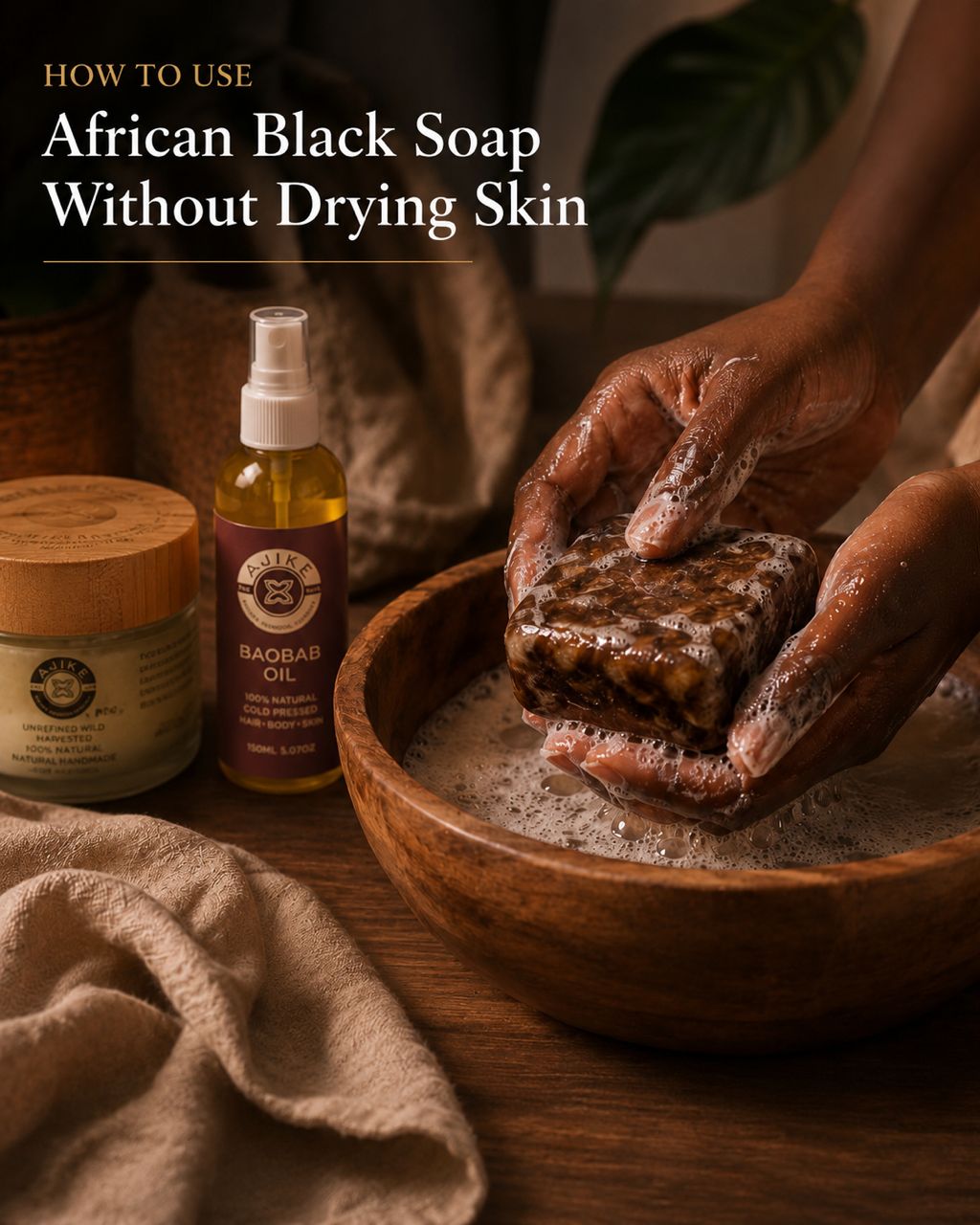
African black soap is one of the most effective natural cleansers available but for some people, especially those with dry or sensitive skin, the first few uses can feel drying. The skin feels tight after washing, or the experience does not quite match what they were expecting from a soap celebrated for being gentle and nourishing.
Here is what most people do not realise: in the vast majority of cases, African black soap is not too drying for your skin type. The dryness comes from how it is being used. And that is something that can be fixed quickly and completely.
This guide explains exactly why African black soap can feel drying, what you are likely doing wrong, and precisely how to use it so that your skin feels clean, comfortable, and well-hydrated every single time regardless of your skin type.
🔗 Read Also: Not sure what to expect in the first few weeks? Read: African Black Soap Breaking Me Out Is This Normal? → https://www.ajikeghana.com/blog/african-black-soap-breaking-me-out
Why Does African Black Soap Feel Drying for Some People?
The Role of Natural pH in Cleansing.
Authentic African black soap, made through traditional saponification using cocoa pod ash and plant oils, has a naturally slightly elevated pH compared to the skin's own acidic pH of 4.5 to 5.5. This mild alkalinity is what gives the soap its deep cleansing ability, it loosens the bonds between dead skin cells and surface oils, allowing them to be rinsed away.
However, this temporary shift in surface pH during cleansing also means the skin needs a moment to return to its natural acidic state. For skin that is already dry or compromised, this shift if not followed immediately by moisturisation can feel like tightness or dryness after washing. The solution is not to avoid African black soap, It is to support the skin's recovery immediately after cleansing.
The Difference Between Skin Feeling Clean and Skin Feeling Stripped.
Many people have been conditioned by years of using commercial cleansers containing synthetic surfactants particularly sodium lauryl sulfate (SLS) and sodium laureth sulfate (SLES) to associate a tight, squeaky clean feeling with effective cleansing. That sensation is actually the feeling of the skin's natural lipid barrier being stripped, not a sign of clean skin.
When transitioning to African black soap, the cleansing sensation is different. The skin feels genuinely clean, impurities and excess sebum removed but without the aggressive stripping that synthetic surfactants produce. For some people, this unfamiliar clean feeling is initially interpreted as dryness, when in reality it is simply what clean skin without synthetic residue actually feels like.
Why Your Previous Skincare Routine Affects How Your Skin Reacts.
If your previous cleanser contained silicones, synthetic waxes, mineral oils, or occlusive film forming ingredients, your skin has been operating under a layer of synthetic coating for potentially years. When you switch to African black soap which removes this layer completely the skin can temporarily feel exposed and drier than usual while it recalibrates its own natural moisture management.
This is not the soap drying your skin. This is your skin relearning how to manage its own moisture without the artificial coating it has relied on. This recalibration typically takes 2 to 4 weeks, during which consistent, immediate moisturisation is essential.
Dry Skin vs Dehydrated Skin Understanding the Difference.
Dry skin is a skin type condition in which the skin produces less sebum than normal due to fewer active sebaceous glands. It is a genetic, largely permanent characteristic that requires consistent, intensive moisturisation.
Dehydrated skin is a temporary skin condition, a lack of water in the skin cells that can affect any skin type, including oily skin. Dehydration is caused by environmental factors, insufficient water intake, over jcleansing, or a disrupted skin barrier, and it presents as tightness, dullness, and fine lines that were not there before.
Many people who believe African black soap is drying their skin are actually experiencing temporary skin dehydration caused by not moisturising quickly enough after cleansing not a skin type issue. The fix is straightforward: moisturise immediately on damp skin after every single wash.
Is African Black Soap Actually Too Drying Or Is It How You Are Using It?
The Most Common Usage Mistakes That Cause Dryness.
In our experience, when someone reports that African black soap is drying their skin, one or more of these mistakes is almost always the cause:
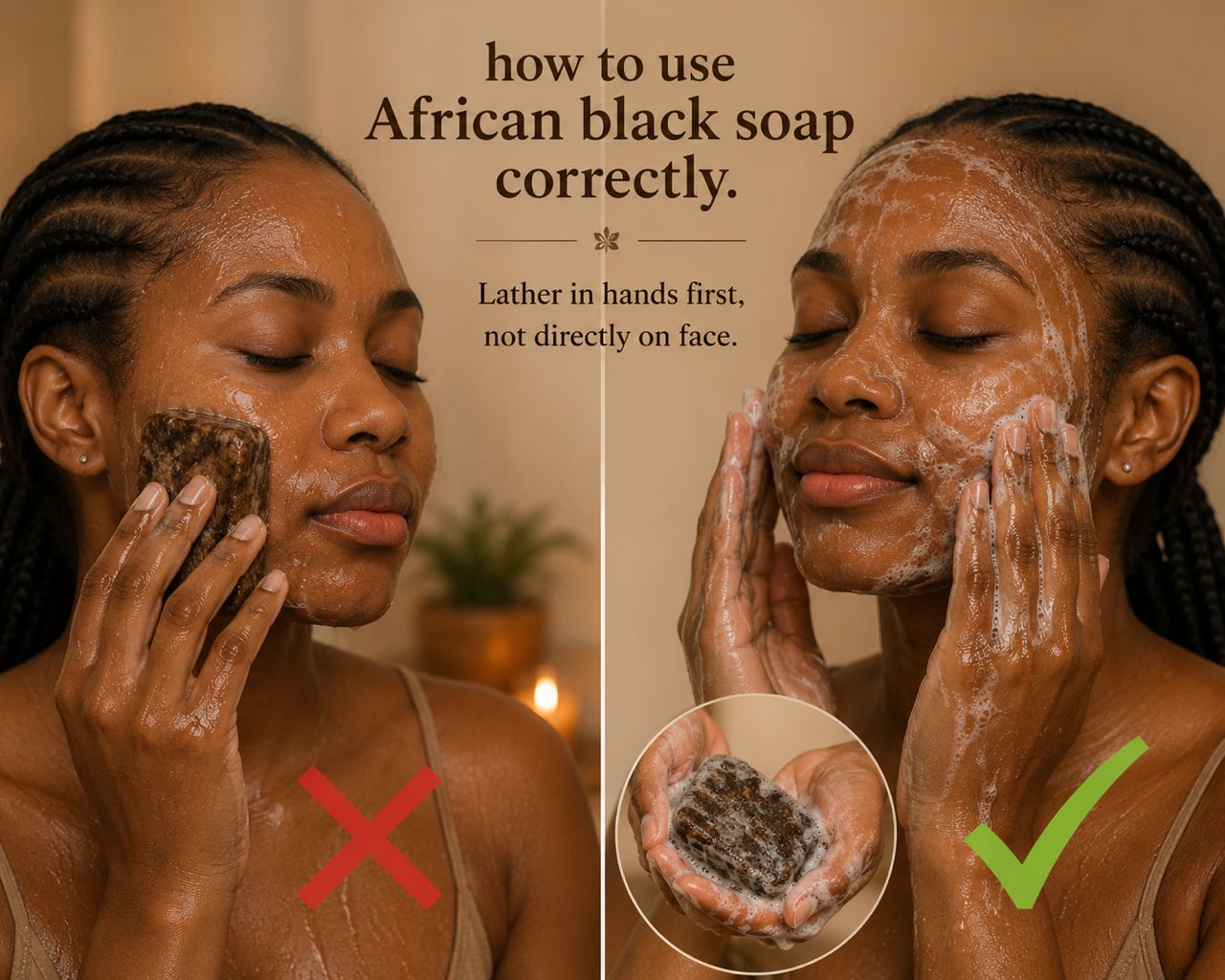
- Applying the bar directly to the face or body instead of lathering in the hands first, direct bar contact dramatically increases the alkaline load on the skin.
- Using hot water instead of lukewarm water. Hot water strips the skin's natural lipid barrier far more aggressively than lukewarm water.
- Leaving the soap on the skin for too long. Contact time should be 30 to 60 seconds maximum.
- Not moisturising immediately after rinsing, waiting even 2 to 3 minutes significantly reduces moisturiser effectiveness.
- Using too much product. A small amount creates sufficient lather for effective cleansing.
- Using it too frequently, starting with daily use on dry skin rather than building up gradually.
- Rinsing with hot water, always finish with cool water to support the skin barrier.
Water Temperature and Its Effect on Skin Moisture.
Hot water is one of the most underestimated causes of post cleansing dryness. Hot water dissolves the skin's natural lipid layer, the thin protective film of oils and fats that keeps the skin barrier intact and prevents transepidermal water loss (TEWL). When this lipid layer is removed by hot water during cleansing, the skin loses moisture rapidly after washing, creating the feeling of tightness and dryness.
Lukewarm water is optimal for cleansing with African black soap warm enough to open the pores and allow effective cleansing, but not so hot as to strip the lipid layer. A cool water rinse at the end closes the pores and calms the skin surface, reducing post-cleansing sensitivity and supporting moisture retention.
How Long You Are Leaving It on the Skin.
African black soap is a rinse-off cleanser, it is designed to clean the skin during active contact and then be rinsed away. It is not a treatment mask intended to remain on the skin. The longer the soap remains in contact with the skin, the more cumulative alkaline exposure the skin receives, and the more likely it is to feel tight or dry after rinsing.
The optimal contact time is 30 to 60 seconds long enough to massage the lather across the skin and allow it to lift impurities and excess oil, but short enough to avoid excessive alkaline exposure. For sensitive or very dry skin, 20 to 30 seconds is sufficient.
How Much Product You Are Using.
African black soap is a concentrated, natural formula. A small amount no larger than a 10p coin if using paste, or a few seconds of lather from the bar is sufficient for effective facial cleansing. Using more product than necessary does not improve cleansing effectiveness. It increases the alkaline load on the skin and can contribute to post-cleansing dryness, particularly for dry and sensitive skin types.
For body use, a larger amount is appropriate, but the same principle applies: use what you need to cover the area and create a working lather, not an excess.
How to Use African Black Soap Correctly for Dry Skin.
📌 Key Rule: Every single step below matters. It is the combination of all steps together, correct format, correct water temperature, correct contact time, correct moisturisation that produces a comfortable, non-drying experience with African black soap for dry skin.
Step 1: Choose the Right Format for Dry Skin.
For dry and sensitive skin types, the paste format (tube) or the liquid body wash format offers a gentler experience than the bar, because the concentration of the formula is slightly lower and the application is more controlled. The bar is the most concentrated format and is best suited to oily, combination, and acne-prone skin types who want a more active cleansing experience.
If you are a dry skin type who wants to use the bar, proceed but reduce contact time to 20 to 30 seconds and be especially diligent about immediate moisturisation.
Step 2: Always Use Lukewarm Water.
Before you pick up the soap, run lukewarm water and test it on your wrist. It should feel comfortably warm not hot, not cool. Wet your face or body thoroughly with this lukewarm water. This step opens the pores gently and prepares the skin for cleansing without stripping the lipid barrier before the soap even touches your skin.
Step 3: Lather in Hands First Never Apply Bar Directly.
This is the most important mechanical step. Wet your hands, then rub the soap bar between your palms until you have a generous, creamy lather. Apply this lather not the bar to your face or body. This method distributes the cleansing action evenly and reduces the concentrated alkaline contact that would occur if the bar were rubbed directly onto the skin.
For the paste format, dispense a small amount onto wet palms and work into a lather before applying. For the body wash, the same principle applies work into lather in your hands or on a cloth rather than applying the liquid directly to the skin.
Step 4: Keep Contact Time Under 60 Seconds.
From the moment the lather touches your skin, count 30 to 60 seconds as you gently massage in circular motions. Do not leave it on the skin while you do other things in the shower or bathroom. For dry skin, 30 to 45 seconds is ideal. For oily skin that wants a more thorough cleanse, up to 60 seconds is appropriate.
Step 5: Rinse Thoroughly with Cool Water.
Switch to cool water for rinsing. Rinse thoroughly, ensuring no soap residue remains on the skin particularly around the hairline, jaw, and sides of the nose where soap can collect. Residual soap on the skin after rinsing will continue to create an alkaline environment and can cause irritation, tightness, and dryness.
The cool water rinse closes the pores, calms the skin surface, and begins to support the skin's return to its natural acidic pH. This step makes a meaningful difference to how the skin feels immediately after cleansing.
Step 6: Pat Dry Gently Do Not Rub
Use a clean, soft towel and gently pat the skin dry. Do not rub. Rubbing creates friction on the skin surface, which can irritate the skin barrier particularly on dry or sensitive skin and removes too much of the remaining moisture from the skin surface. You want the skin to be damp after patting, not bone dry.
Keeping the skin slightly damp at this stage is intentional it prepares the surface for the moisturiser that must be applied immediately in the next step.
Step 7: Moisturise on Damp Skin Immediately
This is the step that transforms the experience of African black soap for dry skin types and the step most people skip, delay, or underestimate. Your moisturiser must be applied while your skin is still slightly damp within 60 seconds of patting dry. Not after you brush your hair. Not after you check your phone. Immediately.
Damp skin is receptive skin. The humectants in your moisturiser bind to the water molecules on the skin surface, drawing them into the skin cells and creating genuine, lasting hydration. Applied to dry skin, moisturiser sits on the surface and provides far less benefit. This single change moisturising on damp skin within 60 seconds transforms the experience of African black soap for dry skin types.
How Often Should You Use African Black Soap?
Dry Skin Recommended Frequency
Begin with every other day use (evenings only) for the first 2 weeks. This gives your skin time to adjust gradually. Assess how your skin is responding if it feels comfortable, hydrated, and balanced, you can progress to once daily evening use. Most dry skin types find once daily use at night sufficient and prefer a gentle water rinse in the morning without soap.
Normal and Combination Skin Recommended Frequency
Once daily use (evening) is the ideal starting point for normal and combination skin. After 2 weeks, if the skin is responding well, twice daily use (morning and evening) is appropriate. Many normal skin types find that once daily cleansing with African black soap is all they need for consistently clear, balanced skin.
Oily and Acne-Prone Skin Recommended Frequency
Oily and acne-prone skin types typically tolerate and benefit from twice daily use morning and evening after an initial adjustment period of 1 to 2 weeks of once daily use. The morning cleanse removes overnight sebum buildup, and the evening cleanse removes the day's impurities and pollution. Starting with twice daily use immediately can be too much for some skin types, so beginning with once daily and building up is always the safer approach.
Signs You Are Using It Too Often
- Skin feels tight immediately after cleansing and remains tight throughout the day
- Skin appears dull, flat, or lacks its usual natural glow
- Fine surface lines that were not present before a sign of dehydration
- Skin is producing more oil than usual a sign of over-stripping and compensatory sebum production
- Sensitivity or redness that is new and has appeared since you started using the soap more frequently
How to Moisturise After African Black Soap This Step Is Everything
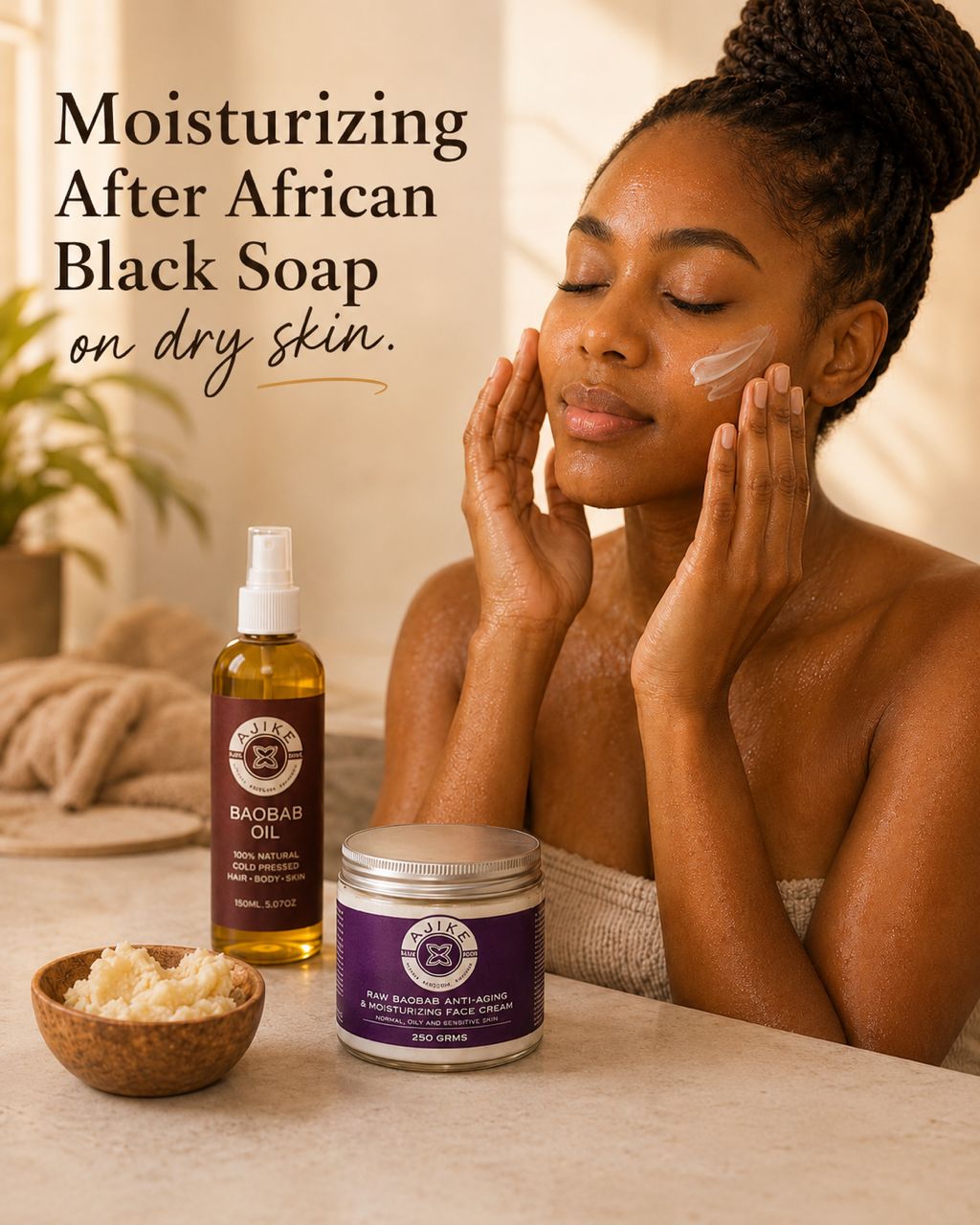
Why Timing of Moisturising Matters
The timing of moisturiser application is not a minor detail it is the most influential factor in whether your moisturiser actually works. The skin's ability to absorb and retain moisture is at its highest immediately after cleansing, when the stratum corneum (the outermost layer of the skin) is still hydrated from water contact. As the skin dries particularly in dry or air-conditioned environments transepidermal water loss (TEWL) begins immediately. Moisturiser applied to dry skin forms a barrier over already-depleted skin cells. Moisturiser applied to damp skin creates a true moisture seal.
Damp Skin vs Dry Skin Why the Difference Is Critical
When skin is damp, the corneocytes the outermost cells of the stratum corneum are swollen with water and their surfaces are temporarily more permeable. Applying a moisturiser at this moment allows the active ingredients humectants, emollients, and occlusives to penetrate more effectively and bind to the water molecules already present in the skin cells.
When skin is fully dry, the corneocytes have contracted and the skin surface is less permeable. Moisturiser at this point provides surface hydration only it does not penetrate as effectively, and the water that was in the skin has already begun to evaporate.
Humectants, Emollients and Occlusives The Layering Method
Understanding the three categories of moisturising ingredients helps you build a routine that genuinely works for dry skin after African black soap cleansing:
- Humectants draw water into the skin from the environment or from deeper skin layers. Examples: hyaluronic acid, glycerine. Apply first on damp skin.
- Emollients fill the gaps between skin cells, improving texture and softness. Examples: baobab oil, squalane, shea butter fractions. Layer over humectants.
- Occlusives form a physical barrier on the skin surface that prevents water from evaporating (prevents TEWL). Examples: raw shea butter, beeswax. Use sparingly as a final seal, particularly for very dry or eczema-prone skin.
How to Build a Moisture Lock Routine After Black Soap
For dry skin, the most effective post-cleansing moisture lock routine is:
- Pat skin dry gently leave slightly damp
- Apply a humectant-rich product first (face mist with hyaluronic acid or glycerine, or a few drops of a hydrating serum) while skin is at its most damp
- Immediately follow with an emollient moisturiser (baobab face cream or nightly moisturiser with hyaluronic acid and marula)
- For very dry skin, seal with a small amount of raw shea butter or facial oil (baobab oil or Pamper Me face oil) as the final step
Best Moisturisers to Use with African Black Soap
For Dry and Very Dry Skin Raw Shea Butter and Baobab Oil
Raw unrefined shea butter is the most intensive moisturiser available for very dry skin types using African black soap. Its high content of oleic acid, stearic acid, and natural vitamins A and E provides deep nourishment, while its unsaponifiable fraction creates a physical barrier that prevents TEWL. Apply sparingly to damp skin immediately after cleansing.
Baobab oil is an ideal companion lightweight enough to layer under shea butter or use alone for those who find pure shea butter too heavy. Its vitamin F (linoleic and alpha-linolenic acid) content makes it particularly effective for supporting the skin barrier in dry skin types.
🛒 PRODUCT LINK Ajike Raw Unrefined Shea Butter (Ivory) Natural African Moisturiser for Dry Skin & Hair Care Wild harvested. 100% pure unrefined. Rich in vitamins A, E, F. Intensive moisture for dry and very dry skin. Apply sparingly on damp skin after cleansing. 🔗 https://www.ajikeghana.com/products/raw-unrefined-shea-butter-ivory
🛒 PRODUCT LINK Ajike Pure Baobab Oil 100% Pure Organic Oil for Skin & Hair Hydration Non-comedogenic. Vitamins A, D, E, F. Lightweight and fast-absorbing. Excellent for dry skin after black soap. Can be used alone or layered under shea butter. 🔗 https://www.ajikeghana.com/products/baobab-oil
For Normal and Combination Skin Lightweight Face Creams
Normal and combination skin types need a moisturiser that hydrates without heaviness something that nourishes the skin after cleansing without clogging pores or creating excess oiliness in the T-zone. A lightweight plant-based face cream with a balanced blend of humectants and emollients is ideal.
🛒 PRODUCT LINK Ajike Raw Baobab Anti-Aging & Moisturizing Face Cream Hydrating Natural Moisturizer Lightweight. Raw baobab oil, shea butter, glycerine. Moisturises and supports skin elasticity. Perfect daily moisturiser after black soap. Normal, combination, dry, sensitive skin. 🔗 https://www.ajikeghana.com/products/raw-baobab-anti-aging-face-cream
For Oily and Acne-Prone Skin Non-Comedogenic Oils
Oily and acne-prone skin types still need moisturisation after cleansing with African black soap skipping this step causes the skin to overproduce sebum in compensation, which worsens oiliness and congestion. The key is choosing a non-comedogenic moisturiser that hydrates without blocking pores.
Baobab oil (comedogenicity rating 2) is one of the best options for oily and acne-prone skin it is light enough to absorb quickly without leaving residue, and its linoleic acid content is particularly beneficial for acne-prone skin, which is typically deficient in this fatty acid.
For Sensitive Skin Fragrance-Free and Minimal Ingredient Options
Sensitive skin types should use our unscented formulations the African Black Soap Eczema Soap paired with raw unrefined shea butter or baobab oil. Avoid anything with essential oils or botanical extracts during the initial period of use. A simple, minimal-ingredient moisturiser with no synthetic additives is the safest and most effective choice for sensitive skin after cleansing.
🛒 PRODUCT LINK Ajike Black Soap Eczema Soap Natural Relief Soothing Soap for Dry, Itchy & Sensitive Skin Unscented. No fragrance, no preservatives, no mineral oil. Specially formulated for sensitive and eczema-prone skin. Gentlest cleansing option in the Ajike range. 🔗 https://www.ajikeghana.com/products/black-soap-eczema-soap
African Black Soap Routine for Dry Skin Morning and Night
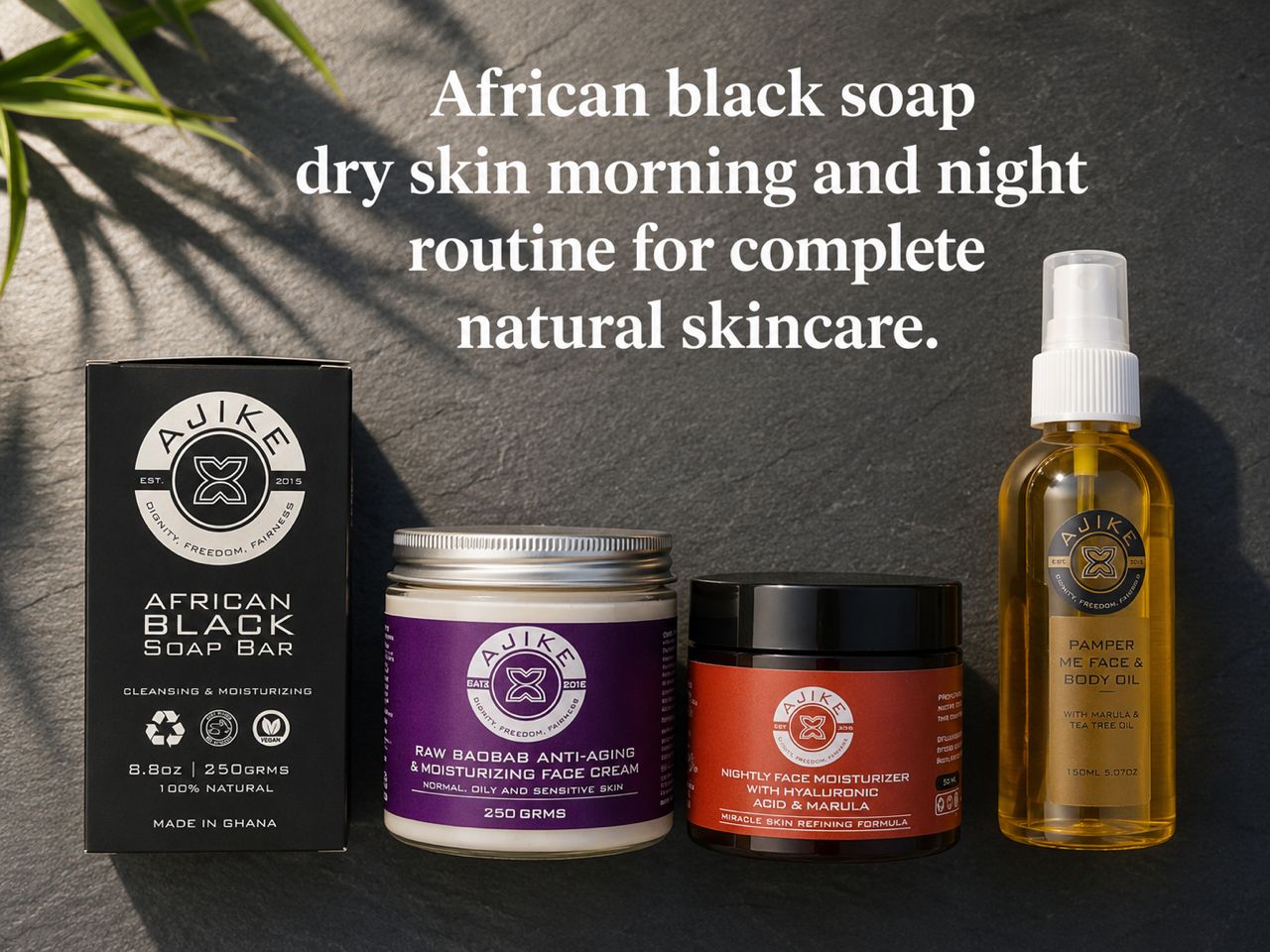
Morning Routine Cleanse, Hydrate, Seal
For dry skin, a gentle morning cleanse is all that is required. Many dry skin types find that a simple water rinse in the morning no soap is sufficient, as the skin has not been exposed to significant impurities overnight. However, if you prefer to cleanse in the morning:
- Splash face with lukewarm water
- Apply a small amount of lather from Ajike African Black Soap Paste or Bar 20 to 30 seconds contact time
- Rinse thoroughly with cool water
- Pat dry gently leave slightly damp
- Apply Ajike Glycerine Hibiscus & Hyaluronic Acid Face Mist to damp skin wait 30 seconds
- Apply Ajike Raw Baobab Anti-Aging Face Cream as your moisturiser
- Seal with 1 to 2 drops of Ajike Pure Baobab Oil if additional moisture is needed
Night Routine Deep Cleanse, Repair, Restore
The evening routine is where African black soap does its most important work for dry skin removing the day's impurities, pollution, and excess oil, and preparing the skin to absorb the reparative ingredients applied before sleep.
- Double cleanse if wearing makeup use Ajike Pamper Me Face and Body Oil to remove makeup first
- Lather Ajike African Black Soap Bar or Paste in hands 45 to 60 seconds massage on damp skin
- Rinse thoroughly with cool water
- Pat dry leave slightly damp
- Apply Ajike Nightly Face Moisturiser with Hyaluronic Acid and Marula
- Layer Ajike Nightly Face Serum with Lactic Acid & Papaya oil over the Moisturiser
- Seal with Ajike Raw Unrefined Shea Butter (very small amount) as final occlusive for very dry skin
Weekly Routine How to Incorporate: Exfoliation Safely
African black soap already provides mild exfoliation through its natural pH. Adding a dedicated exfoliating product on top of this should be done carefully and infrequently no more than once or twice per week for dry skin. Choose a gentle exfoliant such as the Ajike Walnut and Papaya Exfoliating Face Scrub on the evenings you do not cleanse with African black soap, rather than on the same evening.
Avoid using chemical exfoliants (AHAs, BHAs) on the same day as African black soap cleansing during the first month of use. Once your skin has fully adjusted to African black soap, you can assess whether layering actives is appropriate for your skin type.
Ajike Products That Work Best for Dry Skin After Black Soap
Ajike Raw Baobab Anti-Aging Face Cream
Our Raw Baobab Anti-Aging and Moisturizing Face Cream is the most versatile daily moisturiser in our range for use after African black soap cleansing. Formulated with raw baobab oil, shea butter, and glycerine, it provides immediate hydration, supports skin elasticity, and absorbs without heaviness making it suitable for normal to dry skin types seeking daily moisturisation after cleansing.
🛒 PRODUCT LINK Ajike Raw Baobab Anti-Aging & Moisturizing Face Cream Raw baobab oil, shea butter, glycerine. Anti-aging and moisturising. Lightweight absorption. Daily use after black soap. Normal, dry, mature, sensitive skin. 🔗 https://www.ajikeghana.com/products/raw-baobab-anti-aging-face-cream
Ajike Raw Unrefined Shea Butter
For very dry skin, nothing outperforms raw unrefined shea butter as a final sealant after cleansing. Applied in a small amount to slightly damp skin after your primary moisturiser, it creates a breathable occlusive layer that locks in all the hydration from the products beneath. Our ivory shea butter is wild harvested and completely unprocessed every nutrient intact.
🛒 PRODUCT LINK Ajike Raw Unrefined Shea Butter (Ivory) Natural African Moisturiser for Dry Skin & Hair Care Wild harvested. Pure, unrefined. Vitamins A, E, F. Best intensive sealant for very dry skin after black soap cleansing. 🔗 https://www.ajikeghana.com/products/raw-unrefined-shea-butter-ivory
Ajike Nightly Face Moisturiser with Hyaluronic Acid and Marula
Our Nightly Face Moisturiser with Hyaluronic Acid and Marula is specifically designed for the evening routine when the skin's repair processes are most active and the focus is on deep hydration and restoration. Hyaluronic acid draws water into the skin cells, while marula oil seals and nourishes without comedogenicity. The result is skin that feels deeply moisturised and visibly plump by morning.
🛒 PRODUCT LINK Ajike Nightly Face Moisturiser with Hyaluronic Acid & Marula Hydrating Face Moisturizer for Dry & Dull Skin Hyaluronic acid, marula oil, papaya oil, shea butter, cocoa butter, baobab oil. Deep overnight hydration. Dry, sensitive, mature skin. Use after evening black soap cleanse. 🔗 https://www.ajikeghana.com/products/nightly-face-moisturizer-hyaluronic-acid-marula
Ajike Pamper Me Face and Body Oil
Our Pamper Me Face and Body Oil is a multi-purpose nourishing oil blend ideal as a final moisture seal after cleansing, as a first step makeup remover before evening cleansing, or as a lightweight hydrating layer for normal and combination skin types that find face creams too heavy. Its blend of marula, argan, and jojoba oils provides excellent emollient coverage without heaviness.
🛒 PRODUCT LINK Ajike Pamper Me Face and Body Oil Natural Glow & Deep Moisturizing Skin Oil Marula oil, argan oil, jojoba oil, lemongrass essential oil. Multi-purpose. Moisturising and glow-enhancing. Use after black soap as daily oil or makeup remover before evening cleanse. 🔗 https://www.ajikeghana.com/products/pamper-me-face-and-body-oil
Ajike African Black Soap Formulated to Cleanse Without Stripping
Natural Glycerine Retained, Why This Matters for Dry Skin
Every bar of Ajike African black soap is made through traditional saponification the complete, natural process that converts plant oils and ash lye into soap. One of the most important results of this process is the retention of natural glycerine in the finished bar. Commercial soap manufacturing extracts this glycerine and sells it separately. We do not.
Natural glycerine is a powerful humectant, it draws moisture into the skin from the environment during and after cleansing. This built-in humectant action is one of the main reasons that authentic, traditionally made African black soap is gentler and less drying than factory made alternatives. The glycerine is working for your skin at the same time as the soap is cleansing it.
Shea Butter in the Formula Built-In Moisture Protection
Our soap formula includes raw unrefined shea butter as a core ingredient. During saponification, a portion of the shea butter is converted into soap molecules but a meaningful portion remains as unsaponified shea butter fractions in the finished bar. These unsaponified fractions include natural vitamins, triterpenes, and fatty acids that are not converted to soap and remain active on the skin during and after cleansing.
This built-in shea butter content provides a layer of moisture protection within the cleansing formula itself reducing the stripping effect that would occur if the soap formula contained only saponified oils.
Handcrafted in Ghana With Pure Ingredients, No Harsh Additives
Ajike African black soap is handcrafted in small batches in Ghana. No sulfates, no parabens, no mineral oils, no silicones, no synthetic fragrances, no artificial colours, no foam boosters, no synthetic preservatives. Every ingredient in our formula is plant-derived and serves a purpose. Nothing is added to make the formula cheaper, more stable, or more cosmetically appealing at the expense of your skin's health.
This purity is what makes the dryness issue correctable through correct use. When a formula is this clean, the skin's response is predictable and a small number of adjustments to technique and moisturisation routine are all it takes to experience African black soap the way it was always meant to be experienced.
Frequently Asked Questions
Yes African black soap is suitable for dry skin when used correctly. The key differences for dry skin users are: choose the paste or liquid format over the bar, use every other day to start, keep contact time to 20 to 30 seconds, always moisturise on slightly damp skin within 60 seconds of patting dry, and use a rich moisturiser like raw shea butter or baobab oil. Results may vary depending on skin type.
Tightness after cleansing with African black soap is almost always caused by one or more of these factors: waiting too long to apply moisturiser after rinsing, using water that is too hot, leaving the soap in contact with the skin for too long, or applying the bar directly to the face rather than lathering in hands first. Address each of these and the tightness typically resolves within a few uses.
Yes, but we recommend building up gradually rather than starting with daily use immediately. Begin with every other day for the first 2 weeks, then progress to once daily if your skin is responding comfortably. Once daily evening use is the ideal long-term frequency for most dry skin types. Results may vary depending on skin type.
For dry skin, raw unrefined shea butter applied sparingly on damp skin is the most intensive option. Ajike Raw Baobab Anti-Aging Face Cream is the best daily option lightweight enough for day use but nourishing enough for dry skin needs. For the evening, the Ajike Nightly Face Moisturiser with Hyaluronic Acid and Marula provides deep overnight hydration. Sealing with 1 to 2 drops of Ajike Pure Baobab oil is an excellent final step for very dry skin.
Most dry skin types find that their skin adjusts fully within 2 to 4 weeks of consistent, correct use. The initial period may involve some tightness or unfamiliar sensation this is the skin recalibrating from synthetic cleansers to a natural formula. By week 3 to 4, most users report that their skin feels comfortable, balanced, and more naturally hydrated throughout the day. Results may vary depending on skin type.