
Start writing here...
Acne is one of the most common skin concerns in the world and one of the most frustrating. You try product after product, and either nothing works, or something works temporarily and then stops, or the treatment itself causes new problems: dryness, irritation, sensitivity, or post-acne marks that linger long after the breakouts are gone.
African black soap has been used across West Africa for generations as a daily skin cleanser and balancer and for those dealing with acne, it offers something that most commercial acne treatments do not: effective cleansing and oil control without the dryness, irritation, and long-term dependency that pharmaceutical and chemical acne treatments often create.
This complete guide explains exactly why African black soap works for acne, which types of acne it helps with, and gives you a precise, step-by-step routine to follow for the best results along with realistic expectations about what you will see and when.
🔗 Read Also: New to African Black Soap? Start here: What Is African Black Soap? Complete Guide → https://www.ajikeghana.com/blog/what-is-african-black-soap
Why Acne Happens Understanding the Root Causes
To understand how African black soap helps with acne, you first need to understand what actually causes acne because different types of acne have different root causes, and not every treatment addresses all of them.
Excess Sebum Production and Clogged Pores
Sebum is the natural oil produced by sebaceous glands in the skin. A healthy amount of sebum keeps the skin moisturised and protected. But when sebaceous glands overproduce sebum triggered by hormones, genetics, diet, or overly harsh cleansers that strip the skin and cause compensatory oil production the excess sebum mixes with dead skin cells inside the pore.
This mixture creates a plug inside the follicle. When the plug remains below the skin surface, it forms a whitehead (closed comedo). When it oxidises on contact with air, it turns dark and forms a blackhead (open comedo). Both are the foundation of most acne and the entry point through which acne-causing bacteria colonise the pore.
Acne-Causing Bacteria Cutibacterium Acnes
Cutibacterium acnes (formerly known as Propionibacterium acnes) is an anaerobic bacterium that naturally lives on the skin's surface and within hair follicles. In normal skin conditions, C. acnes is part of the skin's microbiome and causes no harm. However, when a sebum-filled, oxygen-depleted pore provides the perfect anaerobic environment, C. acnes multiplies rapidly.
As C. acnes colonises the clogged follicle, it releases enzymes that break down sebum into free fatty acids compounds that directly irritate the follicle wall and trigger an immune response. This immune response is what creates the inflammation visible as redness, swelling, and pain around an acne lesion. Addressing C. acnes overgrowth without disrupting the broader skin microbiome is a key component of effective acne treatment.
Inflammation Why Some Spots Are Worse Than Others
Not all blocked pores become inflamed acne lesions. Inflammation occurs when the immune system mounts a response to C. acnes activity within the follicle. The intensity of this inflammatory response which varies significantly between individuals based on genetics and skin type determines whether a clogged pore remains a non-inflammatory comedo (blackhead or whitehead) or progresses to an inflamed papule, pustule, or cystic lesion.
Reducing skin inflammation not just killing bacteria is therefore as important as any antibacterial action. This is why harsh, drying acne treatments that strip the skin and cause irritation can worsen acne in some individuals: the skin irritation increases baseline inflammation, which intensifies the immune response to C. acnes.
Hormonal Triggers and Acne
Androgens the group of hormones that includes testosterone stimulate sebaceous gland activity and increase sebum production. This is why acne is so common during puberty (when androgen levels surge), during the menstrual cycle (hormonal fluctuations cause sebum spikes), and for people with conditions like polycystic ovary syndrome (PCOS) that cause chronically elevated androgen levels.
Hormonal acne typically manifests along the lower face chin, jawline, and neck in a characteristic pattern. Because its root cause is internal, topical treatments alone can only manage symptoms rather than resolve the underlying cause. African black soap supports cleaner skin surface conditions that reduce the impact of hormonal acne triggers, but hormonal acne may also benefit from dietary and lifestyle interventions or medical evaluation.
Product Buildup and Congestion The Hidden Cause
A frequently overlooked cause of persistent acne particularly in adults who already have an established skincare routine is product buildup. Moisturisers containing mineral oil or heavy synthetic emollients, foundations and primers containing silicones, sunscreens with occlusive synthetic ingredients, and even some cleansers that leave a film residue can all contribute to pore congestion over time.
If acne persists despite a careful routine, the products themselves may be contributing to the congestion. African black soap, as a cleanser free from all of these occlusive synthetic ingredients, removes product buildup effectively without adding to it and this is often why people transitioning from commercial cleansers to African black soap experience an initial purging phase as the accumulated congestion is finally cleared.
🔗 Read Also: Experiencing a purging phase? Read: African Black Soap Breaking Me Out Is This Normal? → https://www.ajikeghana.com/blog/african-black-soap-breaking-me-out
Is African Black Soap Good for Acne?
How Cocoa Pod Ash Addresses Acne-Causing Bacteria
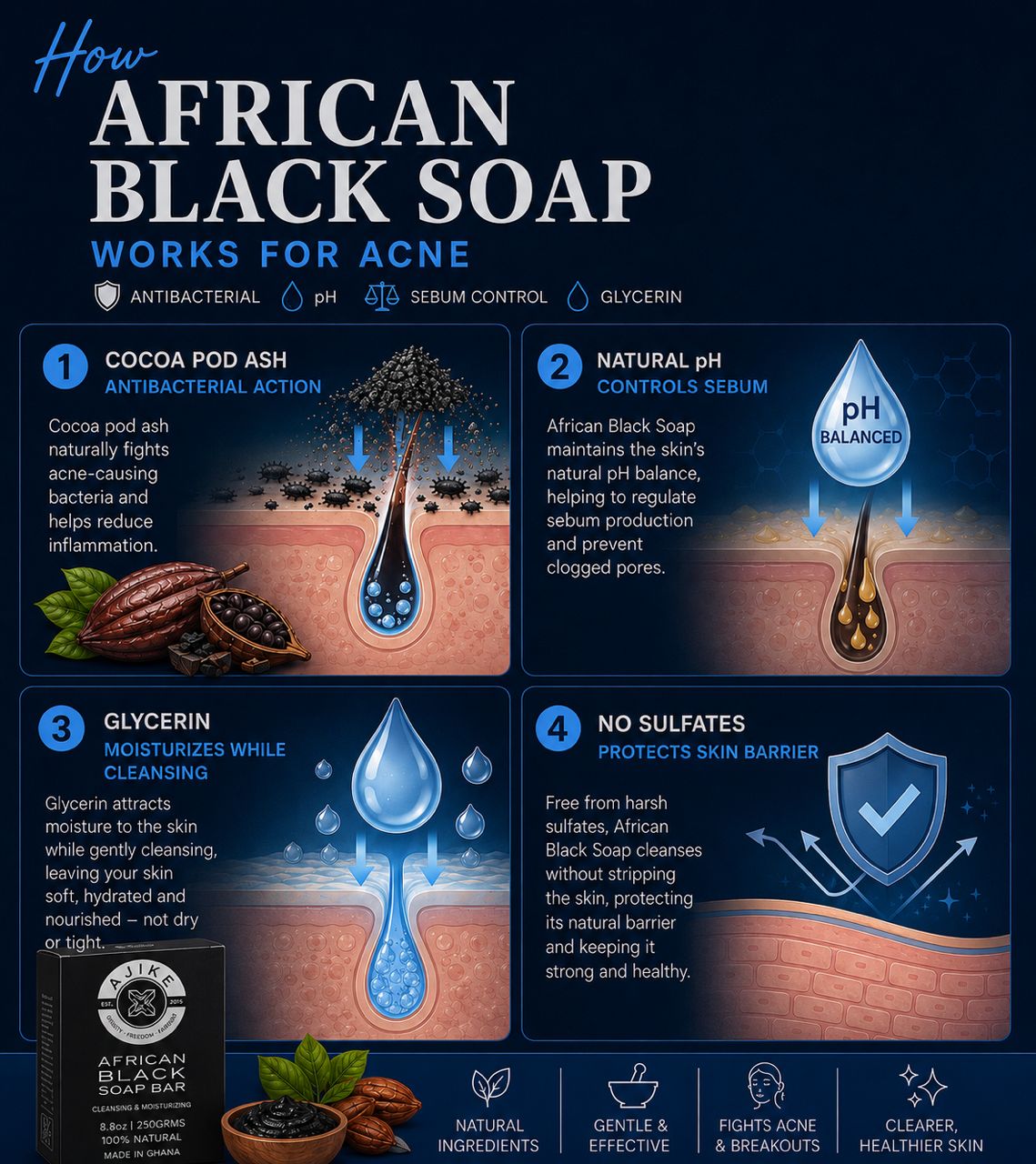
Cocoa pod ash the roasted ash of cocoa pod shells is the defining ingredient in authentic Ghanaian African black soap. The alkaline environment created by cocoa pod ash during cleansing creates conditions on the skin surface that are hostile to many bacteria, including Cutibacterium acnes.
Unlike antibiotic acne treatments that specifically target C. acnes and risk creating antibiotic-resistant bacterial strains, cocoa pod ash creates a broad-spectrum antibacterial environment through its natural alkalinity and mineral composition. This approach is less likely to contribute to long-term antibiotic resistance an increasingly important consideration given the growing problem of antibiotic-resistant acne bacteria in clinical dermatology.
How Natural pH Controls Excess Sebum Without Stripping
The slightly elevated alkaline pH of African black soap effectively removes excess sebum from the skin surface and from within the pores during cleansing. Critically, because this cleansing action is driven by natural plant-based saponification rather than synthetic surfactants, it removes excess sebum without triggering the compensatory sebum overproduction that harsh synthetic cleansers cause.
Commercial cleansers containing SLS or SLES strip the skin aggressively, disrupting the acid mantle and signalling the sebaceous glands to produce more oil in compensation. This creates a cycle: harsh cleanser → over-stripping → rebound sebum overproduction → more acne → harsher cleanser. African black soap breaks this cycle by cleansing effectively without over-stripping.
How Saponification Retains Glycerine No Over-Drying
Traditional saponification the process that creates authentic African black soap produces natural glycerine as a byproduct of the reaction between plant ash lye and oils. This glycerine is retained in the finished bar. In commercial soap manufacturing, it is extracted and sold separately, leaving a drier, harsher product.
The retained glycerine in African black soap is a humectant it draws moisture from the environment into the skin cells during and after cleansing. This means even acne-prone skin, which often becomes dry and dehydrated from over-treatment, maintains adequate moisture levels when cleansing with African black soap. Properly hydrated skin has a more balanced sebum production cycle and a healthier skin barrier both of which reduce acne severity over time.
Why No Sulfates and No Synthetic Additives Matters for Acne Skin
Acne-prone skin has a compromised skin barrier the tight junction proteins between skin cells are less effective, making the skin more permeable to irritants and bacteria. Introducing sulfates, synthetic preservatives, artificial fragrances, and synthetic emollients to already-compromised acne-prone skin aggravates this barrier dysfunction, increases inflammation, and worsens the conditions that allow C. acnes to thrive.
African black soap contains none of these aggravating ingredients. No sulfates, no parabens, no synthetic fragrances, no mineral oils, no silicones. For acne-prone skin, every ingredient removed from a cleanser that is not serving a genuine purpose reduces the inflammation load on the skin and improves conditions for healing.
African Black Soap for Mild, Moderate and Severe Acne What to Expect
Mild acne (occasional blackheads, whiteheads, and small papules) responds well to African black soap as a standalone cleansing treatment, particularly when paired with a non-comedogenic moisturiser and appropriate weekly exfoliation.
Moderate acne (multiple inflamed papules and pustules, some cystic activity) benefits significantly from African black soap as the cleansing foundation, paired with targeted spot treatment (neem oil) and a brightening serum for post-acne marks. Consistent daily use is essential for meaningful results.
Severe or cystic acne characterised by deep, painful, widespread cystic lesions will benefit from African black soap as a gentle daily cleanser, but may require additional medical evaluation and treatment alongside the natural skincare routine. Results may vary depending on skin type and the individual causes of acne.
African Black Soap for Different Types of Acne
Blackheads and Whiteheads Comedonal Acne
Blackheads (open comedones) and whiteheads (closed comedones) are non-inflammatory acne blocked pores without significant bacterial activity or immune response. They form when excess sebum and dead skin cells create a plug inside the follicle.
African black soap addresses comedonal acne through two mechanisms: first, its effective sebum removal during cleansing reduces the raw material available for new comedone formation; second, its gentle pH exfoliation supports the regular shedding of dead skin cells that would otherwise contribute to follicle plugging. Consistent daily use produces a meaningful reduction in blackhead and whitehead formation over 4 to 8 weeks.
Inflammatory Acne Papules and Pustules
Inflammatory acne red papules and pus-filled pustules involves active C. acnes colonisation and an immune response. African black soap's antibacterial action reduces the bacterial load on the skin surface, and its anti-inflammatory plant compounds (from unsaponified shea butter fractions) help moderate the inflammatory response.
For inflammatory acne, consistent twice-daily use once in the morning and once in the evening is most effective, paired with a non-comedogenic moisturiser and targeted neem oil spot treatment on active lesions. The reduction in new papule and pustule formation typically becomes visible within 3 to 4 weeks of consistent, correct use.
Cystic Acne Deep Painful Breakouts
Cystic acne involves deep, large, painful lesions that form when the follicle ruptures beneath the skin surface, causing a larger inflammatory response in the surrounding dermis. Cystic lesions are the most likely to leave permanent scarring if damaged or improperly treated.
African black soap as a daily cleanser supports a cleaner skin surface environment that reduces the likelihood of new cystic lesions forming, and its anti-inflammatory properties can help moderate the severity of existing ones. However, active cystic acne lesions should not be approached with any topical treatment alone severe cystic acne benefits from medical evaluation alongside a gentle natural skincare routine. Do not attempt to squeeze or extract cystic lesions. Results may vary depending on skin type.
Hormonal Acne Chin and Jawline Breakouts
Hormonal acne characterised by breakouts concentrated along the chin, jawline, and lower cheeks, often correlating with the menstrual cycle or stress is driven primarily by androgen-related sebum surges. African black soap provides effective daily cleansing that removes the excess sebum produced during hormonal spikes, reducing the pore congestion that allows C. acnes to thrive.
Because the root cause is internal, dietary support, stress management, and in some cases medical evaluation are important components of managing hormonal acne. African black soap works best as the cleansing foundation of a broader approach to hormonal skin balance.
Back and Body Acne
Back acne (bacne), chest acne, and shoulder acne respond particularly well to African black soap the back and chest have high concentrations of sebaceous glands, making them prone to both comedonal and inflammatory acne. Our Lavender and Lemongrass Black Soap Body Wash or the original African Black Soap Bar used daily in the shower provides effective, thorough cleansing of these areas.
For back acne, applying the body wash with a long-handled brush or loofah allows thorough coverage. Allow a 30 to 60 second contact time before rinsing. Follow with a lightweight, non-comedogenic body moisturiser or a few drops of Ajike Pure Baobab Oil if the skin is dry.
Acne Scars and Post-Acne Marks
Post-acne marks the flat dark discolourations left after acne heals are one of the most persistent concerns for acne-prone skin, particularly for melanin-rich skin types where post-inflammatory hyperpigmentation (PIH) is more pronounced. African black soap's consistent gentle exfoliation supports the gradual fading of these marks through regular skin cell renewal.
For faster fading of post-acne marks, pairing African black soap with our Nightly Face Serum with Lactic Acid and Papaya Oil every evening significantly accelerates the renewal of hyperpigmented surface cells. This combination gentle cleansing exfoliation plus targeted AHA treatment produces better results than either approach alone.
🔗 Read Also: Full guide on dark spots: African Black Soap for Hyperpigmentation and Dark Spots on Dark Skin → https://www.ajikeghana.com/blog/african-black-soap-for-hyperpigmentation-dark-spots
Step by Step Guide How to Use African Black Soap for Acne
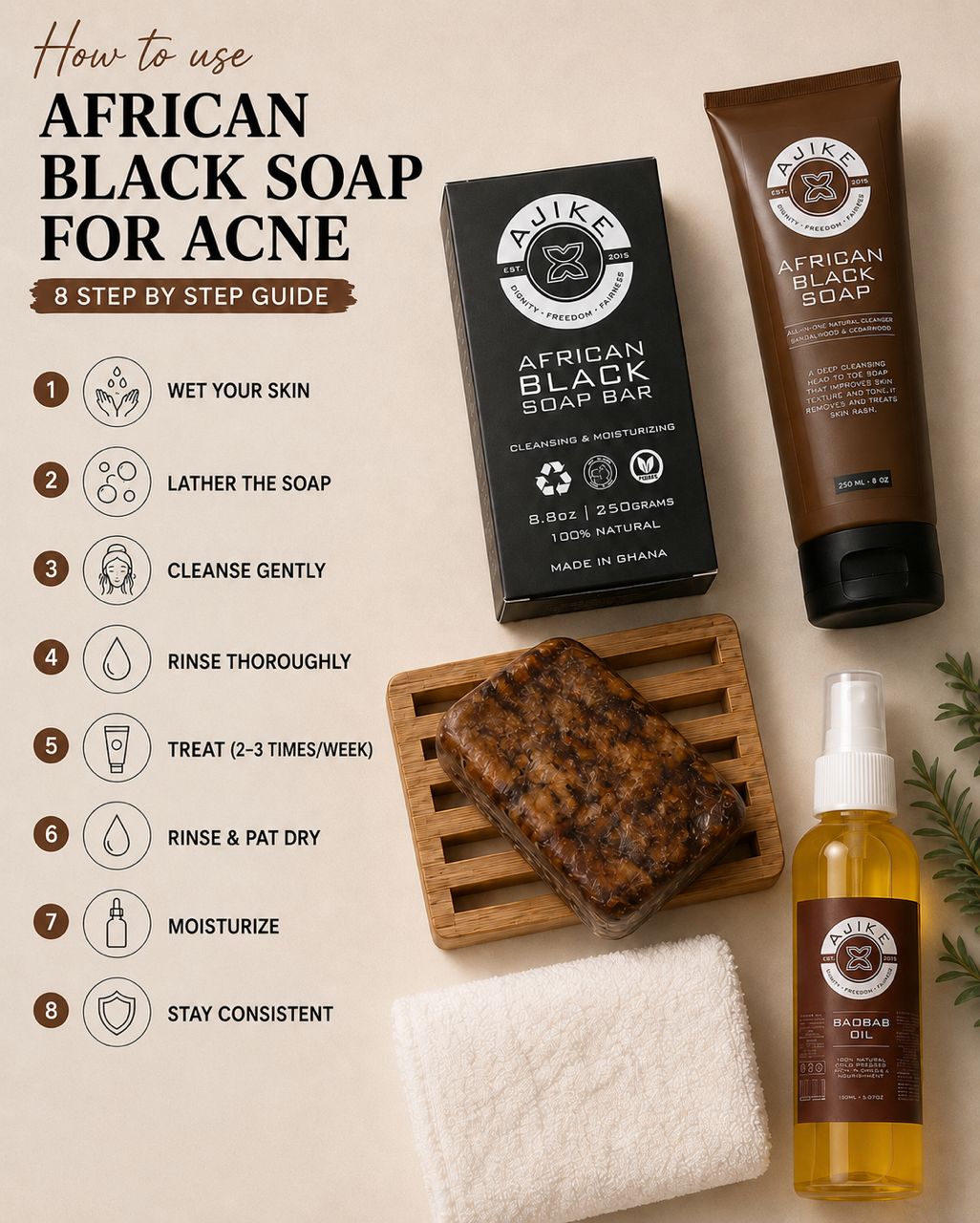
📌 Before You Begin: Read all 8 steps before starting. The most common reason African black soap does not work for acne is incorrect usage specifically skipping the moisturiser step or using water that is too hot. Every step matters.
Step 1 Choose the Right African Black Soap Format
For facial acne: the African Black Soap Bar or Paste Tube are both appropriate. The bar provides the most concentrated cleansing action best for oily and moderately acne-prone skin. The paste tube offers a slightly more controlled application better for sensitive acne-prone skin or those who find the bar too active initially.
For body acne (back, chest, shoulders): the Lavender and Lemongrass Black Soap Body Wash provides effective full-body coverage in the shower. The African Black Soap Bar can also be used on the body for a more concentrated cleanse of specific areas.
Step 2 Start with Clean Hands
Before touching your face, ensure your hands are clean. Acne-causing bacteria transfer from hands to face easily, and adding new bacteria to an already congested skin surface counteracts the antibacterial benefit of the cleanser. Wash your hands with soap and water before beginning your facial cleansing routine.
Step 3 Use Lukewarm Water Not Hot
Wet your face with lukewarm water. Hot water strips the skin's natural lipid barrier more aggressively, increases skin surface inflammation, and critically for acne-prone skin triggers compensatory sebum overproduction that can worsen congestion. Lukewarm water opens the pores sufficiently for effective cleansing without these negative effects.
Step 4 Create Lather in Hands First Never Apply Bar Directly to Face
This is the most important mechanical step for acne-prone skin. Rubbing the bar directly on the face concentrates the alkaline load in a single small area repeatedly, which can cause localised irritation and dryness both of which worsen acne. Instead, wet your hands and rub the soap bar between your palms until you have a generous, even lather. Then apply this lather to your face.
For the paste format: dispense a small amount approximately the size of a pea onto wet palms. Work into an even lather before applying to the face.
Step 5 Massage Gently in Circular Motions for 30 to 60 Seconds
Apply the lather to your face and massage gently in small circular motions. Do not press hard or scrub. The cleansing action of African black soap is chemical driven by the soap's pH interacting with the skin surface not physical. Aggressive scrubbing creates skin trauma that triggers inflammation, which worsens acne.
Pay particular attention to the T-zone (forehead, nose, chin) where sebaceous gland density is highest, and to any specific areas of active breakouts. 30 seconds is sufficient for mild acne; 60 seconds provides a more thorough cleanse for oily or moderate acne.
Step 6 Rinse Thoroughly with Cool Water
Switch to cool water for rinsing. Rinse thoroughly ensuring all soap residue is removed from the skin, particularly from around the hairline, jaw, and the sides of the nose. Soap residue left on acne-prone skin can cause irritation and contribute to congestion. The cool water rinse also helps to calm any surface inflammation and supports the skin's return to its natural acidic pH.
Step 7 Pat Dry Never Rub
Use a clean towel ideally one used only for your face and pat the skin dry very gently. Do not rub. Rubbing creates physical friction on already-inflamed acne-prone skin, can spread bacteria from one part of the face to another, and irritates the skin surface in a way that increases inflammation. Leave the skin slightly damp this is important for the next and most critical step.
Step 8 Apply a Non-Comedogenic Moisturiser Immediately
This step is non-negotiable even for oily and acne-prone skin. Skipping moisturiser after cleansing with African black soap causes the skin to become dehydrated, which triggers compensatory sebum overproduction that worsens acne. The moisturiser must be non-comedogenic meaning it does not block pores.
Apply to slightly damp skin within 60 seconds of patting dry. For acne-prone skin, Ajike Pure Baobab Oil is the ideal moisturiser non-comedogenic (rated 2 on the comedogenicity scale), rich in linoleic acid (which acne-prone skin is typically deficient in), and lightweight enough to absorb without residue. 2 to 3 drops massaged into damp skin is sufficient.
How Often Should You Use African Black Soap for Acne?
For Mild Acne Recommended Frequency
Once daily use evenings only is the appropriate starting point for mild acne. Evening cleansing removes the day's sebum, impurities, and pollution that have accumulated on the skin. A morning rinse with water only (no soap) is sufficient for most mild acne skin types, as the skin has not been significantly exposed to external impurities overnight.
After 2 to 3 weeks of comfortable once-daily use, you can progress to twice daily if you prefer but once daily is sufficient for mild acne management.
For Moderate Acne Recommended Frequency
Twice daily use morning and evening is recommended for moderate acne. Morning cleansing removes overnight sebum buildup and creates a clean, balanced surface for the day. Evening cleansing removes the day's accumulated impurities, pollution, and sebum. Both washes must be followed by immediate moisturisation.
For the first 2 weeks, start with once daily (evening) to allow the skin to adjust, then introduce the morning cleanse in week 3 if the skin is tolerating the routine well.
For Cystic and Severe Acne Recommended Frequency
Once daily use (evening) is recommended for cystic and severe acne, with a gentle water rinse only in the morning. Cystic acne-prone skin is typically highly reactive, and twice-daily cleansing with any active cleanser including African black soap can over-stimulate an already-inflamed skin. Gentle, once-daily cleansing paired with targeted spot treatment is the more appropriate approach.
Morning vs Evening When Is the Best Time to Use It?
If you are only cleansing once daily, the evening is more important than the morning. Evening cleansing removes the full day's accumulated sebum, dead skin cells, pollution particles, and any product residue all of which would otherwise sit on the skin surface overnight and contribute to pore congestion. Morning cleansing, if done, removes overnight sebum and prepares a clean surface for any morning products.
Signs You Are Overusing It
- Skin feels tight or dry throughout the day despite regular moisturising
- New areas of redness or irritation appearing that were not present before
- Skin is producing noticeably more oil than before you started compensatory sebum response
- Sensitivity or stinging when applying moisturiser or other products after cleansing
- Skin appears dull, dehydrated, or flaky
The Adjustment Phase What to Expect in the First Two Weeks
Why Initial Breakouts Happen
During the first 1 to 2 weeks of using African black soap, some users particularly those transitioning from commercial cleansers containing silicones, synthetic emollients, or film-forming polymers experience an increase in surface breakouts. This is the skin purging phase, and it happens because the soap is removing the synthetic layer that has been suppressing the emergence of existing subsurface congestion.
The congestion that surfaces during purging was already there developing beneath the skin surface before you started using African black soap. The soap is simply accelerating its emergence. Once this backlog of congestion has cleared typically within 2 to 4 weeks breakouts reduce significantly and the skin begins to improve consistently.
Purging vs Making Acne Worse How to Tell the Difference
Purging: breakouts appear in your usual problem zones, come to a head quickly, resolve within days, and the overall situation begins to improve by week 3 to 4. No burning, stinging, or new areas of inflammation.
Worsening reaction: breakouts appearing in areas that have always been clear, deep painful cystic lesions forming where none existed before, burning or stinging after cleansing that does not subside, persistent redness or rash-like reaction beyond 4 weeks with no improvement. Discontinue use if irritation occurs.
How to Manage the Adjustment Phase Comfortably
- Reduce frequency to every other day for the first 2 weeks if purging is intense
- Keep contact time shorter 20 to 30 seconds rather than 60 during the adjustment period
- Ensure moisturiser is applied immediately every single time
- Do not add any other active ingredients (retinoids, AHAs, BHAs) during the first 4 weeks
- Do not pick or squeeze spots that surface during purging this creates PIH and potential scarring
- Stay consistent stopping and restarting extends the adjustment phase
African Black Soap Acne Results What a Realistic Timeline Looks Like
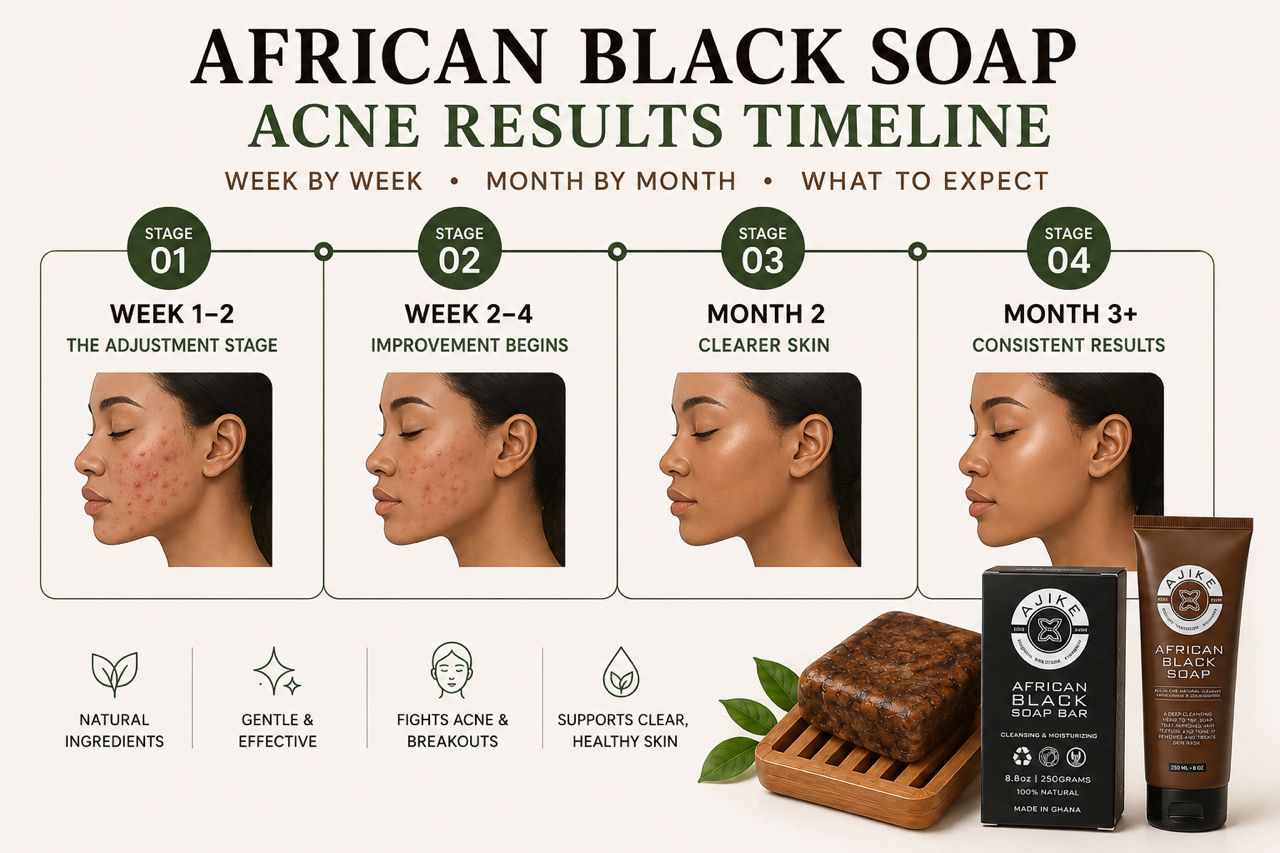
Week 1 and 2 Skin Is Adjusting
The skin is recalibrating from synthetic cleansers to a natural formula. Some purging may occur. Sebum production has not yet fully adjusted. Skin may feel different after cleansing not worse, just different from the synthetic smoothness it was accustomed to. Maintain consistency, moisturise every time, and resist the urge to add other products.
Week 3 and 4 Oil Control and Fewer New Breakouts
By weeks 3 and 4, most users begin to notice that the skin is producing less oil throughout the day. The frequency of new breakouts starts to decrease. Existing spots are resolving more quickly. Skin texture begins to feel more refined. For those using neem oil as a spot treatment, active lesions are healing faster.
This is the period where many users who stuck through the adjustment phase begin to feel their confidence in the routine building. The direction of change is clearly positive.
Month 2 Clearer Skin and Reduced Acne Marks
Month 2 is where the most noticeable improvements appear. Active breakouts are significantly reduced for mild to moderate acne, many users are largely clear at this stage. Post-acne marks from previous breakouts are beginning to fade visibly, particularly for those using the Nightly Face Serum with Lactic Acid and Papaya Oil alongside the soap.
Skin texture is noticeably smoother and more even. Pores appear smaller a result of consistently reduced sebum production and more regular dead skin cell removal keeping pores cleaner.
Month 3 and Beyond Consistent Clear Skin
By month 3, users who have been consistent with their routine typically report that their acne is largely under control. New breakouts are infrequent and resolve quickly. Post-acne marks have faded significantly. Skin tone is more even, and the skin's overall health hydration, barrier function, natural glow is visibly improved.
This is the stage where the routine becomes maintenance rather than treatment and where many users discover that their skin continues to improve gradually for months beyond this point as the skin's health compounds with consistent care.
Factors That Affect How Fast You See Results
- Acne type and severity mild comedonal acne responds faster than severe cystic acne
- Hormonal activity active hormonal fluctuations slow results by continuously triggering new sebum surges
- Consistency of use daily use accelerates results significantly compared to occasional use
- Moisturisation skin that is well hydrated heals and renews faster
- Diet and lifestyle high-glycaemic diet and chronic stress worsen acne severity regardless of topical treatment
- Additional targeted treatments neem oil spot treatment and lactic acid serum accelerate results
- Avoiding picking every picked spot creates PIH and potential scarring that extends the clear skin timeline
Common Mistakes That Make Acne Worse with African Black Soap
Skipping Moisturiser After Cleansing
This is the most common and most damaging mistake. Skipping moisturiser after African black soap cleansing causes skin dehydration, which triggers the sebaceous glands to increase sebum production in compensation. More sebum means more pore congestion, which means more acne. The moisturiser step is not optional for acne-prone skin it is a critical component of the anti-acne routine.
Using Too Much Product
African black soap is concentrated. Using more than a small amount a few seconds of lather from the bar, or a pea-sized amount of paste increases the alkaline load on the skin without improving cleansing effectiveness. Excess product also makes thorough rinsing more difficult, increasing the risk of residue remaining on the skin. Use less than you think you need.
Washing Too Many Times a Day
More cleansing does not mean clearer skin. Washing more than twice daily with African black soap removes too much sebum, disrupts the acid mantle, and irritates the skin barrier all of which increase inflammation and worsen acne. Twice daily is the maximum. If skin is feeling tight or irritated, reduce to once daily.
Combining with Harsh Active Ingredients Too Soon
During the first 4 weeks of using African black soap for acne, keep your routine as simple as possible. Do not layer retinoids, high-concentration BHAs, benzoyl peroxide, or other aggressive acne treatments alongside the soap during this period. The skin is adjusting to a new cleansing environment, and adding multiple active treatments simultaneously makes it impossible to assess what is working and significantly increases the risk of over-exfoliation and irritation.
After 4 weeks, when the skin has adjusted to African black soap, you can gradually introduce a targeted serum or treatment starting slowly and monitoring the skin's response.
Using Hot Water
Hot water strips the skin's natural lipid barrier, increases surface inflammation, and triggers compensatory sebum production all directly counterproductive to acne management. Always use lukewarm water for cleansing and finish with a cool water rinse. This single change makes a meaningful difference to the post-cleansing experience and the skin's sebum balance throughout the day.
Rubbing Instead of Patting Dry
Rubbing the face dry with a towel creates physical friction that irritates already-inflamed acne-prone skin, spreads bacteria from active lesions to clear skin, and disrupts the skin surface in a way that increases inflammation. Always pat dry with a clean towel using gentle, pressing movements never rubbing strokes.
Best Ajike Products to Pair with African Black Soap for Acne
Ajike African Black Soap Bar For Daily Face Cleansing
Our traditional bar is the most concentrated format of Ajike African black soap handcrafted in Ghana with cocoa pod ash, shea butter, and plant oils. Best suited to oily and moderately acne-prone skin that benefits from a more active cleansing experience. Use once or twice daily following the 8-step routine above.
🛒 PRODUCT LINK Ajike African Black Soap Bar Natural Acne & Dark Spot Cleansing Soap Traditional bar. Most concentrated formula. 100% natural. Cocoa pod ash + shea butter + plant oils. Handcrafted in Ghana. Best for oily, acne-prone, combination skin. 🔗 https://www.ajikeghana.com/products/african-black-soap-bar
Ajike African Black Soap Paste Tube For Targeted Application
Our paste format in a hygienic tube offers a slightly less concentrated, more controlled application ideal for sensitive acne-prone skin, first-time African black soap users, and those who prefer a more precise application to specific acne-prone zones. The tube format is also ideal for travel.
🛒 PRODUCT LINK Ajike African Black Soap Paste (Tube) Gentle Natural Cleanser for Acne & Oily Skin Paste format in hygienic tube. Slightly gentler application. Perfect for sensitive acne-prone skin or first-time users. Convenient for travel. Same authentic formula. 🔗 https://www.ajikeghana.com/products/african-black-soap-paste-tube
Ajike Pure Baobab Oil Lightweight Non-Comedogenic Moisturiser
Baobab oil is the ideal moisturiser for acne-prone skin after African black soap cleansing. Its comedogenicity rating of 2 means it is very unlikely to block pores. Its high linoleic acid content is particularly beneficial for acne-prone skin research has shown that acne-prone skin is typically low in linoleic acid, and applying a linoleic acid-rich oil topically can help normalise sebum composition and reduce comedone formation.
2 to 3 drops applied to slightly damp skin immediately after cleansing is sufficient. It absorbs quickly without heaviness or residue making it suitable even for those who have always avoided oils for fear of worsening acne.
🛒 PRODUCT LINK Ajike Pure Baobab Oil 100% Pure Organic Oil for Skin & Hair Hydration Non-comedogenic. High linoleic acid. Vitamins A, D, E, F. Lightweight and fast-absorbing. Ideal daily moisturiser for acne-prone skin after black soap. 2-3 drops on damp skin. 🔗 https://www.ajikeghana.com/products/baobab-oil
Ajike Nightly Face Serum with Lactic Acid and Papaya Oil For Acne Marks
For post-acne marks and hyperpigmentation the flat dark spots left after breakouts heal our Nightly Face Serum provides targeted support. Lactic acid gently exfoliates the hyperpigmented surface cells, while papain (papaya enzyme) further supports skin renewal. Apply every evening after cleansing and before baobab oil moisturiser.
🛒 PRODUCT LINK Ajike Nightly Face Serum with Lactic Acid & Papaya Oil Natural Exfoliating Night Repair Glow Serum Lactic acid + papain. Evening use after black soap cleansing. Fades post-acne marks. Supports skin renewal. All skin types including acne-prone and sensitive. 🔗 https://www.ajikeghana.com/products/nightly-face-serum-lactic-acid-papaya-oil
Ajike Neem Oil For Targeted Spot Treatment
Pure neem oil is one of the most effective natural spot treatments available for active acne lesions. Neem oil contains nimbidin, nimbin, and azadirachtin compounds with documented antibacterial, anti-inflammatory, and antifungal properties. Applied directly to an active pimple with a cotton tip after cleansing, it helps reduce the size, inflammation, and healing time of individual spots.
Use neem oil as a targeted treatment on specific active lesions not over the entire face. Its strong natural scent and potency make it unsuitable for full-face application. Apply after cleansing and before moisturiser, on the specific spots only.
🛒 PRODUCT LINK Ajike Neem Oil Natural Acne & Scalp Treatment for Clear Skin & Healthy Hair Pure neem oil. Natural antibacterial and anti-inflammatory. Targeted spot treatment for active acne lesions. Apply after black soap cleansing using a cotton tip on individual spots only. 🔗 https://www.ajikeghana.com/products/neem-oil
Ajike Black Soap Eczema Soap For Sensitive Acne-Prone Skin
For acne-prone skin that is also sensitive skin that reacts easily to products, experiences redness or irritation with standard formulations, or has both acne and eczema our Black Soap Eczema Soap provides the same African black soap cleansing foundation in a gentler, unscented formulation enriched with shea butter and neem. It is fragrance-free and specifically formulated for reactive, sensitive skin.
🛒 PRODUCT LINK Ajike Black Soap Eczema Soap Natural Relief Soothing Soap for Dry, Itchy & Sensitive Skin Unscented. Fragrance-free. Shea butter + neem. Formulated for sensitive, reactive, and eczema-prone acne skin. Gentlest option in the Ajike range. 🔗 https://www.ajikeghana.com/products/black-soap-eczema-soap
Ajike African Black Soap Pure Ingredients Formulated for Acne-Prone Skin
No Sulfates, No Parabens, No Mineral Oil Why This Matters for Acne
Every ingredient excluded from Ajike African black soap is excluded for a specific reason related to acne-prone skin health. Sulfates (SLS, SLES) are excluded because they strip the skin aggressively and trigger compensatory sebum overproduction. Parabens are excluded because they have been shown to disrupt the skin's microbiome. Mineral oil is excluded because it is occlusive and can contribute to follicle congestion in acne-prone skin.
Silicones are excluded because they form a film on the skin surface that traps sebum and impurities. Artificial fragrances are excluded because they are among the most common skin irritants and inflammation triggers. Synthetic preservatives are excluded because they can disrupt the skin barrier and microbiome.
What remains when all of these are removed is a cleanser built entirely on ingredients that serve your skin cocoa pod ash, shea butter, palm kernel oil, coconut oil, and any additional plant-based ingredients chosen for their specific skin benefits.
Handcrafted in Ghana Small Batch Quality Control
Every batch of Ajike African black soap is handcrafted in small quantities in Ghana. Small batch production means every batch is individually monitored the ash preparation, the saponification process, the curing time, the finished texture and appearance. There are no shortcuts for the sake of volume or cost efficiency.
This quality consistency matters for acne-prone skin. When your skin is already reactive and prone to breakouts, the last thing you need is variability in your cleanser a formula that works one month and is slightly different the next because of ingredient substitutions or production shortcuts. With Ajike, every bar is made the same way, from the same sourced ingredients, every time.
Traditional Formula Trusted Across Generations
African black soap has been used on acne-prone skin across West Africa for centuries. This is not a new formulation developed in a laboratory and launched based on marketing claims. It is a traditional formula that has been tested on real skin, in real daily use, across generations of West African families including families in Ghana where melanin-rich, acne-prone skin is the norm rather than the exception.
At Ajike, we have not invented anything new. We have taken a proven traditional formula, maintained its integrity, and made it available to a global audience through consistent small-batch handcrafting in Ghana. The results speak through the generations of use behind them.
Frequently Asked Questions
Yes African black soap is effective for acne through multiple mechanisms: natural antibacterial action from cocoa pod ash that reduces C. acnes on the skin surface, gentle sebum control without stripping, retained natural glycerine that prevents the dehydration that triggers compensatory sebum overproduction, and anti-inflammatory plant compounds that moderate the immune response to acne bacteria. Results vary by acne type and severity. Results may vary depending on skin type.
Most users see meaningful improvement fewer new breakouts, reduced oiliness by weeks 3 to 4 of consistent daily use. Significantly clearer skin is typically visible by month 2. Consistent clear skin with ongoing maintenance is usually achieved by month 3 for mild to moderate acne. Severe or cystic acne may take longer and may benefit from additional medical support alongside the natural routine. Results may vary depending on skin type.
Yes African black soap is appropriate as a daily cleanser for cystic acne-prone skin. Its gentle, non-stripping formula is well suited to the reactive, inflamed skin associated with cystic acne. However, active cystic lesions may require additional dermatological treatment alongside the natural skincare routine. Use once daily and do not attempt to use African black soap as a spot treatment on active cystic lesions.
Absolutely yes. This is one of the most important points in acne management. Skipping moisturiser after cleansing regardless of how oily your skin is causes dehydration, which triggers the sebaceous glands to produce more oil in compensation. This worsens both oiliness and congestion. Use a non-comedogenic moisturiser Ajike Pure Baobab Oil is ideal for acne-prone skin applied to slightly damp skin within 60 seconds of cleansing.
During the first 4 weeks of use, we recommend keeping the routine simple African black soap cleanser plus a non-comedogenic moisturiser only. After the adjustment period, targeted additions like Ajike Neem Oil (spot treatment) and Ajike Nightly Face Serum (post-acne marks) can be incorporated. If you are using prescription retinoids or other medical acne treatments, consult with your prescriber about incorporating a new cleanser into your routine.
For body acne (back, chest, shoulders), our Lavender and Lemongrass Black Soap Body Wash used daily in the shower provides effective, thorough cleansing. Alternatively, the African Black Soap Bar can be used directly on body acne areas. Follow with a lightweight body moisturiser or a few drops of Ajike Pure Baobab Oil on the affected areas to prevent the dehydration that worsens body acne.