
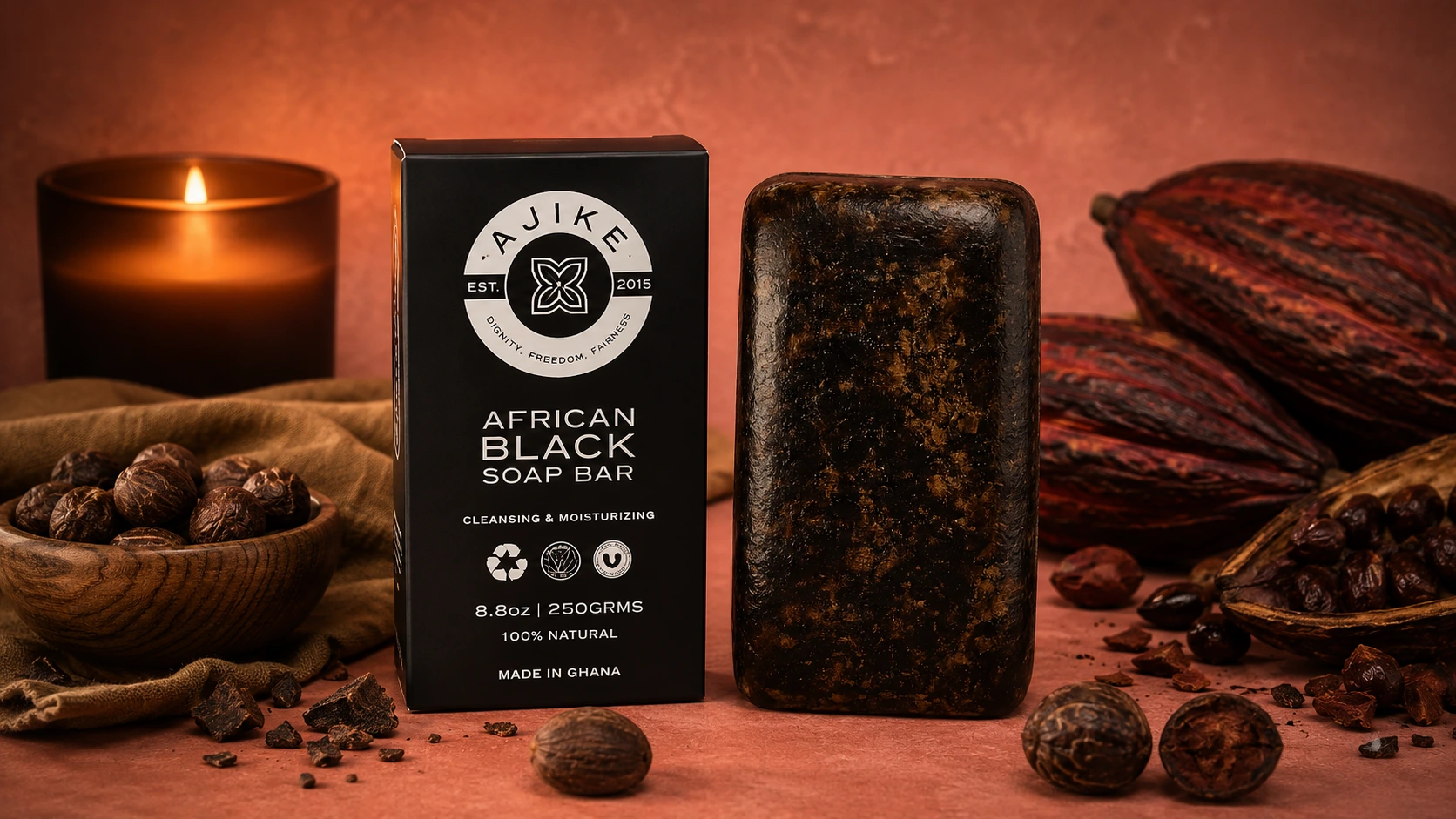
African black soap is one of the most talked about natural skincare ingredients in the world today and for good reason. Used across West Africa for centuries, this traditional cleansing soap has been passed down through generations as a daily skincare essential, trusted for its ability to cleanse deeply, support clear skin, and nourish without harsh chemicals.
But with so many products now labelled as African black soap, it is important to understand what authentic African black soap actually is, what it is made of, how it is produced, and what it genuinely does for your skin.
At Ajike, we have been handcrafting authentic African black soap in Ghana since 2015, using the same traditional methods and pure plant-based ingredients that have made this soap a generational staple across West Africa. Everything we share in this guide comes from deep, firsthand knowledge of this remarkable ingredient.
🔗 Read Also: How to Use African Black Soap Without Drying Your Skin → https://www.ajikeghana.com/blogs/how-to-use-african-black-soap-without-drying-skin
What Is African Black Soap?
African black soap is a traditional plant-based cleansing soap originating from West Africa. It is made from a combination of roasted plant ash primarily from cocoa pod shells and plantain peels combined with natural oils and butters such as shea butter, palm kernel oil, and coconut oil. The result is a deeply cleansing, naturally moisturising soap that contains no synthetic detergents, no artificial colours, and no harsh chemical additives.
Unlike the majority of commercial soaps found in supermarkets today, African black soap is produced through a traditional process called saponification, a completely natural chemical reaction between plant ash lye and natural oils that creates soap while retaining beneficial compounds for the skin.
The Meaning Behind the Name - Alata Samina and Ose Dudu.
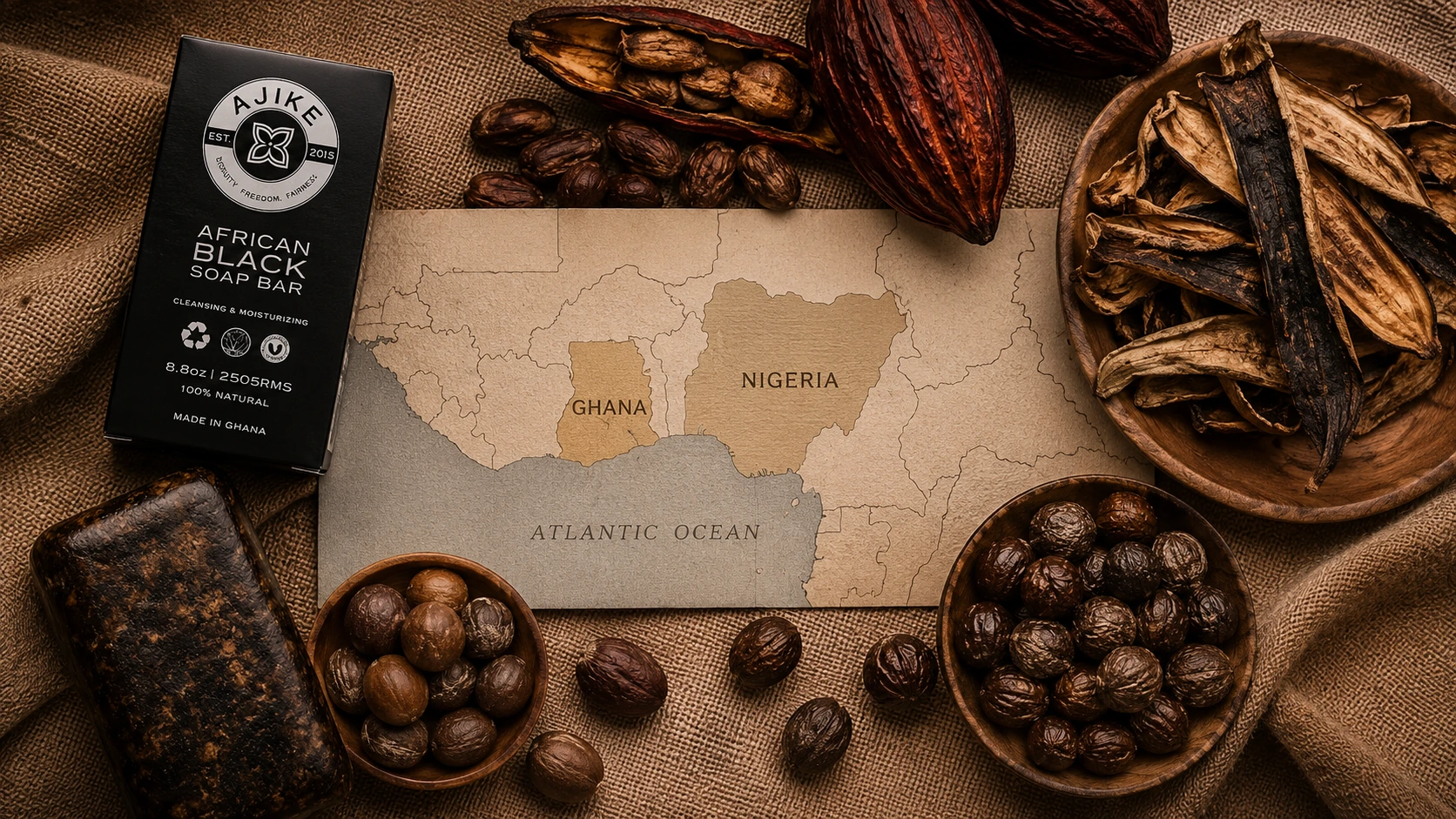
African black soap is known by different names across West Africa, each reflecting its deep cultural roots. In Ghana, it is called alata samina in Twi meaning 'pepper soap' or 'foreign soap' and is a household staple that has been made and used by Ghanaian families for centuries. In Nigeria, the Yoruba people call it ose dudu, meaning 'black soap', where it holds an equally important place in traditional skincare and bathing rituals.
These names are not just labels they represent generations of knowledge about plant ingredients, traditional preparation methods, and the skin benefits that have been observed and passed down through communities long before the global beauty industry took notice.
How It Differs from Regular Soap.
The most fundamental difference between African black soap and commercial soap lies in what they are made of and how they are made. Commercial soap is typically manufactured using synthetic surfactants, artificial lathering agents, chemical preservatives, artificial fragrances, and dyes. During the industrial manufacturing process, the natural glycerine produced by saponification is extracted and sold separately, leaving behind a harsher bar that strips the skin of its natural oils.
African black soap retains all of its naturally produced glycerine. This retained glycerine is a humectant, it draws moisture into the skin which is why authentic African black soap moisturises as it cleanses rather than leaving skin tight and stripped. There are no sulfates, no parabens, no mineral oils, no artificial fragrances, and no synthetic preservatives in a properly made African black soap.
Where Does African Black Soap Come From?
Origins in Ghana and West Africa.
African black soap has been produced and used across the West African subregion for hundreds of years. Its roots are most strongly established in Ghana and Nigeria, where traditional soap making has been a community craft passed from mother to daughter across countless generations. The soap was not originally a beauty product in the commercial sense, it was a practical household essential used for bathing, hair washing, and treating various skin conditions.
The specific ingredients used in African black soap vary slightly by region, reflecting the natural resources available locally. In Ghana, cocoa pod ash is the primary ash source, a natural byproduct of Ghana's world renowned cocoa farming industry. In Nigeria and other parts of West Africa, plantain ash and palm kernel ash may feature more prominently.
The Akan and Yoruba Tradition.
Among the Akan people of Ghana, soap making using natural plant ash and shea butter has been a traditional practice deeply embedded in daily life and cultural identity. The knowledge of which plants to use, how to roast the ash correctly, and how to combine ingredients was considered skilled, valued knowledge held primarily by women within the community.
Similarly, among the Yoruba people of Nigeria, ose dudu has been used for generations not only as a cleanser but also as a traditional remedy for skin conditions. Its use was passed down orally and practically, with each community developing its own slight variations in ingredients and preparation methods.
Why Ghana Is the Home of Authentic African Black Soap.
While African black soap is produced across West Africa, Ghana holds a particularly central place in its story. The abundance of cocoa farms across Ghana's Ashanti and Brong Ahafo regions provides a consistent, high quality source of cocoa pod ash the defining ingredient that gives Ghanaian black soap its distinctive cleansing properties. Ghana's wild harvested shea butter, sourced from the northern savannah regions, is also among the finest in the world.
At Ajike, our soap is handcrafted in Ghana, using locally sourced Ghanaian cocoa pod ash and wild harvested Ghanaian shea butter. This is not just a production location it is a commitment to authenticity, to supporting local communities, and to ensuring that our ingredients are the real thing.
What Is African Black Soap Made Of?
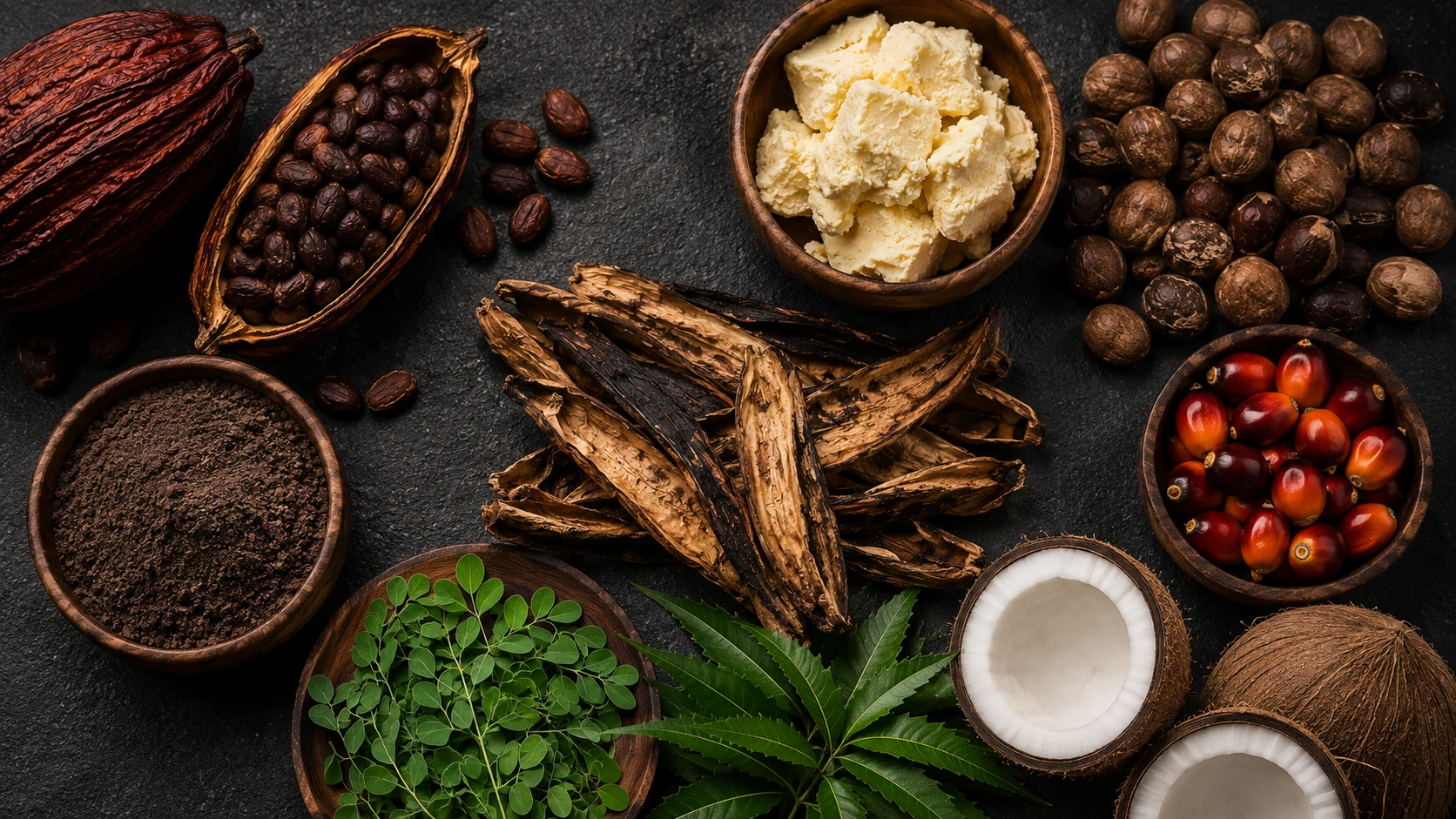
The ingredients in authentic African black soap are entirely plant-derived. There are no synthetic chemicals, no artificial colours, no mineral oils, and no petroleum based derivatives. Here is what goes into a properly made African black soap:
Cocoa Pod Ash - The Core Cleansing Ingredient
Cocoa pod ash is the ingredient that defines authentic Ghanaian African black soap and gives it its most important properties. The dried outer shells of cocoa pods a byproduct of cocoa processing are roasted at controlled temperatures until they become ash. This ash is then combined with water to create a natural alkaline lye solution, which is the foundation of saponification.
The natural alkalinity of cocoa pod ash gives the soap its deep cleansing ability breaking down excess sebum, lifting impurities from pores, and providing a gentle antibacterial environment on the skin. The specific mineral profile of cocoa pod ash, rich in potassium and natural salts, contributes to the soap's effectiveness in a way that synthetic alternatives cannot replicate.
Plantain Skin Ash - The Second Ash Source
Dried and roasted plantain peels are the second major ash source in traditional African black soap. Plantain ash contributes additional potassium and mineral content, and its inclusion creates a more balanced alkaline profile in the final soap. Plantain ash also contributes to the soap's texture and lathering characteristics.
In some regional variations and formulations, plantain ash takes a more prominent role than cocoa pod ash, giving the soap a slightly different colour, texture, and scent profile. Both ash sources are completely natural and plant-derived.
Shea Butter - The Moisturising Base
Raw, unrefined shea butter is the moisturising backbone of authentic African black soap. Sourced from the seeds of the shea tree (Vitellaria paradoxa), which grows wild across West Africa's savannah belt, shea butter is extraordinarily rich in oleic acid, stearic acid, vitamins A, E, and F, and natural triterpenes that support skin health.
In the saponification process, shea butter reacts with the plant ash lye to form soap molecules while also leaving behind unsaponified shea butter fractions - meaning beneficial shea compounds remain in the finished soap, providing nourishment and helping to prevent the cleanser from being drying. At Ajike, we use only wild harvested, unrefined shea butter in our soap - the same premium grade available in our raw shea butter range.
🔗 Read Also: Learn more: What Is Raw Unrefined Shea Butter? Complete Guide → https://www.ajikeghana.com/blogs/what-is-raw-unrefined-shea-butter
Palm Kernel Oil and Coconut Oil - The Lather Builders.
Palm kernel oil and coconut oil are the oils that give African black soap its lathering characteristics. Both oils are rich in lauric acid and capric acid, which are responsible for producing a rich, creamy lather during cleansing. They also contribute to the hardness and longevity of the bar, and provide additional skin conditioning properties.
Palm kernel oil distinct from palm oil is extracted from the kernel (seed) of the oil palm fruit and has been used in West African skincare and cooking for centuries. At Ajike, we use sustainably sourced, cold-pressed plant oils that retain their natural nutritional profile.
Additional Plant-Based Ingredients - Honey, Turmeric, Neem, Lavender
Beyond the core ingredients, different formulations of African black soap incorporate additional plant-based ingredients to enhance specific skin benefits. At Ajike, our range includes several specialised formulations:
- Honey naturally antibacterial and humectant properties, excellent for acne-prone and dry skin
- Turmeric rich in curcumin, a natural antioxidant that supports even skin tone and reduces inflammation
- Neem powerful natural antibacterial and antifungal properties, ideal for acne, eczema, and problem skin
- Lavender essential oil calming, soothing properties with a clean floral scent
- Lemongrass essential oil refreshing, naturally antibacterial, supports skin tone
📌 Important: All Ajike African black soap formulations are free from mineral oils, petroleum derivatives, artificial colours, synthetic fragrances, parabens, sulfates, and silicones. Every ingredient serves a purpose.
How Is African Black Soap Made? The Saponification Process
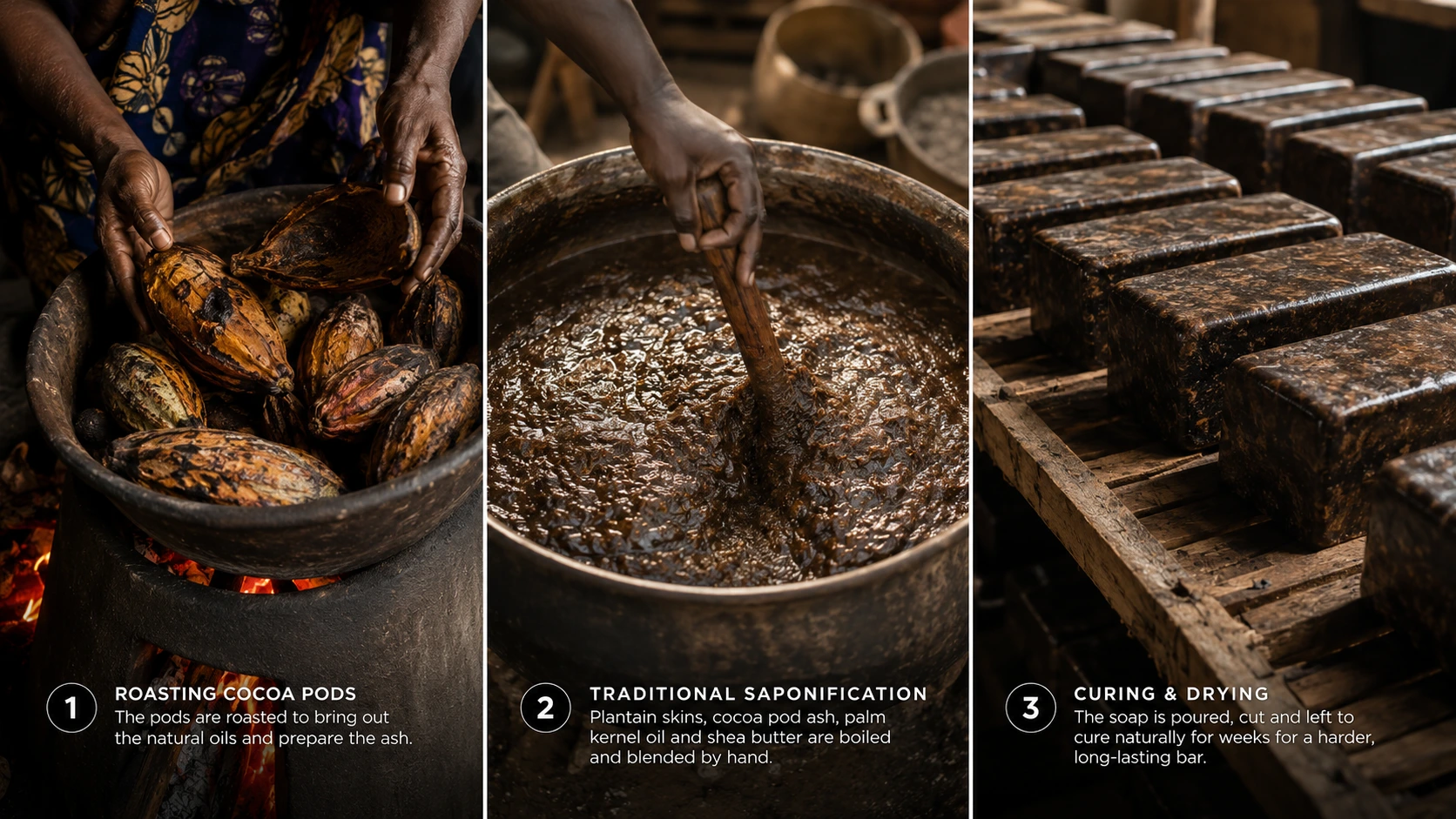
Understanding how authentic African black soap is made helps you appreciate not only why it works so well, but also why it behaves differently from commercial soap and how to identify genuinely traditional soap from mass-produced imitations.
Step 1 - Harvesting and Drying the Plant Materials:
The process begins with the collection of cocoa pod shells and plantain peels. These are sun-dried for several days sometimes weeks until they are completely dehydrated. Proper drying is essential; if the plant material retains moisture, the resulting ash will not have the correct alkaline profile for saponification.
The quality of the raw materials at this stage has a direct impact on the quality of the finished soap. Properly dried, clean plant materials produce a more consistent, effective ash than hurriedly dried or poorly sourced materials which is why Ajike's sourcing process begins here.
Step 2 - Roasting to Create Plant Ash:
The dried plant materials are roasted in open clay pots or on raised platforms at controlled temperatures. This is a highly skilled step the roasting must achieve the right level of combustion. Under-roasted materials produce ash that is too carbonaceous and lacks sufficient alkalinity. Over-roasted materials produce ash that is too caustic and can damage the skin.
Experienced soap makers many of whom have been trained over years by family members judge the roasting by sight, smell, and texture. This is knowledge that cannot be replicated by a factory process, which is why small-batch, handcrafted African black soap produces a consistently superior product.
Step 3 - Combining with Oils and Butters:
The cooled ash is mixed with water and allowed to settle, creating a natural alkaline lye solution. This lye solution is then slowly and carefully combined with shea butter, palm kernel oil, coconut oil, and any additional plant ingredients. The combination of alkali (lye solution) and fat (oils and butters) initiates the saponification reaction the chemical process that transforms these ingredients into soap.
The ratio of ash to oils, the temperature at which they are combined, and the sequence of adding ingredients all affect the properties of the finished soap. This is where the soap maker's expertise becomes critical.
Step 4 - Cooking, Stirring and Curing:
The mixture is cooked over low to medium heat and stirred continuously for several hours. As saponification progresses, the mixture thickens and deepens in colour, eventually reaching what soap makers call 'trace' the point at which the soap is formed and ready to be set. The resulting soap is poured or scooped into moulds and allowed to cure.
Curing is a critical final stage that is often skipped in mass production. A properly cured African black soap bar rested for several weeks after production is milder, longer-lasting, and more effective than a freshly made bar. At Ajike, we allow adequate curing time for every batch.
Why Small Batch Handcrafted Matters.
Large-scale industrial production of African black soap involves shortcuts that compromise authenticity and quality pre-made synthetic ash, machine mixing, accelerated curing, and the addition of synthetic stabilisers to extend shelf life. These shortcuts produce a product that carries the name 'African black soap' but lacks the properties and benefits of the real thing.
At Ajike, every batch of our African black soap is handcrafted in small quantities in Ghana, using traditionally prepared cocoa pod ash and carefully selected plant oils. This is not just a production method it is a commitment to the integrity of a tradition that has served generations of West African families.
🛒 PRODUCT LINK Ajike African Black Soap Bar - Natural Acne & Dark Spot Cleansing Soap Traditional bar format. 100% natural. Cocoa pod ash, shea butter, palm kernel oil. Vegan. Not tested on animals. Handcrafted in Ghana since 2015. 🔗 African Black Soap Bar
What Does African Black Soap Do for Your Skin?
Deep Cleansing Without Stripping:
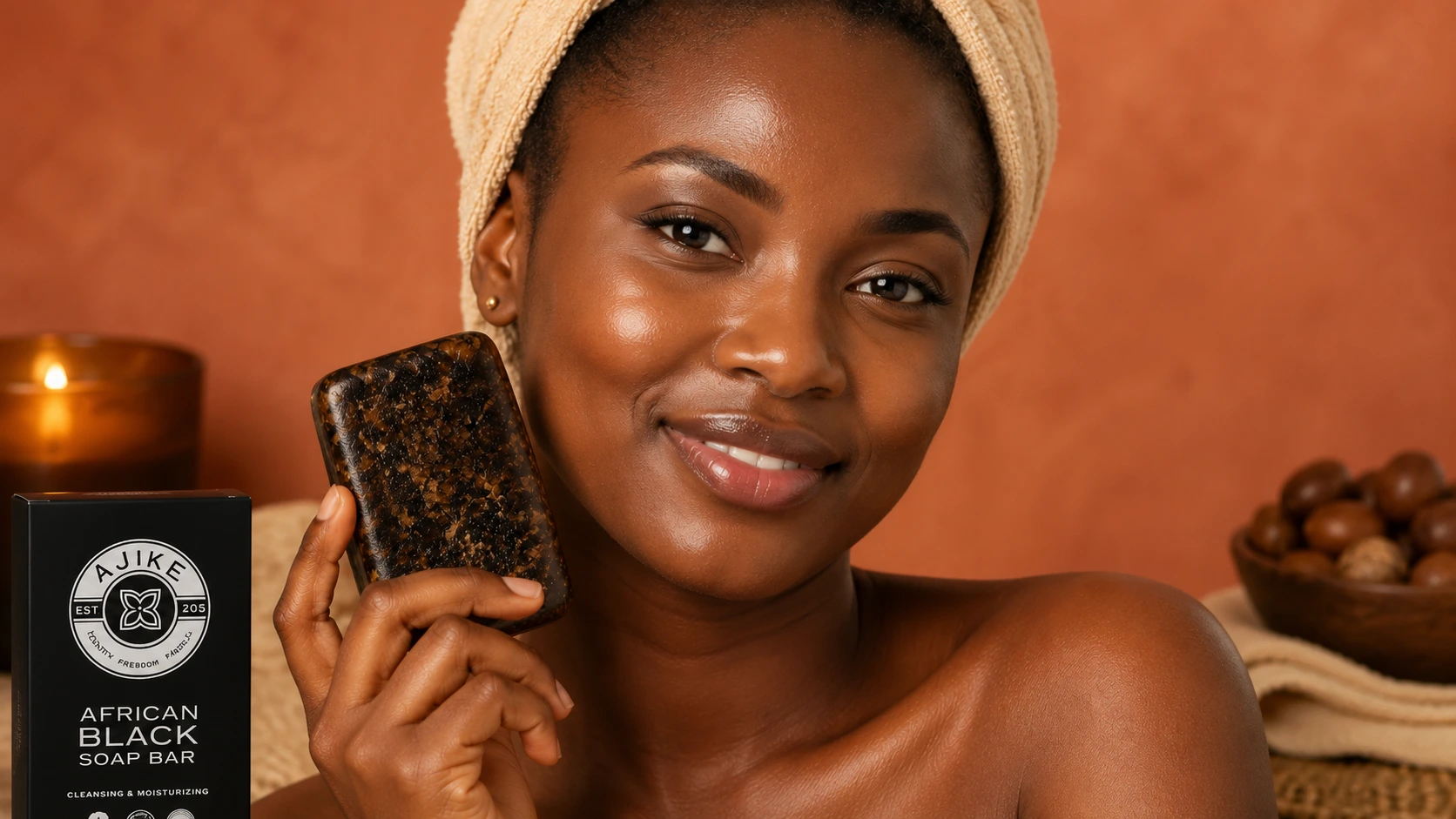
African black soap cleanses deeply removing dirt, excess sebum, environmental pollutants, and daily impurities from the skin but because it retains its naturally produced glycerine and contains shea butter, it does not strip the skin's natural moisture barrier in the process. After cleansing with authentic African black soap and following with a moisturiser, skin feels genuinely clean and refreshed rather than tight, dry, or irritated.
This is the most significant practical difference between African black soap and commercial cleansers for daily users. The absence of sulfates and synthetic surfactants means the skin is not subjected to repeated barrier disruption with every wash.
Acne and Excess Oil Control:
The natural antibacterial environment created by cocoa pod ash helps address one of the primary drivers of acne the presence of acne-causing bacteria on the skin surface. At the same time, the soap's natural cleansing action removes excess sebum from the pores without triggering the rebound oil production that often follows the use of harsh, stripping cleansers.
The result, with consistent use, is a more balanced skin surface fewer active breakouts, reduced congestion in the pores, and over time, a reduction in the frequency and severity of acne. Results may vary depending on skin type and the individual causes of acne.
🔗 Read Also: African Black Soap for Acne Step by Step Guide for Clear Skin → https://www.ajikeghana.com/blogs/african-black-soap-for-acne
Dark Spots and Uneven Skin Tone:
African black soap supports a gradual improvement in the appearance of dark spots and uneven skin tone through gentle, consistent exfoliation. The slightly elevated pH of the soap encourages natural skin cell turnover, gradually bringing fresher, more evenly pigmented skin to the surface. This is not bleaching it is supporting the skin's natural renewal process.
For faster results on dark spots and hyperpigmentation, African black soap works best as part of a routine that also incorporates targeted brightening products such as a lactic acid serum or kojic acid lotion.
🔗 Read Also: African Black Soap for Hyperpigmentation and Dark Spots on Dark Skin → https://www.ajikeghana.com/blogs/african-black-soap-for-hyperpigmentation-dark-spots
Eczema and Sensitive Skin Support:
For skin that is reactive, sensitive, or prone to eczema flares, the absence of sulfates, synthetic fragrances, parabens, and harsh preservatives makes authentic African black soap one of the gentler cleansing options available. It removes impurities without further compromising an already-stressed skin barrier.
Discontinue use if irritation occurs.
🔗 Read Also: African Black Soap for Eczema and Itchy Skin - Does It Help? → https://www.ajikeghana.com/blogs/african-black-soap-for-eczema
Natural Exfoliation and Skin Renewal.
The natural pH profile of African black soap provides a mild chemical exfoliation effect supporting the shedding of dead skin cells from the skin's surface without the abrasion of physical scrubs. This gentle, consistent exfoliation contributes to smoother skin texture, reduced dullness, and a more naturally radiant complexion over time.
African Black Soap for Different Skin Types.
Oily and Combination Skin:
African black soap is particularly well-suited to oily and combination skin types. Its ability to remove excess sebum from the skin surface and pores without triggering the rebound oil production caused by over-stripping cleansers makes it an excellent daily cleanser for those who struggle with shine, enlarged pores, and congestion. For oily skin, twice daily use (morning and evening) is generally well tolerated after an initial adjustment period.
Dry Skin:
Dry skin types can use African black soap effectively, but the moisturising step after cleansing is absolutely non-negotiable. Because African black soap is a cleanser, it will remove surface oils along with impurities. Without an immediate follow-up moisturiser applied to damp skin, dry skin types may find the experience drying. We recommend starting with once daily use (evenings) and pairing with a rich moisturiser such as raw shea butter or baobab face cream. Results may vary depending on skin type.
Sensitive and Eczema-Prone Skin:
Sensitive and eczema-prone skin types should approach African black soap carefully and thoughtfully. Begin with every other day use, perform a patch test before first full use, keep contact time under 45 seconds, and moisturise immediately after every wash. Our dedicated Black Soap Eczema Soap an unscented formulation specifically developed for sensitive and eczema-prone skin is the most appropriate choice for this skin type.
Normal Skin:
Normal skin types will generally find African black soap straightforward to incorporate into a daily routine. Once daily use is a good starting point, progressing to twice daily if desired. The focus for normal skin types should be on pairing the soap with appropriate moisturisation to maintain the skin's existing balance.
How to Identify Authentic African Black Soap.
Signs of Authentic African Black Soap:
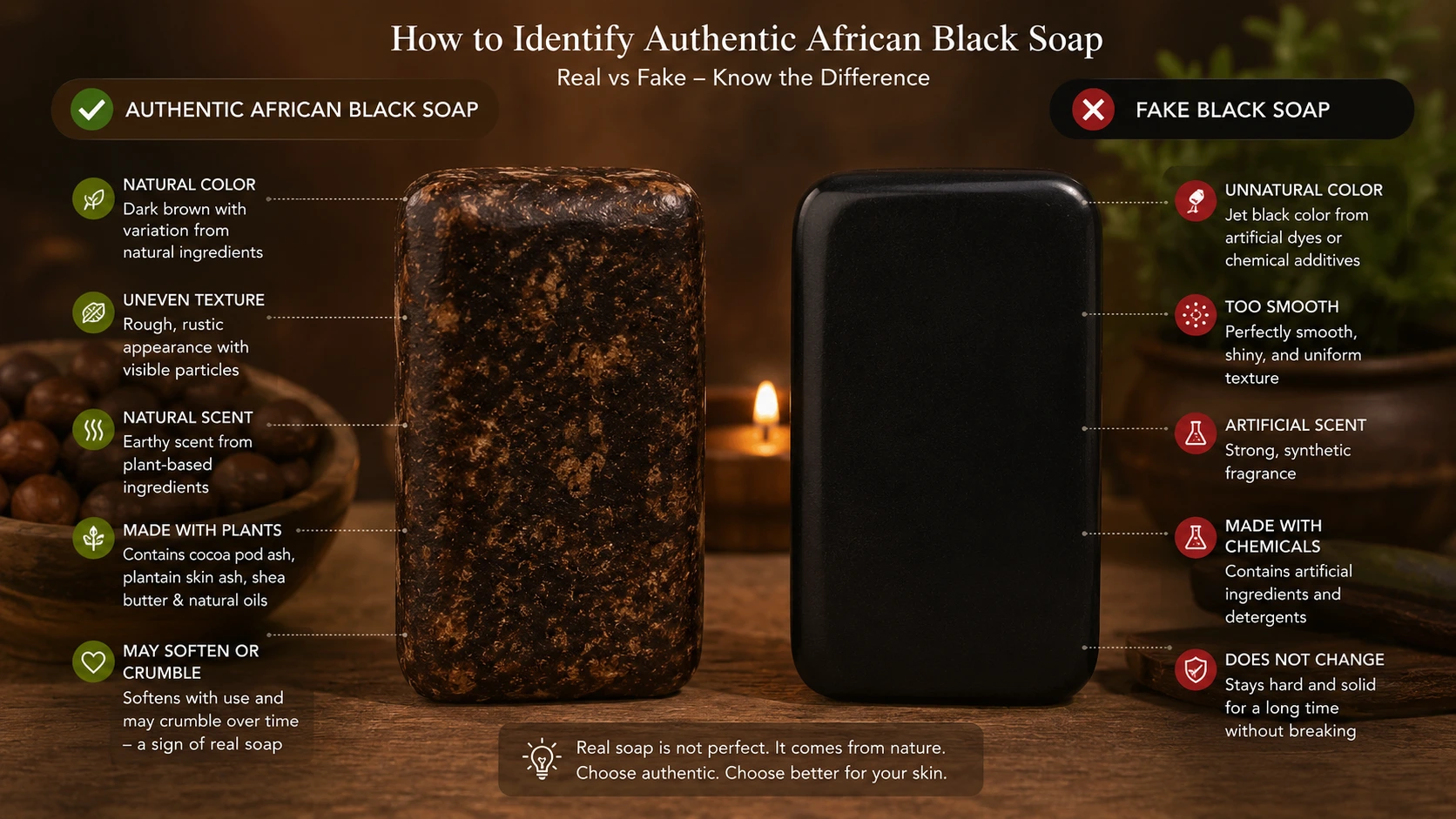
- Colour - genuine African black soap is dark brown to deep brown, not jet black. Natural variation in colour is expected and normal.
- Texture - authentic soap is slightly soft and may be uneven or crumbly. It is never perfectly smooth and uniform.
- Scent - a mild, earthy, slightly smoky natural scent from the plant ash. Not strongly perfumed unless essential oils were added.
- Ingredients - cocoa pod ash or plantain ash, shea butter, palm kernel oil or coconut oil. A short, recognisable ingredient list.
- Lather - a moderate, creamy lather. Not excessively bubbly or foamy like synthetic cleansers.
- Origin - made in Ghana or another West African country, in small batches by traditional soap makers.
Red Flags for Fake Black Soap:
- Jet black colour - almost always indicates artificial colouring has been added.
- Perfectly uniform shape and smooth texture - a sign of machine manufacturing, not handcrafting.
- Contains SLS, SLES, parabens, artificial fragrance, or mineral oil - these are commercial additives not found in traditional African black soap.
- No mention of cocoa pod ash or plantain ash in the ingredients - these are the defining ingredients of authentic soap.
- Extremely low price - genuine, traditionally produced African black soap requires quality ingredients, skilled labour, and proper curing time.
Bar, Paste and Liquid - Which Format Is Right for You?
Authentic African black soap is available in several formats, each suited to different preferences and uses:
Format | Best For | Ajike Product |
Bar | Traditional daily face and body cleansing. Long-lasting. Economical. | Ajike African Black Soap Bar |
Paste / Tube | Convenient, hygienic, no mess. Great for targeted application and travel. | Ajike African Black Soap Paste (Tube) / African Black Soap Paste (Jar). |
Liquid Body Wash | Body cleansing. Easy to use in shower. Infused with botanical essential oils. | Lavender & Lemongrass / Honey & Turmeric Body Wash |
Ajike African Black Soap Paste (Tube) - Gentle Natural Cleanser for Acne & Oily Skin Convenient tube format. Hygienic, no mess, perfect for daily face and body use. Same authentic formula. Sulfate-free, preservative-free. 🔗 African Black Soap Paste (Tube)
How to Use African Black Soap Correctly.
Step-by-Step Usage Guide:
- Wet your face or body with lukewarm water - not hot water, which can increase skin sensitivity.
- If using the bar: create a lather between your palms first. Never rub the bar directly on your face.
- If using the paste or body wash: dispense a small amount onto your hands.
- Gently massage the lather onto your skin in slow, circular motions for 30 to 60 seconds.
- Rinse thoroughly with cool or lukewarm water until no residue remains.
- Pat your skin dry gently with a clean towel - do not rub.
- Immediately apply your moisturiser while your skin is still slightly damp. This step is essential.
How Often Should You Use It?
Frequency depends on your skin type and the concerns you are addressing. A general guide:
- Oily and acne-prone skin - start with once daily (evening). Move to twice daily after 2 weeks if skin tolerates well.
- Normal and combination skin - once daily is sufficient for most people.
- Dry skin - start with every other day (evenings). Build up slowly based on how your skin responds.
- Sensitive and eczema-prone skin - every other day, or as advised after your patch test experience.
Always Moisturise After - Why This Step Cannot Be Skipped.
African black soap is a cleanser - it performs the cleansing step of your skincare routine. Like any cleanser, it removes oils from the skin surface along with impurities. The moisturising step replaces and seals in moisture, protecting the skin barrier and ensuring that the cleansing process leaves your skin balanced rather than depleted.
Applying your moisturiser to slightly damp skin within 60 seconds of patting dry is the most effective way to lock in hydration. This technique, sometimes referred to as moisture layering, ensures that the humectants in your moisturiser have water molecules to bind to, significantly improving the effectiveness of any moisturiser you use.
🔗 Read Also: How to Use African Black Soap Without Drying Your Skin Full Routine Guide → https://www.ajikeghana.com/blogs/how-to-use-african-black-soap-without-drying-skin
Ajike's African Black Soap - Handcrafted in Ghana Since 2015.
Our Sourcing - Where Our Ingredients Come From.
Every ingredient in Ajike's African black soap is sourced from within West Africa. Our cocoa pod ash is prepared from Ghanaian cocoa pods a natural byproduct of Ghana's cocoa industry, giving purpose to material that would otherwise go to waste. Our shea butter is wild-harvested from shea trees growing naturally in northern Ghana's savannah belt the same unrefined, nutrient-rich shea butter we sell in our raw shea butter range.
Our plant oils palm kernel oil, coconut oil are cold-pressed and sustainably sourced. Our botanical additions honey, turmeric, neem, lavender, lemongrass are carefully selected for potency and purity. We do not use mineral oils, petroleum derivatives, or synthetic chemical ingredients of any kind.
Our Process - Traditional Methods, Small Batch Quality.
Every batch of Ajike African black soap is handcrafted by skilled soap makers in Ghana using the traditional saponification process. We roast our own cocoa pod ash, prepare our own lye solution, and combine ingredients by hand in small batches that allow us to maintain quality control at every stage. Each bar is properly cured before it reaches you.
This is not the fastest or most cost-efficient way to produce soap. It is, however, the most authentic and we believe the results speak for themselves.
Our Range - Bar, Paste, Body Wash Formats.
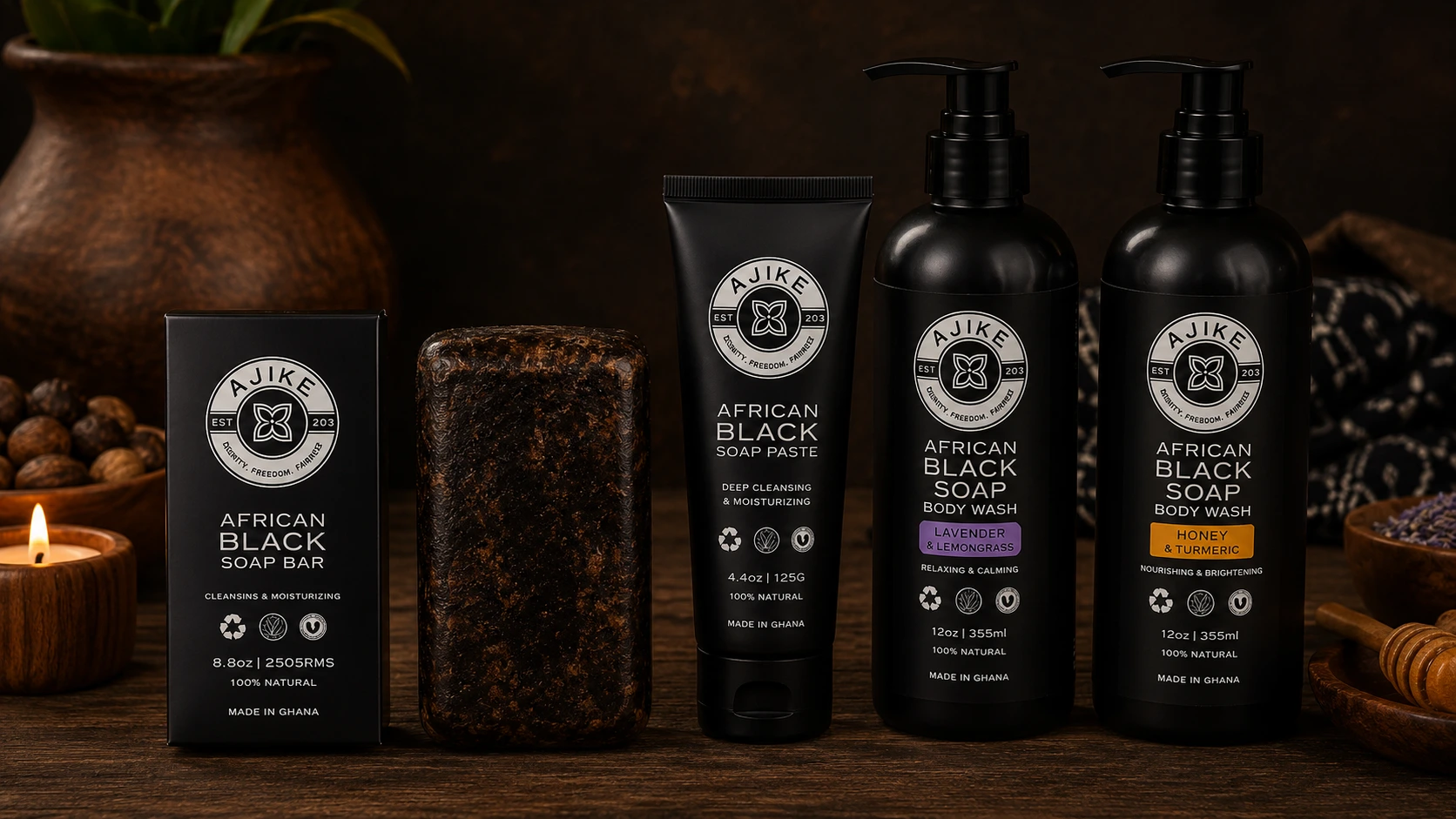
Ajike African Black Soap Bar: Natural Acne & Dark Spot Cleansing Soap Traditional bar. 100% natural. Best for face and body daily cleansing. Oily, acne-prone, combination skin. African Black Soap Bar
Ajike African Black Soap Paste (Tube): Gentle Natural Cleanser for Acne & Oily Skin Convenient tube format. Hygienic. Ideal for daily face and body use. All skin types. African Black Soap Paste (Tube)
Lavender & Lemongrass Black Soap Body Wash: Refreshing & Gentle Natural Cleanser Body wash format. Calming lavender + refreshing lemongrass. All skin types including sensitive. Lavender & Lemongrass Black Soap Body Wash
Honey & Turmeric Black Soap Body Wash: Natural Cleanser for Dark Spots & Uneven Skin Tone Body wash format. Honey (moisturising) + turmeric (brightening). Best for dull skin, uneven tone, dark spots. Honey & Turmeric Black Soap Body Wash
Frequently Asked Questions
Yes African black soap is suitable for facial use across most skin types, particularly oily, combination, and acne-prone skin. The key is correct usage: always create lather in your palms first rather than rubbing the bar directly on your face, use lukewarm water, keep contact time to 30 to 60 seconds, and always follow with a moisturiser. Results may vary depending on skin type.
Authentic African black soap without synthetic preservatives has a natural shelf life. The bar format typically remains effective for 12 to 18 months from production when stored correctly. Exposure to excess moisture, heat, or direct sunlight can shorten this. Store your soap in a cool, dry place on a draining soap dish to extend its life.
🔗 Read Also: How to Store African Black Soap So It Does Not Go Mouldy → https://www.ajikeghana.com/blogs/how-to-store-african-black-soap
Yes. African black soap can be used as a shampoo for scalp cleansing and is particularly effective for oily, congested, or dandruff-prone scalps. Ajike also offers a dedicated Peppermint, Rosemary and Tea Tree African Black Soap Shampoo formulated specifically for hair use.
This is called soap bloom and is a completely harmless natural phenomenon. The natural glycerine in authentic soap attracts moisture from the air, which creates a white film or white spots on the surface over time. Simply scrape or wipe off the white layer and continue using your soap as normal. It does not affect the quality or effectiveness of the soap.
No. Many products are sold as 'black soap' or 'African soap' that are not authentic African black soap. Genuine African black soap must contain plant ash specifically cocoa pod ash and/or plantain ash combined with natural oils and shea butter, produced through traditional saponification. A product that is simply dyed black or made with synthetic surfactants is not authentic African black soap.
Most users notice improvements in skin texture within 2 to 3 weeks of consistent use. For acne and dark spots, meaningful visible improvement typically becomes apparent after 4 to 8 weeks of regular, correct use. Consistency and proper moisturisation are the two most important factors in achieving results. Results may vary depending on skin type.
Our latest Content.
Check out what's new in our Blog!