
Start writing here...
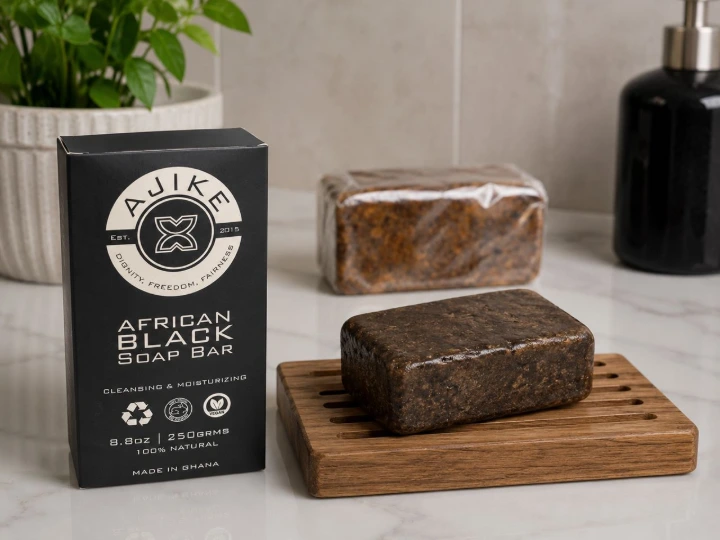 You bought your African black soap, you have been using it, and then you notice it. A patch of something fuzzy. Or the bar has gone soft in one spot. Or there are white marks across the surface that were not there before.
This happens. And if you have never used a genuinely natural soap before, it can come as a surprise. African black soap behaves differently from the commercial bars you may be used to, and understanding why makes all the difference between a bar that lasts months and one that goes wrong in weeks.
This guide covers everything you need to know about storing African black soap correctly, what mould and soap bloom actually are, how to tell them apart, how long each format lasts, and how to get the most out of every bar you buy.
Read Also: New here? Read: What Is African Black Soap?
Why African Black Soap Is Different from Commercial Soap
Before getting into storage, it helps to understand what you are actually dealing with. African black soap is not the same kind of product as the bars you find in most supermarkets, and the differences in how it is made are exactly what determine how it needs to be stored.
No Synthetic Preservatives: Why This Matters for Storage
Commercial soap is manufactured with synthetic preservatives that extend shelf life almost indefinitely under most storage conditions. You can leave a commercial soap bar in a wet dish for weeks and it will look and smell the same. That resilience comes from chemistry that keeps bacteria and mould from growing.
Authentic African black soap contains none of those preservatives. It relies instead on its natural chemistry for self-preservation the high pH from plant ash, the antimicrobial properties of its oils, and crucially, its low water content. That natural self-preservation works well when the soap is stored correctly. When it is not, there is nothing artificial standing between your soap and the environment.
High Natural Glycerine Content and Moisture Absorption
Traditional saponification retains all the natural glycerine produced during the soap-making process. Commercial manufacturers extract this glycerine and sell it separately because it is more valuable as a standalone ingredient. The glycerine that stays in authentic African black soap is genuinely good for your skin, but it also makes the bar hygroscopic. Glycerine attracts moisture from the air.
Leave your black soap in a humid bathroom without proper drainage and the glycerine will pull moisture into the bar, softening it and creating conditions where mould can grow. This is the most common reason people have problems with their African black soap.
The Role of Plant Ash and Natural Oils in Shelf Life
The cocoa pod ash and plantain ash in African black soap create an alkaline pH that is naturally inhospitable to many microorganisms. The fatty acids in shea butter, palm kernel oil, and coconut oil also have some natural antimicrobial activity. Together, these give the soap a reasonable natural shelf life.
The operative word is reasonable. The natural self-preserving chemistry works when the soap is stored dry. Repeated exposure to water, heat, and humidity undermines that chemistry faster than any preservative could compensate for.
Why Authentic Handcrafted Soap Behaves Differently to Factory Soap
Factory soap is often made with hardening agents, synthetic binders, and stabilisers that give it a uniform, hard, dry texture that is very resistant to environmental conditions. Authentic handcrafted African black soap is softer, slightly irregular in texture, and more responsive to its environment.
This responsiveness is part of what makes it a better product for your skin. But it does mean you need to be a bit more thoughtful about where and how you keep it. Think of it the way you would think about the difference between a fresh artisan loaf and a factory-sliced bread. Both are bread, but one needs more care to stay at its best.
Does African Black Soap Go Mouldy?
Yes It Can: Here Is Why
Yes, authentic African black soap can develop mould. This is not a sign of a bad product. It is a sign of a natural one. Any product made without synthetic preservatives and with ingredients that absorb moisture from the environment can develop mould if it is kept in the wrong conditions.
The good news is that mould on African black soap is entirely preventable with the right storage. And it is much rarer than people expect when the soap is stored properly.
What Causes Mould on African Black Soap
Mould on African black soap almost always comes down to moisture. Specifically, water that cannot escape. When a bar sits in a dish that does not drain, water pools around the base of the soap after every use. The wet soap sits in that water until the next shower or wash. The warm, damp, dark conditions of a closed bathroom between uses are exactly the environment that mould needs to grow.
Humidity alone can cause problems too, even without direct water contact. If your bathroom gets very steamy and the soap has no ventilation, moisture from the air can accumulate on and in the bar over days and weeks. High temperatures accelerate the process. The combination of heat, moisture, and poor air circulation is the fastest route to mould.
The Difference Between Mould and Soap Bloom
This is where a lot of people get confused, and it matters to get right because the two things are very different and require different responses.
Mould on soap looks fuzzy or powdery. It tends to be green, grey, black, or sometimes orange. It has a distinct spot or patch formation. It may smell musty or off. Mould is a fungal growth and should not be ignored.
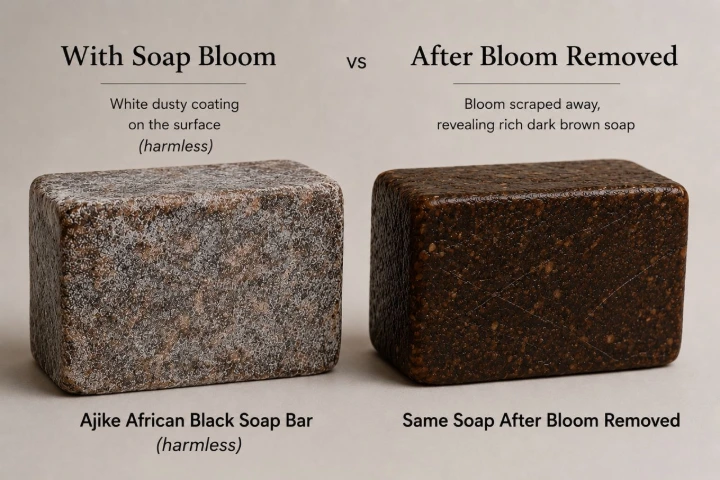
Soap bloom is white. It forms as a flat film or white dusty coating across the surface of the bar. It has no fuzzy texture. It does not smell. It appears particularly on newly made or freshly opened bars and on bars that have been in contact with humid air. Soap bloom is completely harmless.
Is Mouldy African Black Soap Dangerous to Use?
This depends on the extent of the mould and the type of mould involved, which you cannot determine by looking at it. Out of caution, we recommend not using a bar that has significant mould growth. If only a very small, clearly superficial spot of mould has appeared at the base of the bar and the rest is completely fine, you can cut away a generous amount around and below that spot and assess the remaining soap. If the interior looks clean and the soap smells normal, it may still be usable.
When in doubt, replace the bar. Your skin is worth more than the cost of a new one.
Can You Cut Off the Mouldy Part and Continue Using It?
If mould is small, superficial, and isolated to one area, cutting away a generous margin around it is a reasonable approach. Cut at least 2 cm beyond the visible mould in all directions to ensure you are removing all affected material. Smell the cut surface. If it smells clean and the interior of the soap looks normal in colour and texture, you can continue using it from that point.
If the mould is extensive, has penetrated deeply into the bar, or if you have any doubt at all, discard the bar. And review your storage conditions so it does not happen again with the next one.
What Is Soap Bloom: The White Spots Explained
What Causes White Spots and White Film on African Black Soap
Soap bloom, also called glycerine bloom, happens because of the natural glycerine in authentic African black soap. Glycerine is hygroscopic, meaning it pulls water molecules from the surrounding air towards itself. When the soap surface is exposed to humid air, glycerine attracts moisture to the surface. As that moisture evaporates, it leaves behind a white residue.
It is the same phenomenon you see on chocolate that has been exposed to temperature changes and develops a white coating. The chocolate is fine. The white is just the fat or sugar that has migrated to the surface. With soap, it is the glycerine attracting and then releasing moisture.
Soap Bloom vs Mould: How to Tell the Difference
If you see something white on your African black soap, run through this quick check. Soap bloom is flat, powdery, and covers the surface evenly or in a film. It has no texture when you touch it other than the surface of the soap underneath. It has no smell. Mould has a fuzzy or spotty appearance, tends to appear in concentrated patches rather than spread evenly, and may have a musty or earthy smell.
When in doubt, scrape gently with a clean fingernail. Soap bloom scrapes off as a dry powder and reveals healthy dark brown soap beneath. Mould tends to have a different texture when disturbed and the area beneath it may look discoloured or compromised.
Is Soap Bloom Harmful?
No. Soap bloom is entirely harmless. It does not affect the quality, effectiveness, or safety of the soap in any way. It is a natural and very common occurrence with traditionally made soap that retains its natural glycerine.
How to Remove Soap Bloom and Continue Using Your Soap
Simply scrape off the white layer with a clean knife, spoon, or your fingernail. What is beneath it is your normal, healthy soap. You can continue using it exactly as before. Some people rinse the bar under water briefly after removing the bloom and allow it to air dry before their next use.
Can African Black Soap Expire?
Does African Black Soap Have a Shelf Life?
Yes, it does. African black soap is a natural product made without synthetic preservatives, and like all natural products, it has a finite useful life. The shelf life varies depending on the format, how it is stored, and whether it has been opened.
The natural self-preserving chemistry of the soap, particularly the high pH from plant ash, gives it a decent shelf life when stored correctly. But it is not indefinite.
Bar Soap Shelf Life: What to Expect
An unopened, properly stored African black soap bar typically has a shelf life of 18 to 24 months from production. Ajike bars carry an expiry date on the packaging. Once opened and in regular use, a bar that is stored correctly will remain good for the duration of its use, provided it is kept dry between uses.
A bar that is repeatedly left in standing water, stored in a very humid environment without drainage, or exposed to direct sunlight will degrade significantly faster than these timelines suggest.
Paste Format Shelf Life: How It Differs from Bar
The paste format in a tube is somewhat more stable than the bar because the tube packaging protects the product from direct environmental exposure between uses. As long as the tube is kept closed when not in use and stored away from direct heat and sunlight, the paste format typically remains good for 12 to 18 months after opening.
Because the tube limits air exposure, oxidation of the oils happens more slowly than with a bar that is exposed to air constantly. This makes the tube format a practical choice for those who want a longer-lasting, lower-maintenance option.
Liquid and Body Wash Format Shelf Life
Liquid and body wash formats contain water in their formulation, which means they require a preservation system to prevent microbial growth. Ajike uses food-grade preservatives in our liquid formulations. Unopened, these products typically last 18 to 24 months. After opening, use within 12 months and always keep the lid closed between uses.
How to Check If Your African Black Soap Has Gone Bad
The clearest signs that your African black soap has passed its best are: a rancid or distinctly off smell (a sharp, unpleasant smell rather than the mild earthy scent of fresh soap), significant visible mould that has penetrated beyond the surface, a slimy or unusually soft texture that was not present when you first opened it, or a colour change in the interior of the bar that looks grey or discoloured rather than the natural dark brown.
If any of these are present, discard the soap.
Signs Your Soap Is Still Good to Use
- Smells clean, earthy, or mildly smoky, consistent with how it smelled when new
- Dark brown colour throughout, no internal discolouration
- Firm to the touch, not slimy or unusually soft
- Any white coating on the surface is flat and dusty, not fuzzy or patchy
- Within the expiry date printed on the packaging
How Long Does African Black Soap Last?
Unopened: How Long Before You Open It
An unopened Ajike African black soap bar stored in a cool, dry place away from direct sunlight and heat will remain in excellent condition for up to 24 months. Keep it in its original packaging until you are ready to use it. The packaging is not just cosmetic. It protects the bar from humidity, air, and light.
After Opening: How Long It Stays Good
A bar in regular daily use, stored correctly on a draining soap dish in a reasonably well-ventilated bathroom, will typically last as long as it takes you to use it up. A 250g Ajike bar used once daily for face and body cleansing by one person typically lasts 6 to 8 weeks. Used by two people or for body washing in the shower in addition to facial cleansing, it will go faster.
The soap does not have a fixed expiry from the moment you open it, provided it is kept dry. What matters is storage conditions, not simply the passage of time.
How Frequency of Use Affects How Long It Lasts
A bar that is used daily and dried completely between uses will outlast a bar that is used infrequently but left sitting in water between uses. The water contact and the consequent softening and microbial exposure is what shortens a bar's life, not the act of using it.
This is counter intuitive but true. Use your soap regularly, keep it dry between uses, and it will last significantly longer than a bar that sits untouched in a wet dish for days at a time.
How Storage Conditions Affect Shelf Life
The three storage conditions that shorten shelf life most dramatically are moisture exposure, high heat, and direct sunlight. Moisture causes softening, microbial growth, and structural breakdown. Heat accelerates oxidation of the oils in the soap, which produces rancid smells and degrades the soap's effectiveness. Direct sunlight causes similar oxidation and can also cause colour changes.
A cool, dry, shaded location with good air circulation is ideal. A bathroom that gets very steamy from hot showers is not ideal storage for a spare bar. Keep your spare bars in a bedroom drawer or cabinet, not in the bathroom.
How to Store African Black Soap Correctly: Complete Guide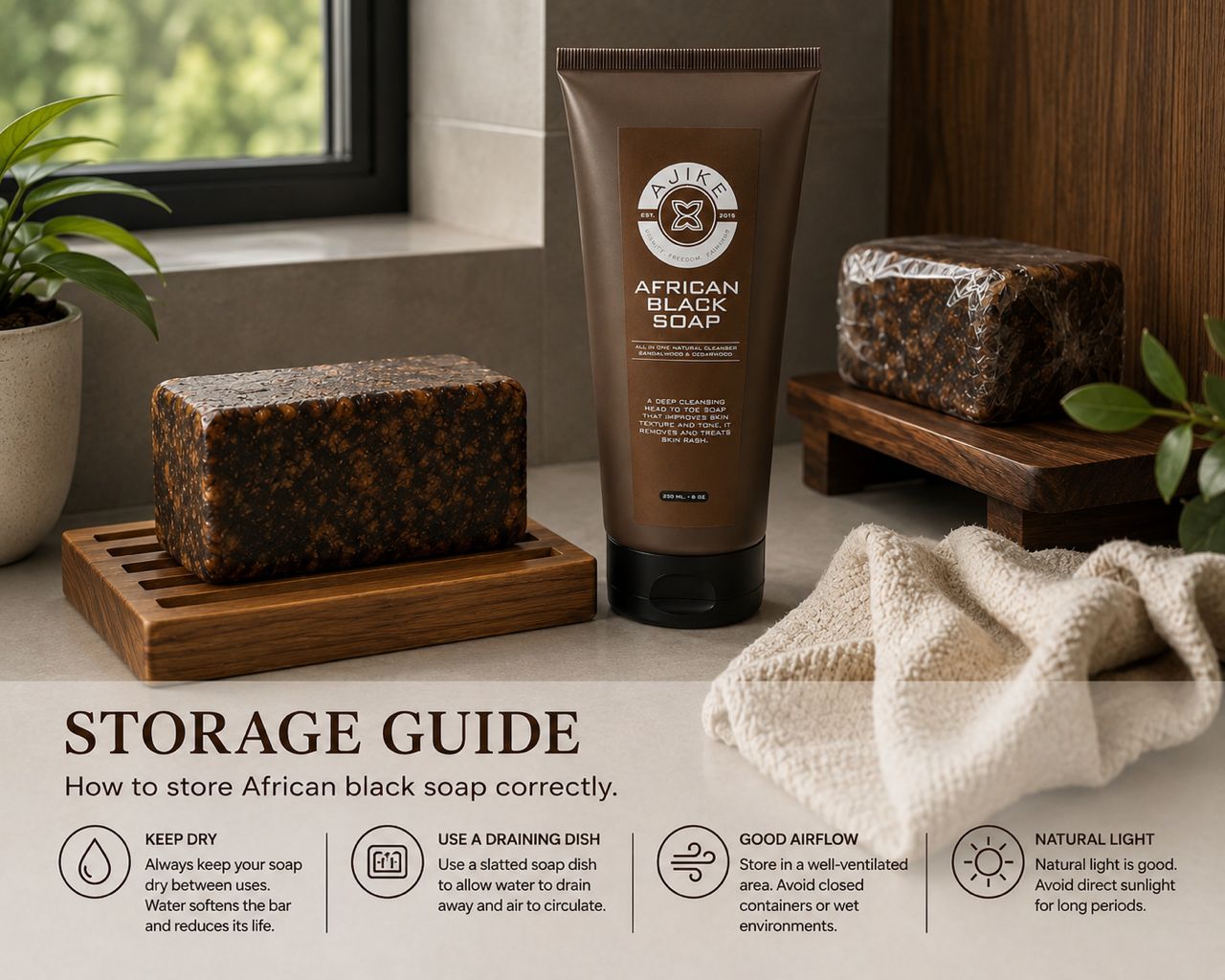
Keep It Dry Between Uses: The Most Important Rule
Everything else in this section matters, but nothing matters as much as this. After every single use, make sure the soap is not sitting in water or a pool of moisture. Rinse the bar briefly under water, give it one firm shake to remove surface water, and place it somewhere it can dry. This one habit prevents the vast majority of mould problems people experience with African black soap.
Use a Draining Soap Dish: Why This Is Essential
A flat soap dish that does not drain turns into a pool of soapy water between uses. The bar sits in that pool, softening and absorbing water, creating ideal conditions for microbial growth. A draining soap dish with slats, ridges, or holes allows water to escape and air to circulate around the bar. This makes a genuine, significant difference to how long your bar lasts.
Wooden soap dishes work particularly well because wood naturally wicks moisture away from the bar. Stone or ceramic dishes with drainage also work. Flat plastic dishes with no drainage are the worst option for natural soap.
Keep Away from Direct Water Contact
In the shower, do not leave your African black soap in the direct stream of water when you are not using it. Move it to a shelf or corner where it is out of the spray zone. Even brief, repeated contact with running water when the soap is not being lathered up shortens its life significantly.
Store in a Cool Dry Place Away from Humidity
Your spare, unopened bars should not live in the bathroom. Bathrooms are consistently among the most humid rooms in a home, and that ambient humidity is working against your soap every day even when you are not using it. A bedroom drawer, a linen closet shelf, or any cool, dry cabinet is a much better place for your stock of spare bars.
Keep Away from Direct Sunlight
Sunlight accelerates oxidation of the natural oils in the soap. Oxidised oils produce rancid smells and lose their beneficial properties. A windowsill may seem like a pleasant place to keep a nice-looking soap, but the UV exposure will degrade it faster than almost any other storage choice. Keep your soap out of direct sun.
Do Not Store in a Sealed Wet Container
Sealing a wet bar of soap in a closed container, bag, or airtight box traps moisture inside and creates exactly the humid, airless environment that mould loves. If you need to travel with your soap and want to protect other items from it, wrap it in a dry cloth or put it in a ventilated soap tin rather than sealing it in a plastic bag while still wet.
How to Store Large Quantities of African Black Soap
If you buy in bulk, which many people do for cost efficiency, keep the majority of your stock in a cool, dry location away from your bathroom entirely. Only bring one bar into the bathroom at a time. Unopened bars in their original packaging will stay in excellent condition for 18 to 24 months under proper storage conditions.
For raw black soap paste bought in bulk (common for those who buy directly from Ghana), divide it into smaller portions, wrap each portion tightly in cling film or beeswax wrap, and store in a cool dark cabinet. Only unwrap and access what you need for the next few weeks.
Best Storage Containers for African Black Soap Paste
For the paste format in a tube, simply keep the cap tightly closed after every use and store the tube upright in a cool, dry location. For paste bought in bulk or in jars, use a clean dry spoon to remove what you need each time rather than dipping wet hands into the jar. Keeping the container free of water contamination is the key to long paste shelf life.
Storage Tips for Different African Black Soap Formats
How to Store African Black Soap Bar
After each use, rinse briefly, shake off excess water, and place on a well-draining soap dish. Between longer gaps in use, move the bar to a dry shelf or let it air dry completely before putting it away. If you use the bar in the shower, keep it on a shelf that is out of the water stream rather than on the floor of the shower.
When you get down to a small piece of bar that no longer sits stably on the dish, you have two options. Press it onto the top of a fresh bar while both are slightly damp and they will fuse together as they dry. Or dissolve the small piece in a little warm water to make a liquid soap for easy use.
How to Store African Black Soap Paste
The tube format is the easiest to store correctly. Cap on, stored upright, out of direct heat and sunlight. That is genuinely all it needs. The tube protects the product from air and moisture far better than a bar or an open jar, which is one of the reasons we use tube packaging for the paste rather than a pot or tub.
Do not squeeze the tube and then leave the cap off for extended periods. Air exposure will dry out the paste near the opening and can allow humidity into the tube if the cap is left off in a steamy bathroom.
How to Store African Black Soap Liquid and Body Wash
Keep the bottle upright with the lid closed between uses. Store at room temperature, away from direct sunlight and significant heat. If your bathroom gets very warm in summer, consider keeping a backup bottle in a cooler location and just keeping one bottle in the bathroom at a time.
Do not dilute the body wash with water and put it back in the bottle. Adding water introduces contamination and breaks the preservation system, shortening the shelf life of the remaining product.
Travelling with African Black Soap: How to Pack It Safely
For short trips, the paste tube is the most practical format. It is compact, hygienic, leak-resistant, and easy to use in unfamiliar bathroom setups. For longer trips where you want to bring a bar, allow the bar to dry completely before packing it. Wrap it in a dry cloth or paper rather than a sealed plastic bag. A ventilated soap tin is the ideal travel container.
If you are passing through airport security, check the tube size against your destination's liquid restrictions. The paste is classified as a cosmetic product.
How to Make Your African Black Soap Last Longer
Cut Your Bar Into Smaller Pieces: Only Use One at a Time
This is one of the most practical tips for getting value from your African black soap. When you receive a large bar, cut it into sections of the size you expect to use in 2 to 3 weeks. Wrap each section tightly and store them in a cool dry place. Only unwrap one section at a time for use.
A smaller bar dries faster between uses, loses less mass to softening and water damage, and is less likely to develop mould before you finish it. Cutting the bar also gives you the chance to check the interior looks healthy before committing to it.
Allow the Bar to Dry Completely Between Uses
Even with a draining soap dish, take a moment to move the bar to a drier spot after your morning routine if possible, rather than leaving it sitting in the humid bathroom air all day. Even 30 minutes on a dry shelf before you leave for work makes a noticeable difference over time.
Lather in Hands: Do Not Leave Bar in Standing Water
We always recommend lathering African black soap in your hands rather than rubbing it directly on the skin, and this habit also protects the bar. When you rub the bar on your body in the shower, it is exposed to running water for longer than it needs to be. Lather in your hands quickly, set the bar aside on its dish, and apply the lather to your skin. The bar spends less time in contact with water overall.
Keep Unused Portions Wrapped and Stored Separately
Any part of the bar you are not actively using should be wrapped and stored outside the bathroom. This is especially true for portions you have cut from a larger bar and are saving for later. Wrapping in beeswax wrap, paper, or even a dry cloth and keeping them in a bedroom drawer will keep them in excellent condition far longer than leaving them unwrapped in a humid bathroom.
Ajike African Black Soap: What We Recommend for Best Results
How Ajike Packages Its Soap for Maximum Freshness
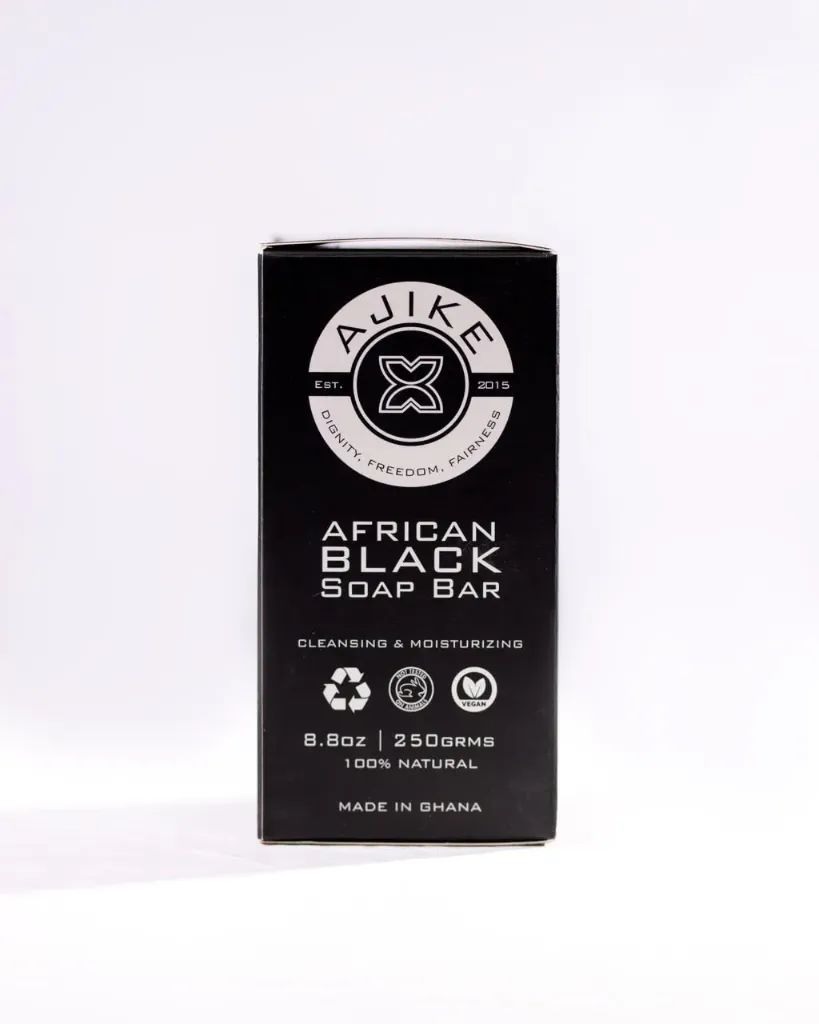
We package our African black soap bar in a matte black box that protects it from light exposure and limits air contact before opening. The box is not just branding. It genuinely extends the pre-use shelf life of the bar by keeping it in a protected environment from the moment it leaves our facility until you are ready to use it.
We make our soap in small batches in Ghana, which means shorter time between production and the customer compared to large-scale manufacturers who may hold stock for extended periods. Fresh soap is better soap.
The Advantage of Our Tube Format for Hygiene and Longevity
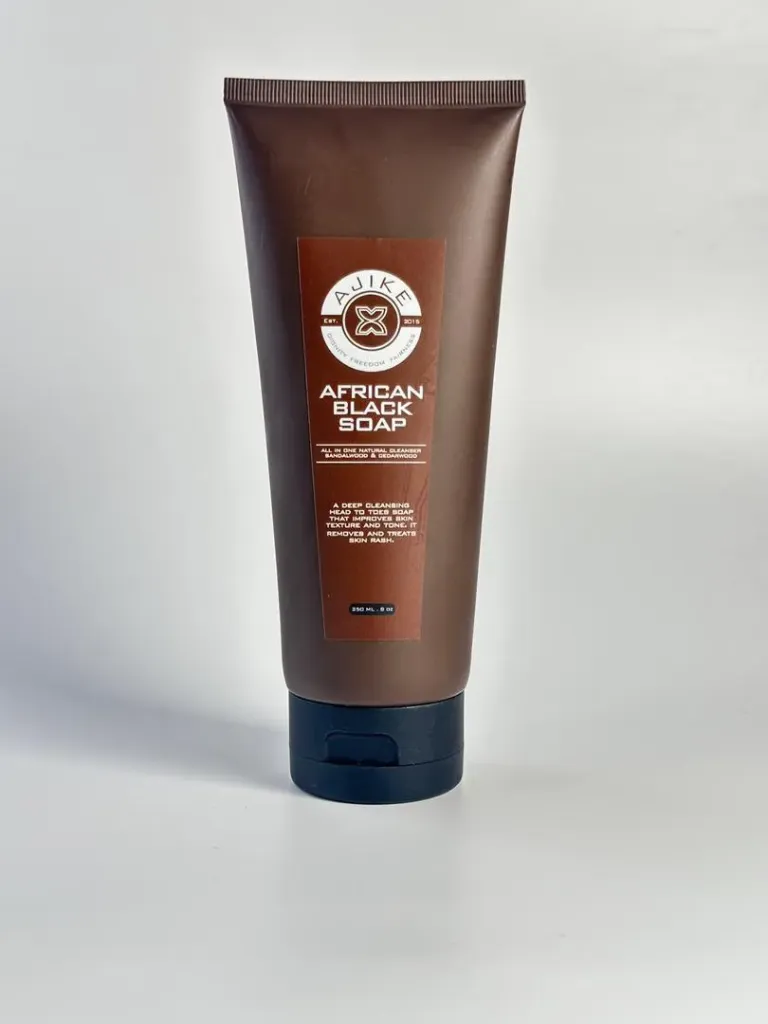
Our paste tube format was designed with daily use practicality in mind. The tube keeps the product sealed between uses, which means no direct exposure to the bathroom environment, no contamination from wet hands dipping into a jar, and consistent product quality from the first squeeze to the last. For anyone who has had problems with their bar soap going soft or developing issues in a humid bathroom, the tube is a practical solution.
Our Recommended Storage for Each Format in Our Range
Format | In Use | Spare / Unopened |
Bar | Draining soap dish, out of water stream, dry between uses | Cool dry cabinet, original packaging, away from bathroom |
Paste Tube | Cap closed, upright, room temperature | Same as in use. Tube protects product well |
Body Wash | Lid closed, upright, room temperature | Cool dark location, away from direct heat and sun |
Handcrafted in Ghana: Made Fresh in Small Batches
Every batch of Ajike African black soap is made in Ghana in small quantities. We do not manufacture massive volumes and hold them in warehouses for months before they reach customers. Small batch production means fresher product, tighter quality control, and soap that has not been sitting on a shelf for a year before it gets to you.
We take the same care with our production that we ask you to take with your storage. The soap arrives fresh. Keeping it well is your part of the process.
Frequently Asked Questions
Softening almost always comes from water exposure. The bar is either sitting in a pool of water between uses, left in the stream of water in the shower when not being used, or stored in a very humid environment. Move it to a draining soap dish, keep it out of the water stream, and let it dry completely between uses. The bar will firm up again once it has a chance to dry out fully.
If it is white, flat, powdery, and has no smell, it is almost certainly soap bloom. Completely harmless. Just scrape it off and keep using your soap. If it is fuzzy, has a patchy or spotted appearance, or smells musty or off, it is more likely to be mould. See the mould section above for how to handle that.
A 250g Ajike bar used once or twice daily for facial cleansing typically lasts one person 6 to 8 weeks. With body cleansing as well, expect 4 to 6 weeks. Stored correctly on a draining dish and kept dry between uses, it will reach the end of its natural lifespan in use rather than deteriorating from storage conditions.
You can, but it is not necessary and not particularly beneficial for most people. Refrigeration does extend shelf life by slowing oxidation, which can be useful if you have bought a large quantity and want to keep spare bars in top condition for an extended period. If you do refrigerate, bring the bar to room temperature and allow it to dry out for a day or two before using it, as condensation from the temperature change can make it soft initially.
Freezing is an option for very long-term storage of large quantities. Wrap each portion tightly in cling film to prevent freezer burn and moisture absorption. Allow to thaw fully at room temperature before use, and give the bar a few days to stabilise before using it. This is primarily useful for people who buy in very large bulk quantities and want to extend shelf life well beyond the standard 18 to 24 months.
It depends on the smell. A mild, earthy, or slightly smoky scent is normal for African black soap. If the soap has developed a sharp, rancid, or distinctly unpleasant smell that was not there before, the oils in the soap have likely oxidised. This typically happens from prolonged heat or sunlight exposure. At that point, the soap is past its best and we would recommend replacing it rather than continuing to use it on your skin.
Our latest content
Check out what's new in our company !